American History · No. 22PennsylvaniaValley ForgeAmerica 250
Valley Forge: The Winter That Built a NationI’ve driven past the exit hundreds of times. I still haven’t stopped.
The exit sign appears for about three seconds. Valley Forge. I’ve been driving past it for years — heading into the city, heading back out — and every time it comes and goes before I do anything about it.
I still haven’t stopped.
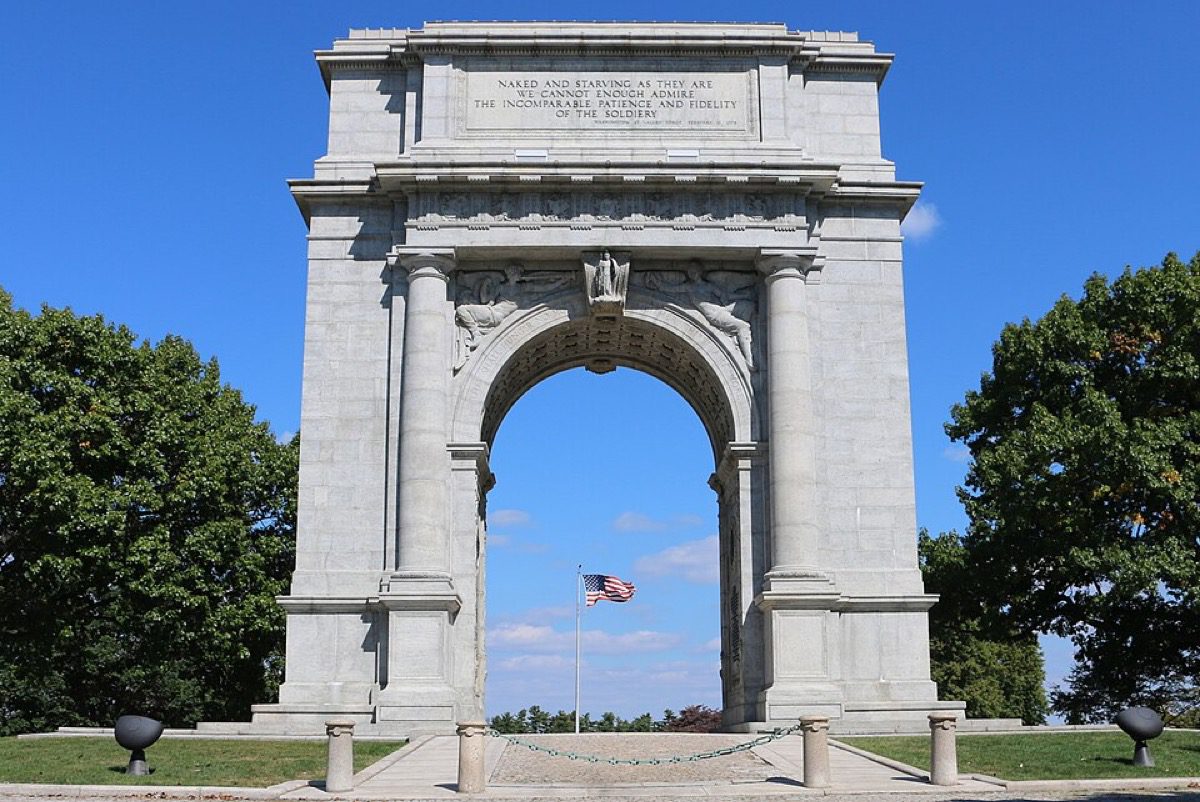
The National Memorial Arch, dedicated to Washington and the Continental Army. Valley Forge National Historical Park, Pennsylvania. Photo: Wikimedia Commons.
A Place to Wait
In the fall of 1777, the British took Philadelphia. Washington tried twice to stop them. Lost both times. He pulled his army back and needed somewhere to put twelve thousand men until spring.
He found a burned-out iron forge along a creek, twenty miles northwest of the city. High ground. Two rivers. Terrain that made a surprise attack unlikely. A defensible place to disappear into until the weather changed.
Twelve thousand men marched in on December 19th.
That Winter
Two thousand of them didn’t make it to spring. Not in battle — the enemy wasn’t the British. It was the winter itself, and a supply chain that had completely collapsed, and Pennsylvania farmers selling grain to the British in Philadelphia, who paid in cash, twenty miles away.
One in three soldiers had no shoes. Washington wrote to Congress that his men were leaving bloody footprints in the snow. He wasn’t speaking figuratively.
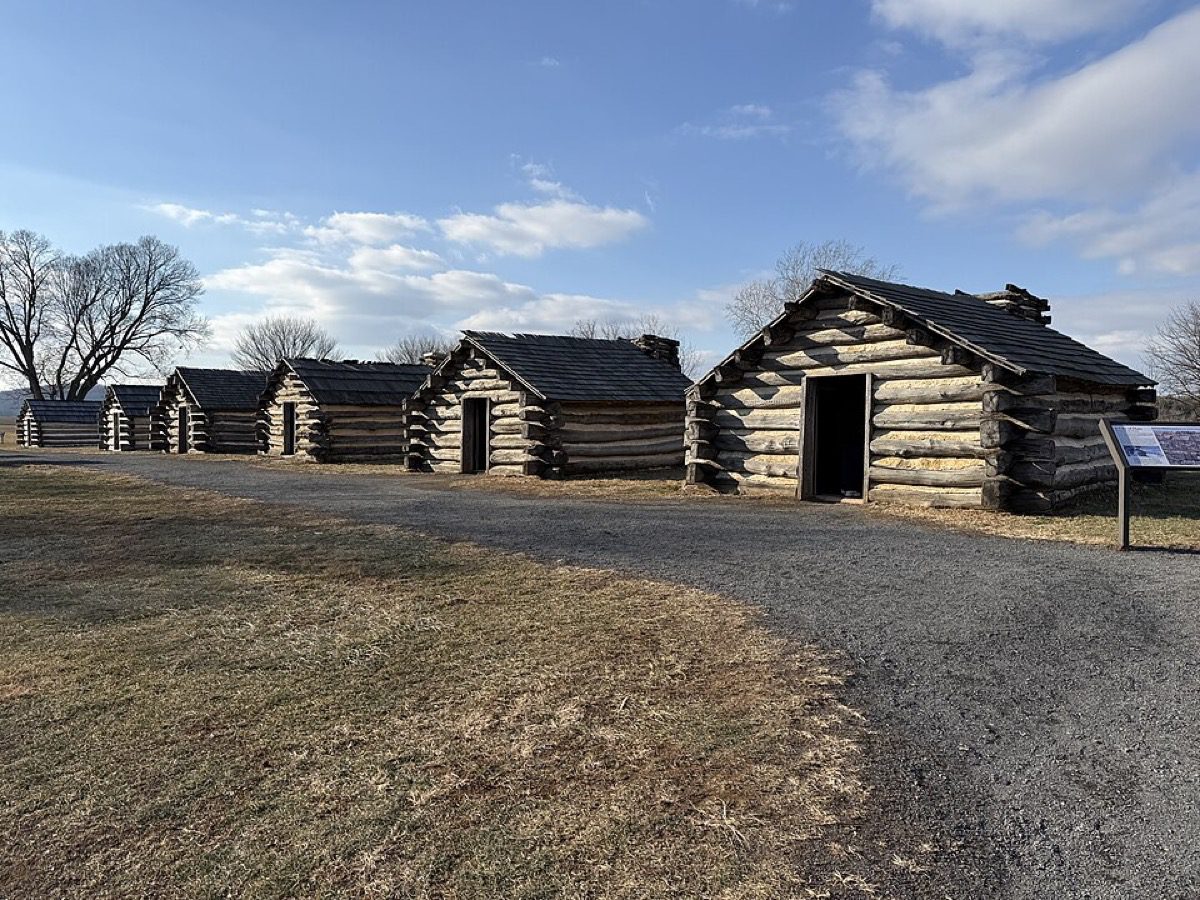
Reconstructed log huts at Muhlenberg’s Brigade. Twelve men to a room. Valley Forge National Historical Park. Photo: Wikimedia Commons.
Two Things
In February, a Prussian officer arrived on a sleigh — fur coat, Italian greyhound in his lap, almost no English. Baron Friedrich von Steuben. Trained under Frederick the Great. Vouched for by Benjamin Franklin. He drilled them. Bayonets, formations, how to hold a line under fire. He swore at them in French and had someone translate. The army that marched out of Valley Forge six months later was not the army that had stumbled in.
Washington, meanwhile, did something quieter. He stayed. There were people in Congress that winter who wanted him replaced. He ignored them and kept writing letters — send food, send shoes — and kept showing up on the same frozen ground as his men.
Holding on was the strategy. There wasn’t another one.
June 19th, 1778
In May, word came that France had entered the war. The soldiers marched out onto the meadow and fired their muskets into the air. Someone handed out rum.
On June 19th, they broke camp. Nine days later, at Monmouth, they held their ground against the British for the first time. The army that had stumbled into Valley Forge six months earlier was not the one that walked out.
The Park
It’s a national park now. No admission fee. Two million people come every year — joggers, school groups, families with strollers, people who just want somewhere quiet to walk on a Sunday afternoon. The reconstructed log huts are still there, twelve men to a room, exactly as Washington ordered them built. You can walk inside. The doorframes are low. The rooms are smaller than you’d expect.
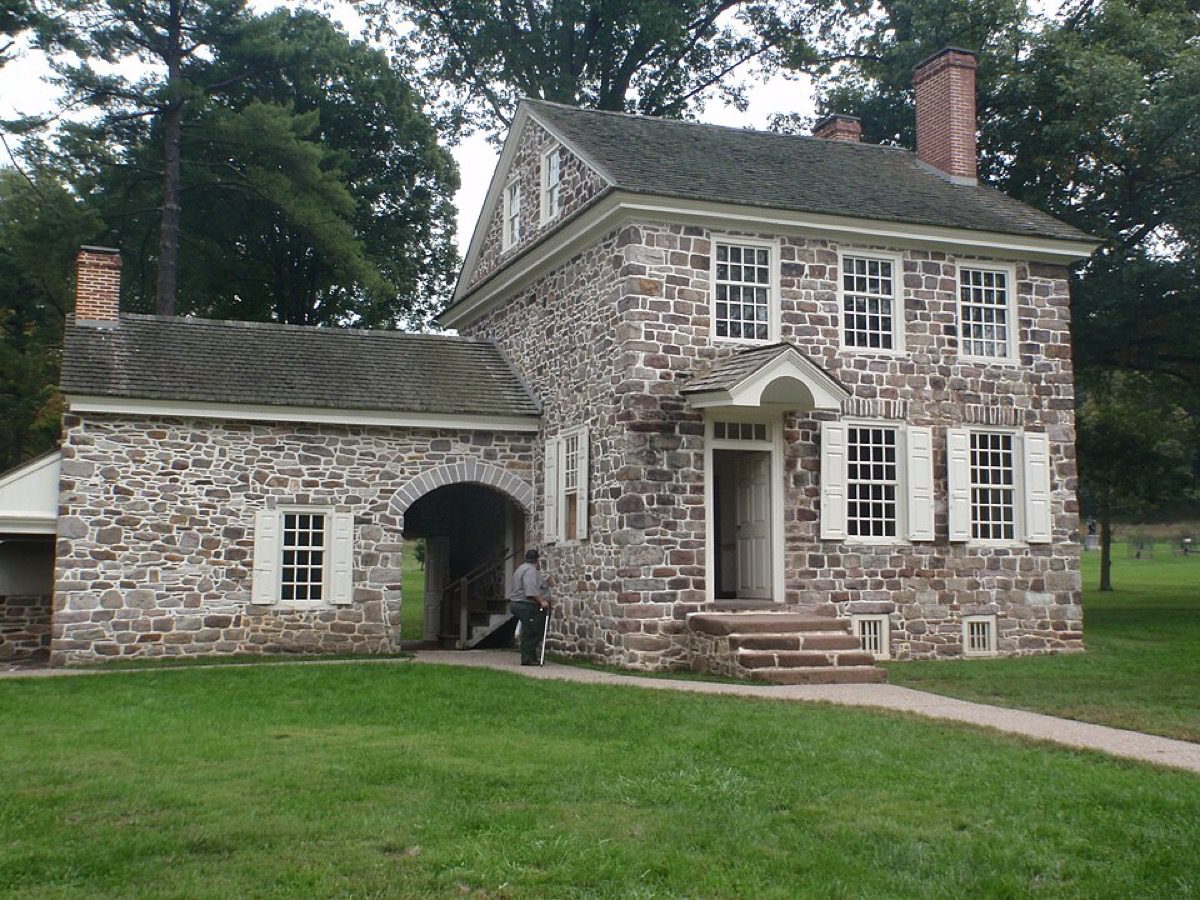
Washington’s Headquarters — the Isaac Potts House. The actual stone building, still standing. Valley Forge National Historical Park. Photo: Wikimedia Commons.
Washington’s headquarters — the actual stone building — still stands. Von Steuben has a statue. There’s a Memorial Arch. The trails run for miles through meadows that were once a city of twelve thousand.
I still haven’t gone in.
Those two thousand who died there — farmers, tradesmen, teenagers — most of them left no record at all. They had no idea what they were part of. They were just trying to make it to morning, staying because the man beside them was staying.
The sign comes and goes at seventy miles an hour.
These days, I look at it a little longer.
Did You Know
Valley Forge was the site of the first large-scale government-mandated inoculation campaign in American history. Washington, having nearly lost his army to smallpox the previous year, ordered every soldier who hadn’t had the disease to be inoculated. It was controversial, it was compulsory, and it worked. The army that left Valley Forge was not only better trained — it was healthier than the one that arrived.
Gaze’s Pick — Where to Stay
General Warren Inne9 Old Lancaster Road · Malvern, PA · $$$$Built in 1745 — the same year Valley Forge’s iron forge was first established, thirty years before the war that would make this ground famous. During Washington’s encampment, this building stood as a waystation on the Lancaster Turnpike, a stop for riders and wagons moving through Chester County. Eight guest suites, all with working fireplaces. A dining room that has been feeding travelers for nearly three centuries.Explore →
Taste — Where to Eat
Black Powder Tavern1164 Valley Forge Road · Wayne, PA · $$$The building dates to 1746. During the Valley Forge encampment, Von Steuben designated it a secret storage point for black powder cartridges — ammunition for the Continental Army’s messengers. The name has stayed. The building has stayed. It sits on Valley Forge Road, a few miles from the park entrance, and still draws a crowd most evenings. Twenty-four craft beers on tap, American menu, indoor fireplaces in winter.Explore →
Plan Your Visit
Valley Forge National Historical Park · 1400 North Outer Line Drive, King of Prussia, PA 19406
Open daily, dawn to dusk · Visitor Center: 9am – 5pm · No admission fee · Free parking
From Philadelphia: approximately 30 minutes via I-76 West · Exit: Valley Forge / Route 422
Hours and conditions subject to change — verify at nps.gov/vafo before your visit.
Carnegie Hall: What He Left BehindHe built it for a city he hadn’t been born in. He died before anyone thought to tear it down. The building is still there. The music never stopped.
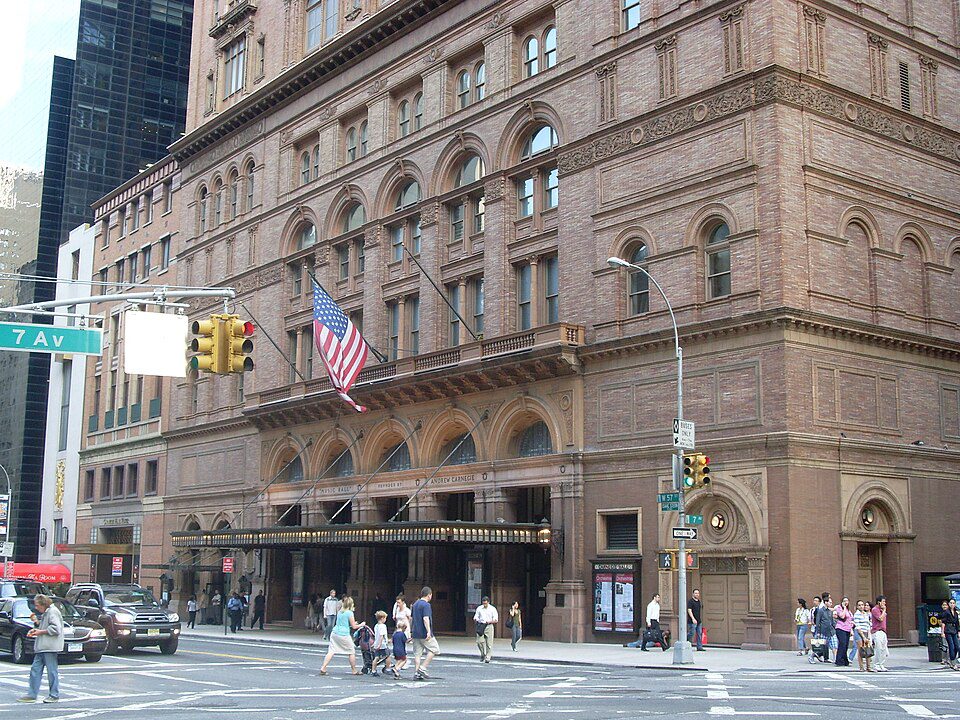
The name above the entrance reads Andrew Carnegie, cut into the stone above the arched doorway on 57th Street.
I must have walked past it a dozen times without reading it. The city moves fast enough that you stop seeing what’s written on things.
I started reading it when I sat down to write about him.
Carnegie Hall is not a museum. It is not a landmark in the way that landmarks are usually managed — roped off, reduced to what they once were. It is a working concert hall. On any given night, someone is on that stage. The lights go down, the room goes quiet, and whatever happened there before recedes into the dark behind the music.
That is what he built. Not a monument. A room that keeps being used.
In the summer of 1887, Andrew Carnegie was crossing the Atlantic with his new wife Louise, on their way to Scotland for their honeymoon. Somewhere on that crossing, he got talking with a conductor named Walter Damrosch.
Damrosch ran the New York Symphony Society. He had one complaint he made to anyone who would listen: New York had no concert hall worthy of the name. The greatest city in the country, and nowhere fit to put a world-class orchestra.
Carnegie listened.
Construction began in 1890. By the following spring the building was done. On May 5th, 1891, it opened — and the man on the podium was Pyotr Ilyich Tchaikovsky, conducting his own music in his American debut, in a hall that hadn’t existed two years before.
Carnegie was in the audience. Whether he fully appreciated what was happening on that stage is not recorded.
The building was called Music Hall. The name Carnegie Hall came three years later, in 1894.
He hadn’t asked for it.
Did You Know — Opening Night
Tchaikovsky arrived in New York for the opening of Carnegie Hall in the spring of 1891 anxious and largely disoriented. He kept a small notebook of questions: what tobacco do New York men smoke, what do their hats look like, can laundry be sent out. He wrote in his diary that the audience’s reception on opening night moved him more than he had expected. He conducted his own music, took his bows, and sailed back to Russia. He was dead two years later. Carnegie Hall was the only American stage he ever stood on.
1960
Carnegie died in 1919. The hall remained.
For four decades it held on — through two world wars, through the Depression, through everything. Then in the late 1950s, Lincoln Center happened. The Philharmonic was moving uptown to a new home, and Carnegie Hall suddenly had no anchor tenant. The building’s owner began talking to developers. The math was straightforward: the site was worth more as an office tower.
A demolition date was set.
In December 1959, a violinist named Isaac Stern decided he wasn’t going to let it happen.
He organized. He lobbied. He sat in rooms with people who controlled things and made the case, over and over, that this was not a real estate question. In June 1960, the city bought Carnegie Hall for five million dollars.
The hall Carnegie built outlasted him. It also outlasted the decision to tear it down.
Today the main auditorium’s official name is Isaac Stern Auditorium. Not the man who built it. The man who saved it.
Did You Know — Isaac Stern
Isaac Stern was a violinist, not a civic activist. What he was, more than anything, was someone who understood that certain things don’t come back once they’re gone. In 1960 he organized the campaign that saved Carnegie Hall from demolition. He performed there for the next forty years. The auditorium now bears his name. He died in 2001. The building he refused to let disappear is still on the corner of 57th and Seventh, exactly where it has always been.
Lenox, 1919
Carnegie died on August 11th, 1919, at Shadow Brook — his estate in Lenox, Massachusetts. Pneumonia. He was eighty-three. A simple funeral in the music room, no ceremony, no speeches, as he had asked. His body was taken by train to Westchester.
In the eighteen years between selling Carnegie Steel and his death, he had given away roughly ninety percent of everything he had ever made. Libraries — more than 2,500 of them. Carnegie Hall. Carnegie Mellon. A pension fund for university teachers. A foundation for international peace. When the final count came in, the total was somewhere around 350 million dollars.
There was still thirty million left when he died.
That went to the foundations too.
The man who dies rich dies disgraced.
He had written that himself, in an essay called “The Gospel of Wealth.” He meant it. Whether he settled the account — whether Homestead could ever be balanced against two thousand libraries — is a question that has no clean answer.
He knew that too.
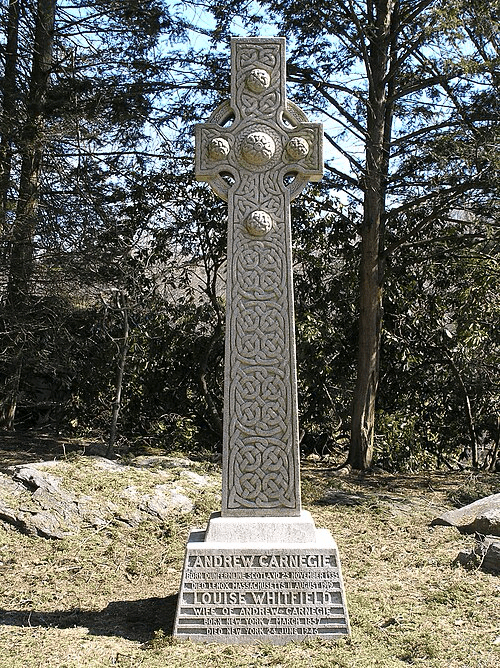
Andrew Carnegie gravesite, Sleepy Hollow Cemetery, Westchester County, New York. The granite was quarried from his estate in Scotland. Source: Wikimedia Commons (CC BY-SA).
Did You Know — Sleepy Hollow
Carnegie is buried at Sleepy Hollow Cemetery in Westchester — named for Washington Irving, who is also buried there, and who arranged in advance for the cemetery to take the name of his most famous story. Carnegie’s headstone is a Celtic cross, cut from granite quarried at his Scottish estate and carved in Glasgow before the Atlantic crossing. A few hundred feet away, Samuel Gompers is buried: the labor organizer who spent his life fighting men like Carnegie. In death, they became neighbors. Visitors still leave coins on Carnegie’s grave. Whether as tribute, or as something harder to name, is difficult to say.
Plan Your Visit
Carnegie Hall — 881 Seventh Avenue at 57th Street, Manhattan.
Tours run most days when the hall is dark. The Rose Museum, inside the building, traces the hall’s history from the 1891 opening to the present. Free with a tour ticket.
Park Hyatt New York153 West 57th Street · Midtown · $$$$Directly across from Carnegie Hall. Forbes Five-Star. There is a suite called the Carnegie. From the upper floors, on most days, you can see the building. It is the kind of hotel that understands its address.Check availability →
Taste
Patsy’s Italian Restaurant236 West 56th Street · Midtown · $$$Open since 1944, three generations of the same family, two minutes from the hall on foot. For decades this was where musicians came after the curtain came down — where the evening continued at a different volume. Sinatra had a table. The menu is what it has always been. So is the room.
American History · No. 20Philadelphia, PennsylvaniaAmerica 250
Benjamin Franklin: The Face on the HundredHe’s been on the hundred-dollar bill since 1914. I never once asked why.
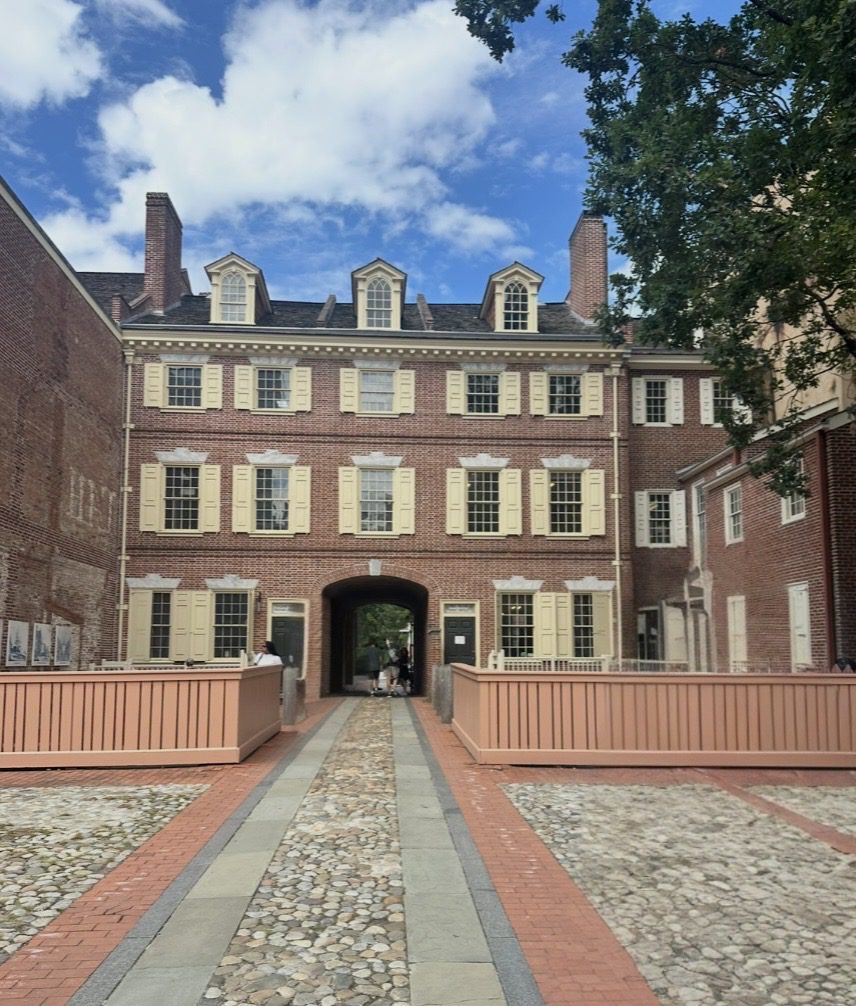
The passageway on Market Street. On the other side: a courtyard, two steel frames, and a question I hadn’t thought to ask. Photo by Gaze.
I didn’t know what I was looking at when I walked into Franklin Court.
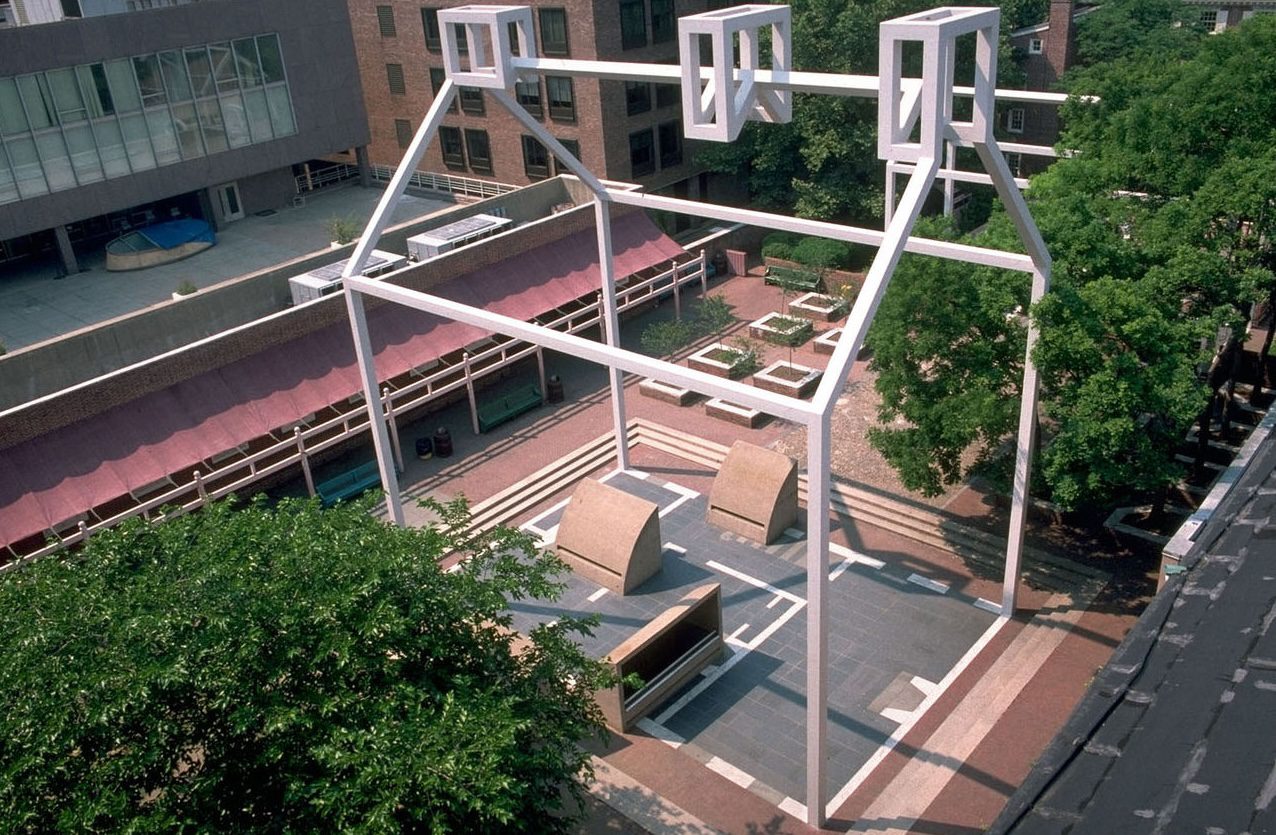
Narrow arch off Market Street, easy to miss. I went through it on a slow afternoon with no particular plan, and on the other side I found a courtyard with two enormous white steel frames standing in it — the shape of buildings, roughly, except with no walls and no roof and nothing inside them. Just the outline. I stood there trying to understand what I was looking at and eventually read the marker.
Benjamin Franklin’s house had been here. Torn down in 1812. The steel frames had gone up in 1976 to mark where it stood, because by then nobody knew enough about the original to rebuild it. This was the best anyone could do: the shape of something gone.
I took a photo and left. On the way home I thought about the face on the hundred-dollar bill, and why I had never wondered about it before.
The Bill
Franklin Court ghost structure, Philadelphia. The outline of a house that came down in 1812, drawn in steel in 1976. National Park Service Digital Image Archives, Public domain, via Wikimedia Commons.
Pull a hundred out of your wallet and look at it.
That’s not a president. Washington is on the one. Lincoln is on the five. Hamilton — who has had some help lately, from a cast album and a sold-out run — is on the ten. Every other face on American currency held the office. Franklin never did. He’s been on the hundred since 1914, through three major redesigns, through security threads and holograms and color-shifting ink, and the question of replacing him has simply never come up.
Turn it over. On the back: Independence Hall. The building where Franklin arrived by sedan chair on the mornings his gout was bad enough that walking wasn’t an option.
Two questions. Why him? And why, given everything, not the presidency?
Did You Know
Franklin is the only person on circulating U.S. currency who never held elected federal office. He is also the only Founding Father to have signed all three of the documents that established the United States: the Declaration of Independence, the Treaty of Paris, and the Constitution.
Twelve
He started in his brother’s print shop at twelve. Setting type, inking the press — the unglamorous physical labor of eighteenth-century publishing. By seventeen he’d fought badly enough with his brother James to make staying impossible, slipped out of Boston without permission, taken a boat to New York, found nothing, walked across New Jersey, and caught a small vessel going down the Delaware. He came ashore at the Market Street wharf — a few blocks from the arch I had just walked through — on the morning of Sunday, October 6, 1723. He had almost nothing in his pockets.
He was nobody yet.
What came next defies summary. Print shop. Newspaper. Poor Richard’s Almanack, ten thousand copies a year, written under a fake name. Lightning rod. Bifocals. Franklin stove. Public library. Fire company. Hospital. The academy that became the University of Pennsylvania. He finished most of this before sixty.
Then he entered politics. He was just getting started.
Paris
October 26, 1776. Congress sent him to France.
Seventy. Gout. Five weeks on the Atlantic. America was losing — the Continental Army was short on everything — and France was the only country with both the means and the reason to change that. They sent the most famous American alive and hoped.
Franklin didn’t negotiate. He performed. Dinner parties. Chess with aristocrats. Deliberately bad clothes — fur cap, plain brown coat — at Versailles, among powdered wigs and silk. The French had decided what they wanted him to be: the philosopher from the wilderness, the genius of the New World. Franklin understood this clearly enough to give it to them with complete precision.
In February 1778, after news of Saratoga reached Paris, France signed the Treaty of Alliance. The Revolution had its turning point.
Nine years he stayed. When he finally came home in 1785, the war was won, he was nearly eighty, and he wanted — badly, by his own account — to rest.
Pennsylvania asked him to serve as governor. He was seventy-nine. He said yes.
The President
He held the governorship for three years. Then the Constitutional Convention: oldest delegate at eighty-one, four months in a sealed room through a Philadelphia August, saying very little and signing at the end because he thought the country needed it more than he needed to be right.
By 1789, when the first presidential election was held, he was eighty-three and couldn’t leave the house.
Washington was fifty-seven.
That’s one answer. The other is that Franklin may have understood, better than anyone in that room, that the office itself wasn’t the point. He had secured the alliance that won the war. He had negotiated the treaty that ended it. He had signed the Declaration and the Constitution — the only Founder to sign all three of the documents that made the country. He had spent fifty years building things that outlasted him, and he had done it without needing his name anywhere in particular.
It ended up on the money instead. The largest bill. The one nobody spends carelessly.
I went back to Franklin Court once more, in the late afternoon when the tourists had thinned out. The steel frames were still there against the sky — the shape of the house, not the house. I thought about what it means to mark something you can’t reconstruct. Whether the outline is enough. Whether it ever is.
I didn’t come to a conclusion. I don’t think Franklin would have minded.
Gaze’s Pick
Penn’s View Hotel14 North Front St · Old City · $$$Fifty-one rooms on North Front Street, facing the Delaware, on the block that served as Philadelphia’s commercial waterfront in Franklin’s time — where ships unloaded, printers sold their broadsheets, and the business of a young republic was conducted at street level. Chippendale furnishings, fireplaces in the better rooms, and il Bar in the lobby: one of the largest cruvinet wine systems in the world. Franklin Court is five minutes on foot.Check availability →
Taste
Forsythia233 Chestnut St · Old City · $$$Two blocks from Franklin Court. Chef Christopher Kearse holds a Michelin recommendation, and the kitchen earns it — dry-aged duck, wagyu tartare, a baba au rhum that makes a case for staying longer. The wine list runs toward France. Franklin spent nine years in Paris and came home fluent in the long dinner; Forsythia operates on the same premise. Reservations open four weeks out on Resy.
Plan Your Visit
Franklin Court — Between Market and Chestnut Streets, Old City. Enter through the brick passageway on Market Street or the gate from Chestnut. Free to enter. The Benjamin Franklin Museum below the courtyard charges a small admission fee. Hours vary by season. nps.gov/inde
Penn’s View Hotel — 14 North Front Street, Philadelphia, PA 19106.
Forsythia — 233 Chestnut Street, Old City. Dinner nightly; happy hour Monday through Friday from 4:30 p.m.
Independence Hall & Liberty Bell: The Names Came Later
American History · No. 19Philadelphia, PennsylvaniaAmerica 250
Independence Hall & Liberty Bell: The Names Came LaterEveryone knows the building. No one asks when it got its name.
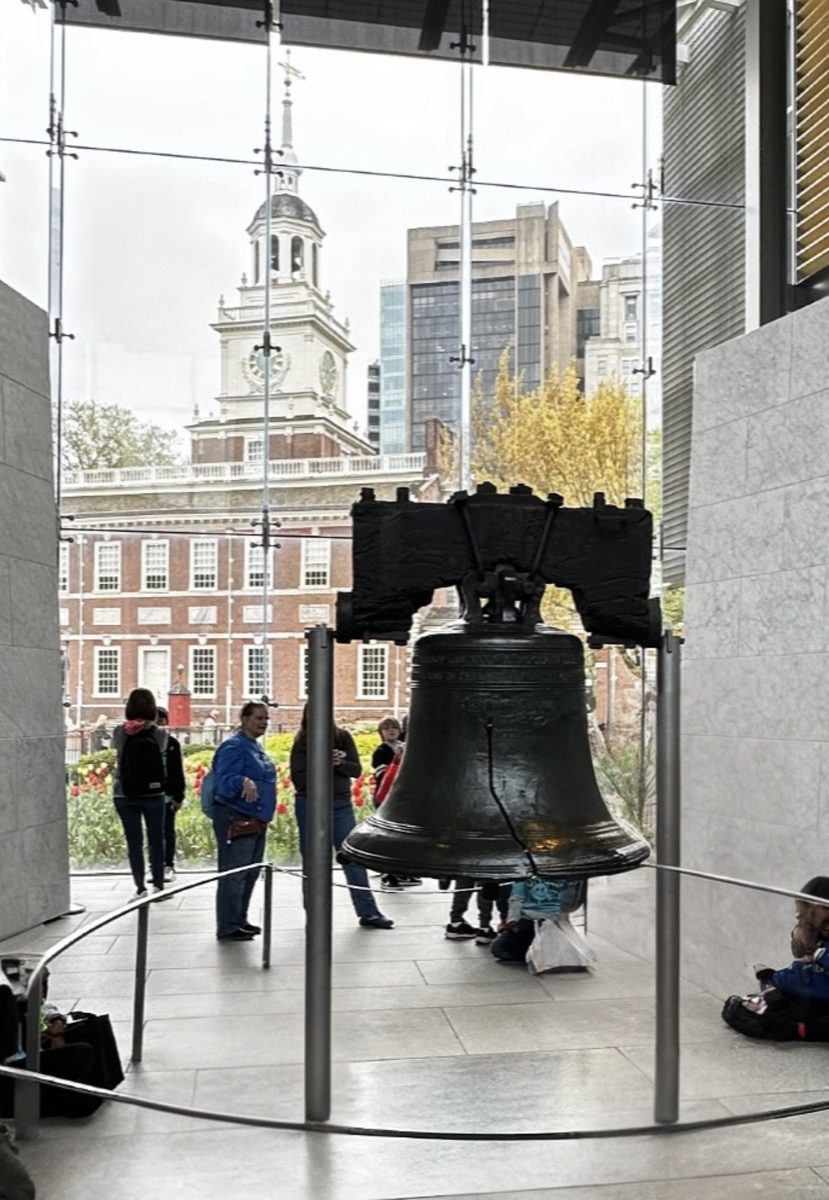
Liberty Bell Center, Philadelphia. The people are always on this side of the street. Photo by Gaze
There is always a line in front of the Liberty Bell.
The first time I came to Philadelphia’s Independence Hall and Liberty Bell, the second time, and every time after that — the line was there. I never questioned it.
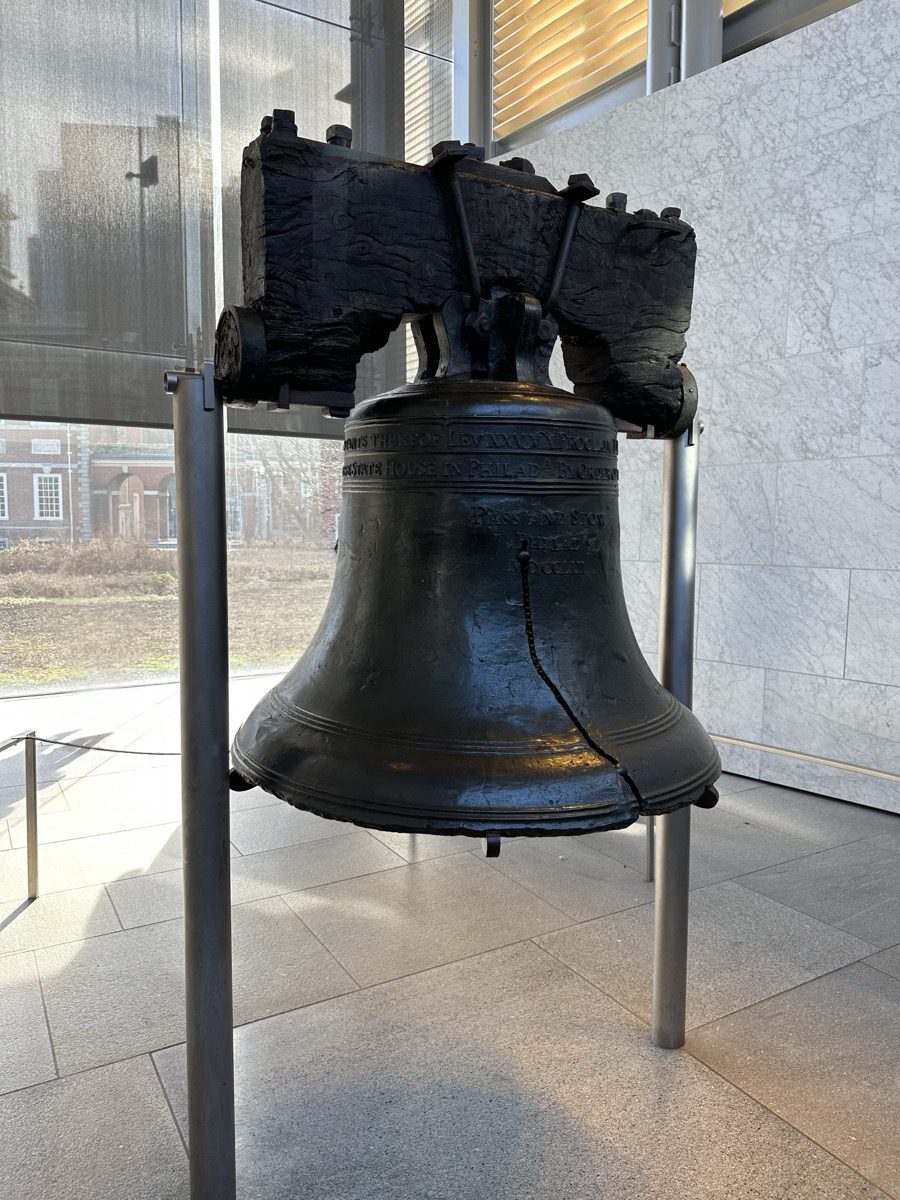
You can stand very close to it. There’s no glass between you and the bell — just a low railing, and then the thing itself. I stood close enough that I could read the inscription along the rim. I looked at the crack. It runs along the lower half of the bell, wider than I expected, the edges slightly raised. It didn’t look ancient. It looked like something that had broken and been left that way.
Standing there, I had a thought I couldn’t quite shake: why is this a symbol of liberty? It’s a bell. Someone cast it, hung it in a tower, rang it too hard, and it broke. At some point, people decided it meant something. But when, exactly? And who decided?
A Name Given Later
The name “Liberty Bell” didn’t exist when the United States declared independence. The bell was cast in 1751 and hung in the steeple of the Pennsylvania State House — which is what everyone called Independence Hall before it had that name. For decades, it was simply the State House Bell.
It was abolitionists in the 1830s who first called it the Liberty Bell. They were looking for a symbol, and they found one in the bell’s inscription: Proclaim Liberty Throughout All the Land. The name caught on slowly, and then it stuck. By the time the Civil War came, the bell had become what everyone now assumes it always was.
The crack is its own mystery. No one knows exactly when it first appeared. A repair record from 1846 documents a significant widening during a ceremonial ringing, but earlier accounts suggest the fracture existed before that. The bell may have been cracked for years before anyone thought to write it down. Today it cannot be rung. It sits, stationary, under a building designed specifically to display it — and people line up every day to stand in front of something that hasn’t made a sound in nearly two centuries.
Did You Know
“Liberty Bell” first appeared in print in 1835 — in an abolitionist pamphlet, nearly sixty years after independence. The bell was not rung on July 4th, 1776. It was rung on July 8th, when the Declaration was read aloud in public for the first time. No one knows exactly when the crack first appeared.
Liberty Bell, Philadelphia. The crack has been there so long no one remembers when it started. Photo by Gaze
Across the Street
One street over, it is quiet.
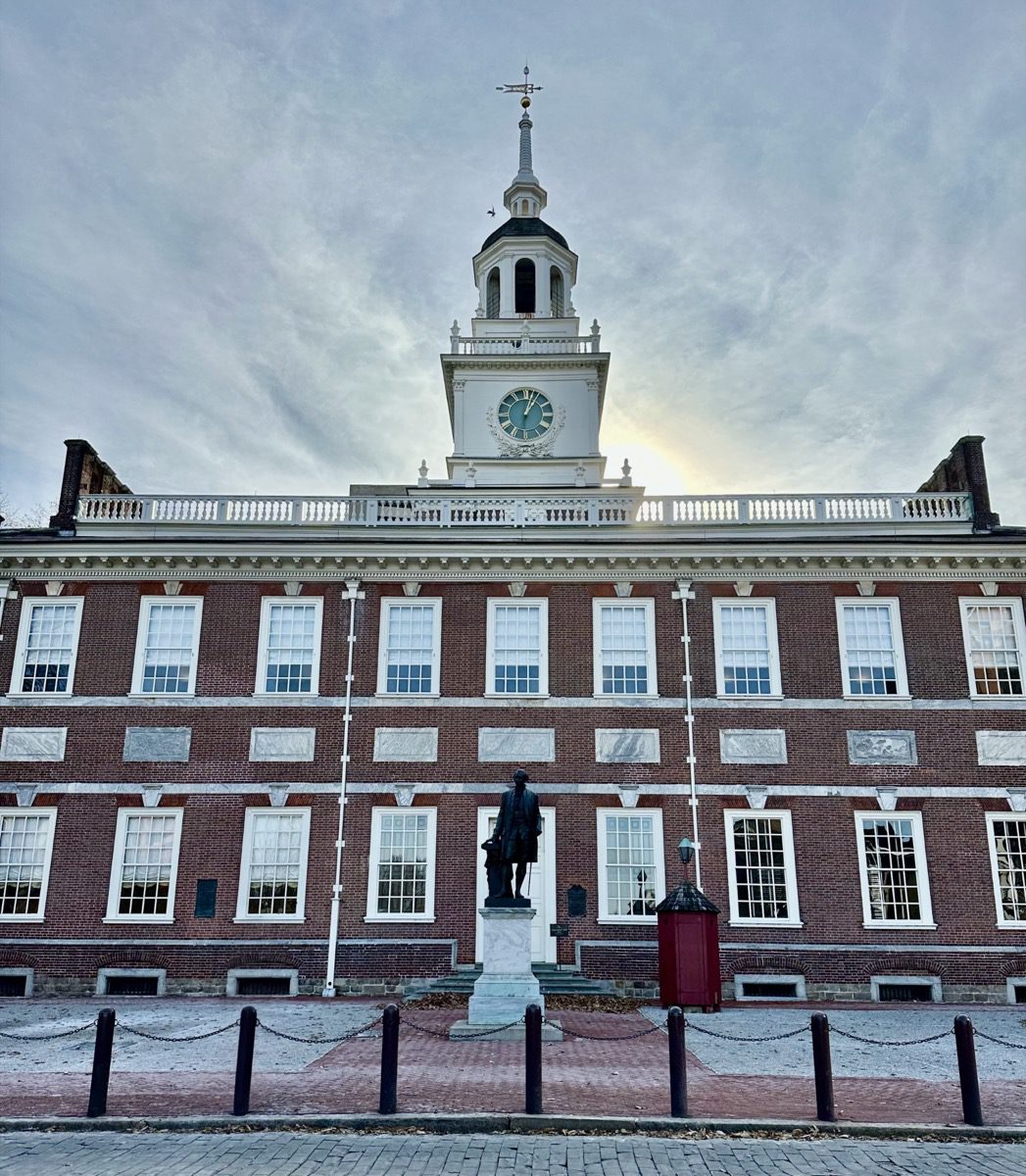
Independence Hall sits behind a low chain barrier, its red brick facade running the full width of the block. The clock tower rises from the center — white cupola, Roman numerals on the face, a weather vane at the top. The proportions are exact. The symmetry is total. On the day I visited, there were maybe a dozen people in the courtyard. A few were taking photographs. Most were just standing there, looking up.
To enter, you need a timed ticket and a guide. That’s why it’s quiet. The Liberty Bell Center is free and open; Independence Hall requires planning. So the crowd stays on the other side of the street, and Independence Hall — the place where the Declaration of Independence was actually debated, adopted, and eventually signed, where the Constitution was drafted eleven years later — gets the tourists who came prepared.
Independence Hall, Philadelphia. The people were across the street. Photo by Gaze
The Building That Didn’t Know
The building was not built for history. Construction began in 1732 as the Pennsylvania State House — a seat of colonial government, nothing more. It took twenty-one years to finish because the money kept running out. They built it in pieces, as funds arrived. There was no grand vision behind the facade. It was practical architecture for a practical purpose: a place for the assembly to meet.
It wasn’t called Independence Hall until 1824, when the Marquis de Lafayette — the French general who had fought alongside Washington — returned to America for a triumphal tour. Philadelphians welcoming him back began referring to the east room as “the Hall of Independence.” The name spread slowly, and then all at once, until the whole building wore it. Nearly fifty years had passed since the signing.
The choice of Philadelphia itself was not symbolic. It was logistical. When the Second Continental Congress needed to convene, this was one of the few cities with enough lodging to house dozens of delegates from across the colonies. The Pennsylvania Assembly lent them the room. It was the largest official building available — and that was enough.
The Rooms Where It Happened
The delegates didn’t stay in grand houses. They spread out across the boarding houses and taverns within walking distance of the State House. James Madison returned to a lodging house he had used before. Alexander Hamilton took rooms nearby. John Adams, who kept meticulous records of everything, noted that his accommodations cost thirty shillings a week — candles and firewood extra. He wrote to Abigail that Philadelphia’s hospitality was almost overwhelming: dinners with the city’s prominent families, wine flowing until seven in the evening, a schedule that left little room for the solemnity the history books would later assign to those months.
Benjamin Franklin, who lived close enough to walk, was brought to the State House by sedan chair each day. His gout had worsened. He sat in the assembly room and watched the younger men argue.
The windows were nailed shut during the Constitutional Convention of 1787. The delegates had agreed to secrecy — no one outside the room was to know what was being debated — and an open window was a risk. Philadelphia in August is brutal. They sat in that closed room through the heat, in wool coats, and wrote a constitution. It took four months.
One more thing worth knowing: the date most people associate with the signing of the Declaration of Independence is not quite right. July 4th, 1776, is when the document was adopted by the Continental Congress. Most historians now believe the actual signing took place on August 2nd, nearly a month later. Not everyone was present even then. Some delegates signed on different days. Some never signed at all.
The scene we carry in our heads — all the founders gathered, the room hushed, history being made in a single afternoon — did not happen that way.
Did You Know
The Declaration of Independence was likely signed on August 2nd, 1776 — not July 4th. July 4th was the date of adoption. Several delegates were absent on August 2nd and signed later; a few never signed at all. The famous painting by John Trumbull, often assumed to depict the signing, actually shows the committee presenting its draft — a different day entirely.
I stood in the courtyard for a while after. The symmetry of the building holds up at any distance. The clock in the tower still keeps time. Whatever was decided inside — over weeks and months, in a room with the windows nailed shut — has been holding up for 250 years. Independence Hall and the Liberty Bell are America’s anniversary, still standing.
The line was still there when I walked back. It will be there tomorrow.
Plan Your Visit
Liberty Bell Center — Free admission, no tickets required. Open daily. Expect lines on weekends and in summer. The bell is visible through floor-to-ceiling glass even after hours. nps.gov/inde
Independence Hall — Free timed-entry tickets required March through December. Book in advance at recreation.gov ($1 processing fee). Guided tours only; tours run every 15–30 minutes. The West Wing does not require tickets.
Gaze’s Pick
Kimpton Hotel Monaco Philadelphia7th & Chestnut · Old City · $$$$Eleven stories above Independence National Historical Park — as close to Independence Hall as you can sleep. Walk to the courtyard before the crowds arrive. The delegates of 1787 were staying in boarding houses within a few blocks of where this hotel now stands.Check availability →
Taste
Fork306 Market St · Old City · $$$Fork has been on Market Street since 1997. Seasonal American, local sourcing, a room that is warm and unhurried. The Founding Fathers ate within a few blocks of here — in taverns that kept the wine coming until late.
American History · No. 18Boston, MassachusettsAmerica 250
Boston Tea Party: The Night Someone Had to Go FirstThey handed me a card at the door. Benjamin Rice. I hadn’t asked to be anyone. But on December 16, 1773, he walked sixty miles to be here. I was already standing in the right place.
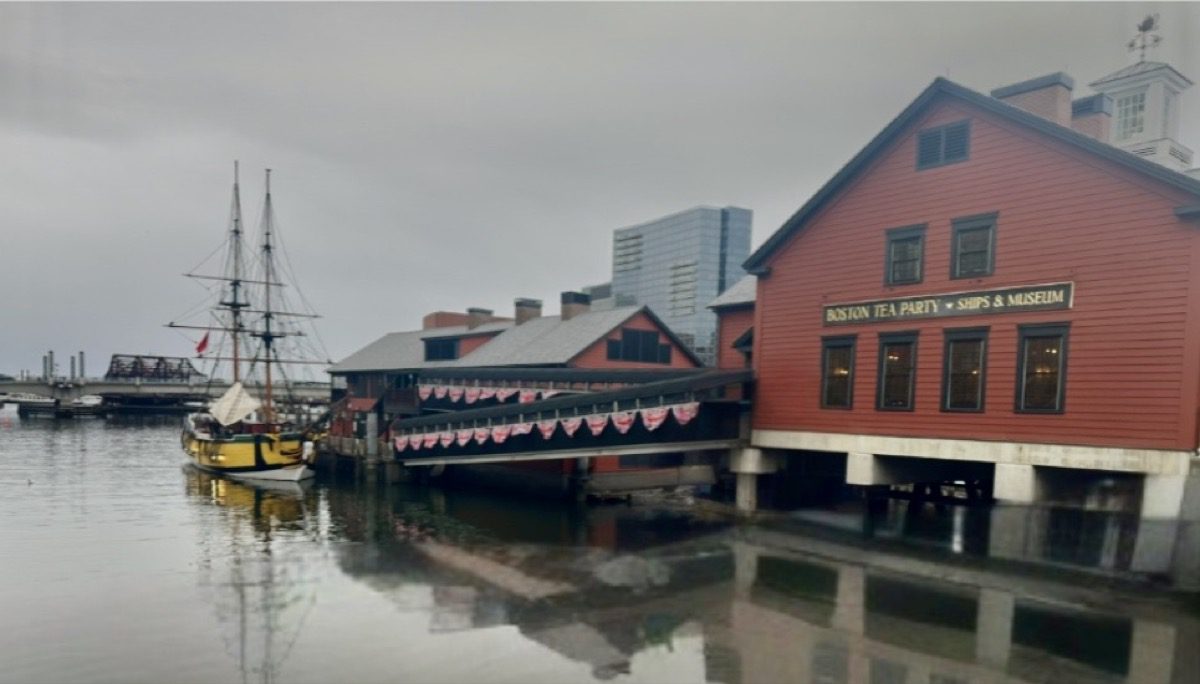
Griffin’s Wharf, Boston. Two centuries in the same frame, neither one flinching.
Boston was not new to me.
I had lost count of the visits. But Griffin’s Wharf was different. There is something particular about encountering the unfamiliar inside a city you think you know. That was the whole of that morning.
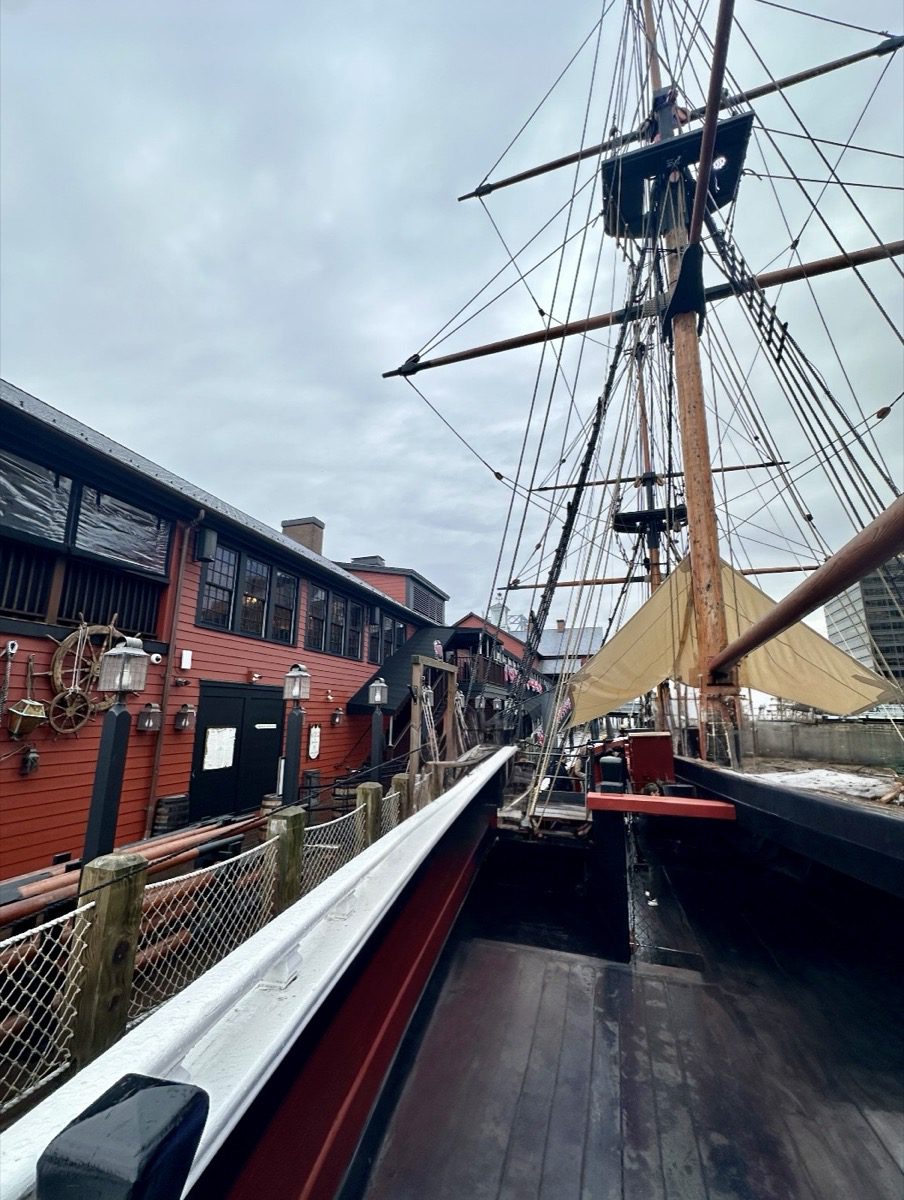
It was raining. I stood at the edge of the harbor and looked out at an eighteenth-century tall ship riding at anchor, its masts cutting the low grey sky. Behind it, forty floors of glass and steel rose without apology. Two centuries sharing the same frame. Neither one flinching.
Benjamin Rice
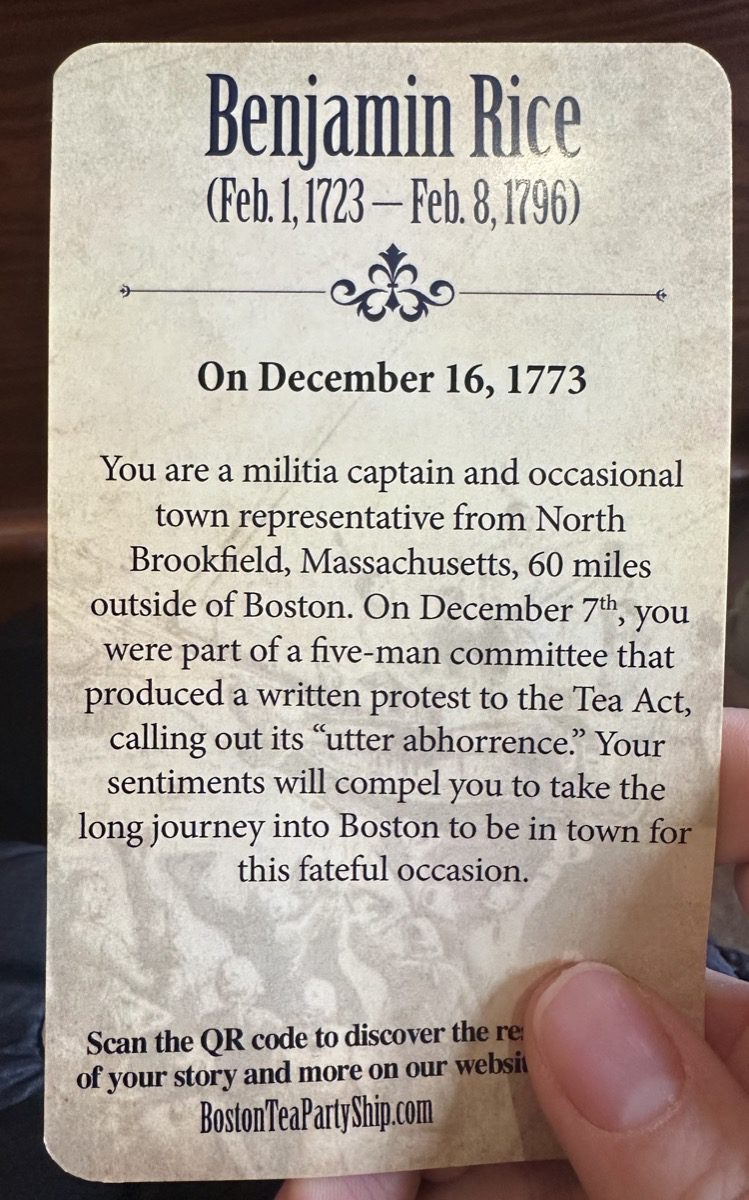
I walked inside and someone handed me a card.
Benjamin Rice. No explanation. No ceremony. Just pressed into my hand as I came through the door.
December 16, 1773. Every visitor receives a card. No one asks if you’d like one.
I read it slowly. Born 1723. Militia captain from North Brookfield, Massachusetts — a town sixty miles from where I was standing. In early December 1773, he had served on a five-man committee that drafted a formal protest against the Tea Act, the British Parliament’s decision to tax colonial America on tea without a single colonial representative having any say in the matter. Nine days after signing that document, he walked to Boston. Alone. Sixty miles. In December.
The back of the card offered one line of explanation: Your sentiments will compel you to take the long journey.
Not duty. Not strategy. Sentiments.
I held the card and walked toward the ship.
The Deck
The deck, after rain. The wood was darker than it looked from the dock.
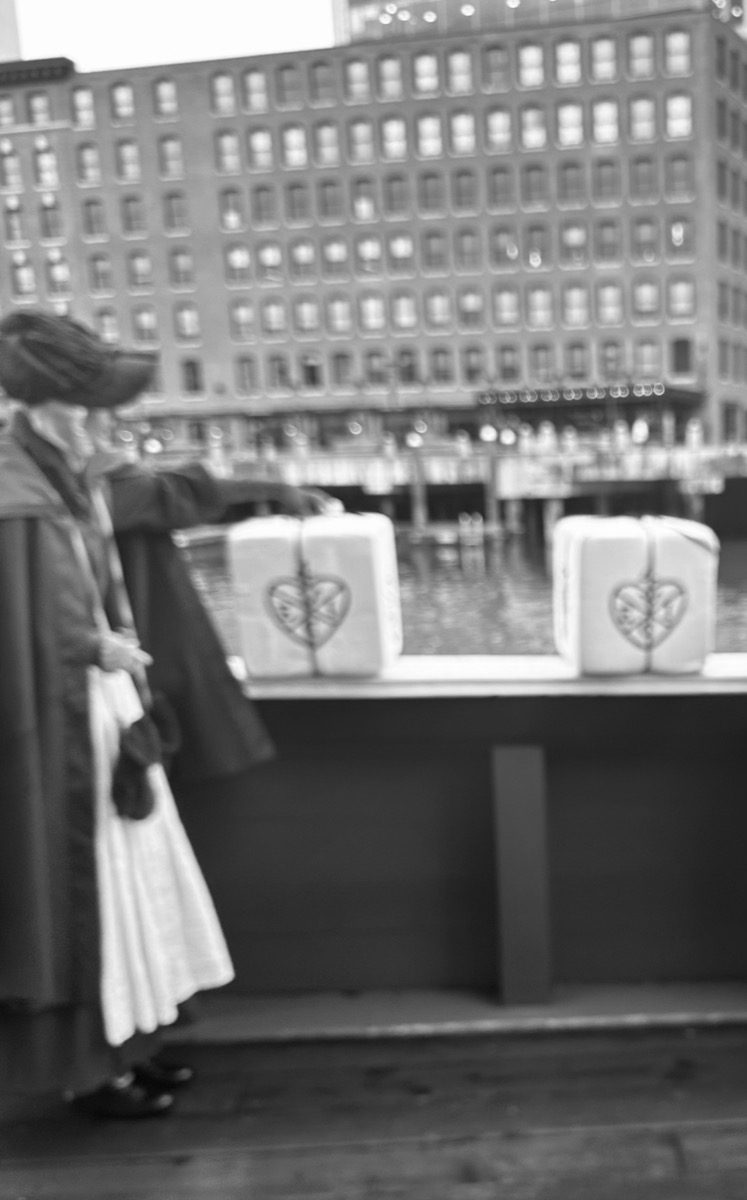
The deck was wet. A woman in a white apron and dark cape stood at the bow, her posture unwavering, her accent carefully period. She spoke about this night as though it were still happening — as though the outcome remained uncertain. Around her, visitors in down jackets held up their phones. The rain came down without drama.
It was, undeniably, a little awkward.
Then the tea chests appeared.
Foam props, East India Company insignia. The instruction was simple: throw them.
Foam props, East India Company insignia stamped on each side. Go ahead, someone said. Throw them.
A beat of silence. Then one person threw. Then everyone threw — laughing, filming, doing it again.
I didn’t throw.
I stood there watching, and the awkwardness and the gravity refused to cancel each other out. Because on the night of December 16, 1773, somewhere very close to where I was standing, it actually happened. One hundred and sixteen men boarded three ships — the Dartmouth, the Eleanor, the Beaver — and spent three hours emptying 342 chests of tea into Boston Harbor. Ninety thousand pounds of it. When they were done, they swept the decks clean. They took nothing. They left no trace beyond the fact of what they had done.
Revolution, it turns out, is methodical.
Did You Know
On the night of December 16, 1773, approximately 116 men — organized under the Sons of Liberty and disguised as Mohawk Indians — boarded three British ships docked at Griffin’s Wharf. Over three hours, they emptied 342 chests of tea into Boston Harbor. The cargo was valued at roughly £10,000 — close to $1.8 million today. When the work was done, they swept the decks clean. Nothing was stolen. Nothing was damaged except the tea. A protest designed to make one point, and no others.
Samuel Adams
Inside, a man in a tricorn hat stood elevated at a pulpit. He was playing Samuel Adams. Or he was Samuel Adams — in that room, the distinction blurred in ways that felt intentional.
He looked out over the assembled visitors and spoke with the gravity of someone who understood exactly what came next.
This meeting can do nothing more to save the country.
The room was quiet. In 1773, the people who heard those words walked out to the harbor.
Did You Know
The British Parliament’s response was swift and severe. In 1774, it passed the Intolerable Acts — placing Massachusetts under military rule. The backlash united the colonies in ways years of debate had not. Later that year, delegates gathered for the First Continental Congress. The following spring, the first shots were fired at Lexington. And on July 4, 1776 — two years and seven months after the tea hit the water at Griffin’s Wharf — fifty-six men signed their names to it.
Leaving
Leaving, I turned the Benjamin Rice card over one more time.
He is not in the history books. Not the way Adams is, or Revere, or Hancock. He was a militia captain from a small town who wrote a protest letter and then decided, for reasons the card called sentiments, that he needed to be there in person. Sixty miles in winter. No guarantee that any of it would matter.
I looked back at the harbor one last time. The water was still. Whatever was thrown into it that night — the tea, the anger, the argument that would not be settled any other way — had long since dissolved.
But here, two hundred and fifty years later, was the country it made.
Whether that was enough reason to walk sixty miles, I honestly couldn’t say.
Plan Your Visit
Boston Tea Party Ships & Museum — Congress Street Bridge, Boston, MA 02210.
Timed entry; booking in advance is recommended, especially in summer. The experience runs approximately 60–90 minutes and includes both ships, museum galleries, and the living history program.
Hours: Daily 10 AM – 5 PM (extended hours in peak season). Admission: Adults $34.95 / Children $25.95.
Gaze’s Pick
Boston Harbor Hotel
Rowes Wharf — ten minutes on foot from Griffin’s Wharf, directly on the harbor. The same harbor. Floor-to-ceiling windows, Forbes five-star service, and a waterfront address that earns its rate. Condé Nast Traveler Readers’ Choice #1 in Boston, 2025.
The oldest continuously operating hotel in the United States, open since 1855, sitting squarely on the Freedom Trail. Longfellow drafted Paul Revere’s Ride here. Every American president since Ulysses S. Grant has passed through. It is not a hotel that trades on history as decoration — it is history, still operational.
Long Wharf. The building itself was once the John Hancock Counting House — named for the man whose signature on the Declaration of Independence was large enough, he said, for King George to read without his spectacles. New England seafood, harbor views, and a room that has been watching this waterfront longer than most. Order the lobster.
Titanic: The Last Night of the Gilded AgeOn the night of April 14th, 1912, an era ended. Not with a law or a speech or a market crash — but with a ship, a railing, and a cigarette.
I realized the date only after I’d already started writing.
April 14th. Tonight, one hundred and twelve years ago, the Titanic struck an iceberg in the North Atlantic. I didn’t plan this. But some coincidences are too precise to dismiss.
He was leaning against the railing, smoking a cigarette.
The lifeboats were already descending. His wife Madeleine was in one of them — five months pregnant, lifted through the porthole by his own hands and placed into Lifeboat 4. He had asked the officer on deck whether he might join her. She was pregnant, he explained. The officer said no. He nodded, stepped back, and walked to the railing.
Witnesses said he was calm. No sign of panic. No argument.
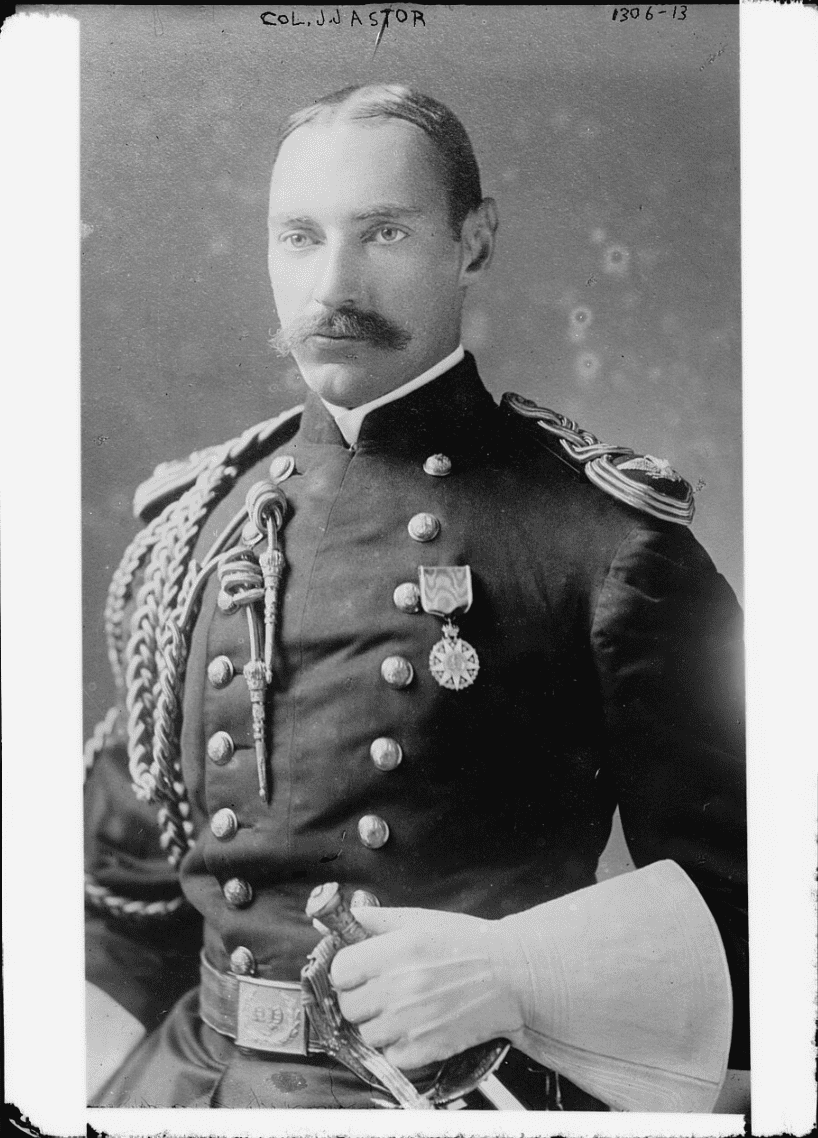
His name was John Jacob Astor IV.
Colonel John Jacob Astor IV, circa 1898. He financed his own artillery unit in the Spanish-American War and served in Cuba. Fourteen years later, he was the wealthiest passenger aboard the Titanic. Source: Library of Congress / Wikimedia Commons (Public Domain).
Eighty-seven million dollars. The wealthiest passenger aboard the most advanced vessel human engineering had yet produced. The ship was sinking. He didn’t try to leave.
What the witnesses left us is only the image: the railing, the cigarette, the stillness. Whatever was behind it — composure, resignation, something else entirely — no record survives to say.
The Others on That Ship
Astor was not alone in that company.
Isidor Straus was there — the man who built Macy’s into what it became. He and his wife Ida had a first-class cabin. When the lifeboats filled, Ida refused her seat. “Where you go, I go,” she told him. Isidor refused his as well. He was an old man, he said. He would not take a place that belonged to someone else. The two of them found deck chairs and sat down together. Witnesses saw them talking quietly. That was the last anyone saw of them. Neither body was ever recovered.
Benjamin Guggenheim went below when the ship began to list. He returned to the deck in a dinner jacket, his valet beside him, also dressed. He had removed his life vest. “We’ve dressed in our best,” he told the people around him, “and are prepared to go down like gentlemen.” His body was never found.
Same class, same ship, same night. Each of them chose differently. Each arrived at the same place.
The Year It All Came Apart
The Titanic was not the only thing that went under in 1912.
The year before, in 1911, the Supreme Court had ordered the breakup of Standard Oil. The monopoly Rockefeller had spent thirty years assembling was ruled illegal and dissolved. In 1913, the Federal Reserve was established — the government planting itself permanently inside the machinery of American finance. That same year, the Sixteenth Amendment was ratified: a federal income tax. For the first time, private wealth was subject to the reach of the state.
The structures that had made the Gilded Age possible — unchecked monopoly, untaxed accumulation, individuals who operated above and around government — were being dismantled, one law at a time. The Titanic sinking was the most dramatic moment in that unraveling. But it was a moment inside a longer collapse, not the cause of it.
The age didn’t end that night. It had been ending for years. History made the rest.
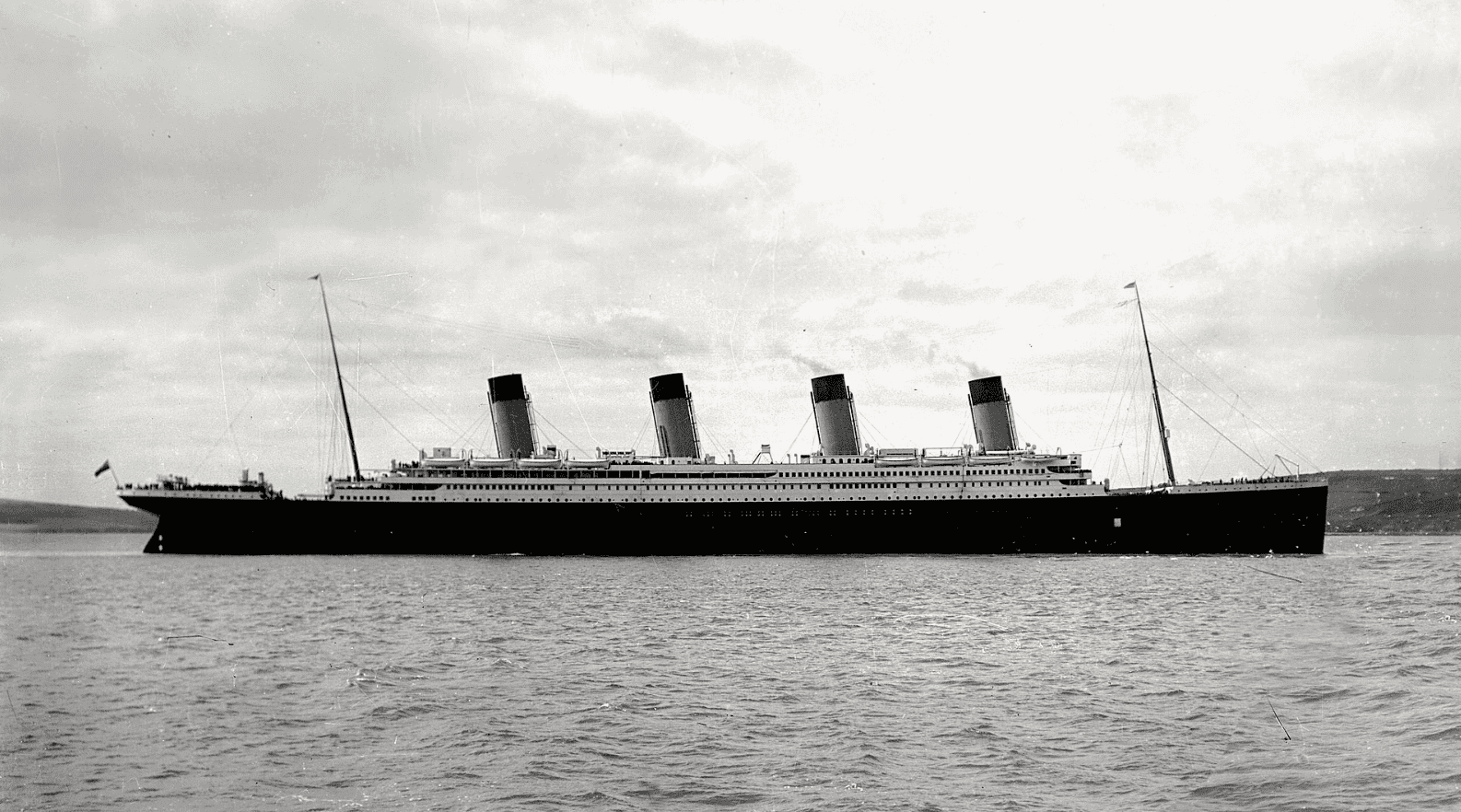
RMS Titanic at Cobh Harbour, Ireland, April 11, 1912 — three days before she sank. This was her last port of call. Source: Wikimedia Commons (Public Domain).
The Hotel He Built
Five days after the ship went down, the United States Senate opened its inquiry.
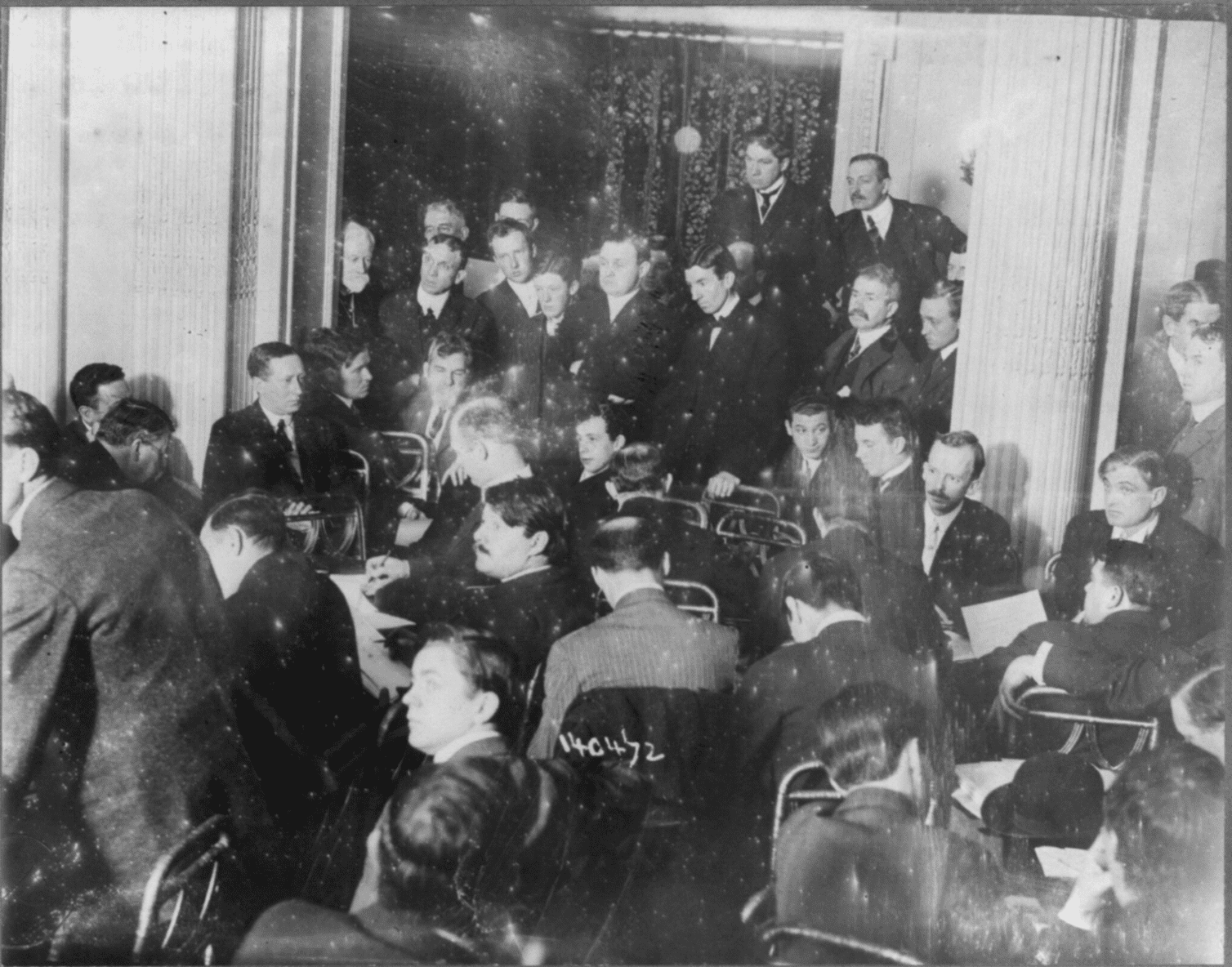
The hearings were held at the Waldorf-Astoria — the hotel Astor himself had built, the one born from his family’s feud, the one that had made his name synonymous with New York luxury. He had been dead for less than a week. For eighteen days, in the ballroom of his own hotel, eighty-six witnesses sat and described what they had seen. Survivors reconstructed the night, hour by hour, in the room where he had once hosted presidents and kings.
History arranges its ironies without comment. You either notice them or you don’t.
The U.S. Senate inquiry into the Titanic disaster, held at the Waldorf-Astoria Hotel, New York, April–May 1912. The hotel had been built by Astor himself. Source: Wikimedia Commons (Public Domain).
How They Each Ended
Rockefeller lived to ninety-seven. After Standard Oil was broken up, he grew richer — he owned shares in every successor company, and their combined value exceeded the original. In his final years, he carried dimes in his pocket and handed them to strangers. Good luck, he would say. Whatever he was trying to settle, he never said.
Morgan died in the spring of 1913, in a hotel room in Rome. He was seventy-five, still traveling, still acquiring. When the news reached New York, the stock market dropped. The library he built on Madison Avenue — the one that was his private sanctuary, the one no one entered without his permission — is open to the public now. Anyone can walk in.
Carnegie died in 1919, at eighty-three. He had built more than 2,500 libraries and given away the vast majority of his fortune. It still wasn’t enough to settle the account. The name Homestead outlasted him.
Cornelius Vanderbilt II collapsed from a stroke in 1899, four years after The Breakers was finished. He was fifty-five. The house outlasted him by more than a century. There’s a gift shop now.
Astor died on April 14th, 1912, in the North Atlantic. He had leaned against the railing and smoked a cigarette. The lifeboat descended. He did not. His body was recovered a week later by a cable ship. He was identified by the initials sewn into the lining of his jacket. His son kept his watch for the rest of his life.
And that was the end of that gilded age.
Did You Know
The Titanic hearings at the Waldorf-Astoria ran for eighteen days — April 19 to May 25, 1912. Senator William Alden Smith of Michigan presided. Eighty-six witnesses testified, including surviving officers, crew members, and passengers. The inquiry led directly to sweeping changes in maritime safety law, including requirements for sufficient lifeboats for all passengers aboard any vessel.
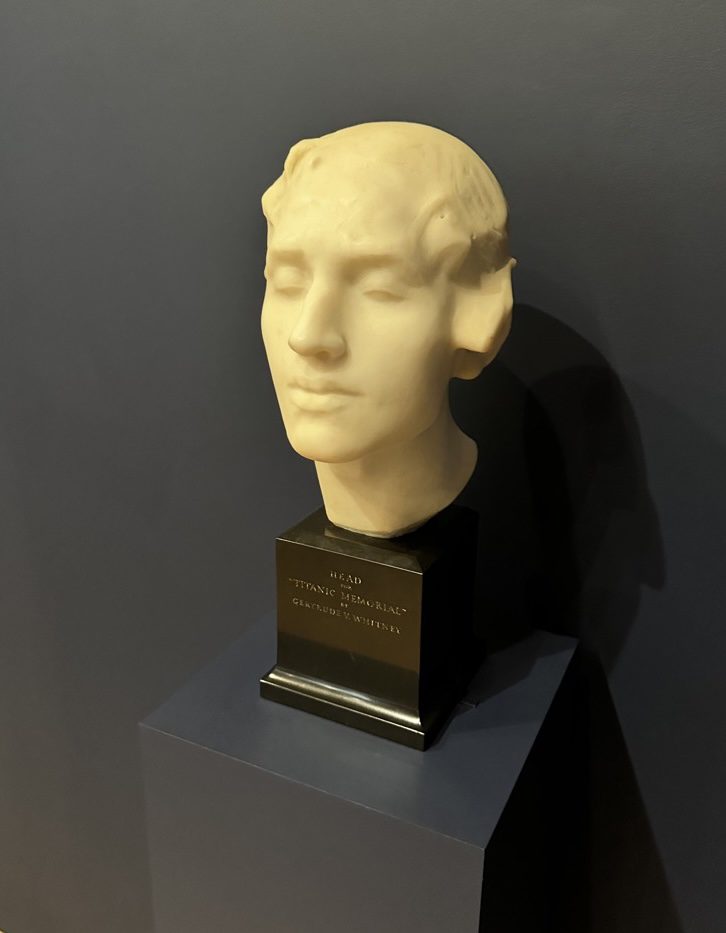
When I was writing the Vanderbilt episode, I stood in front of a sculpture at the Whitney Museum. A male figure with arms outstretched — made by Gertrude Vanderbilt Whitney as a memorial to the men who stayed behind on the Titanic so that women and children could go first. I photographed it. I didn’t know what it was.
A Vanderbilt had made a monument to Astor’s death. I stood in front of it without understanding what I was looking at.
This series has been full of moments like that.
Nobody knows they’re living at the end of an era.
Astor imagined the year 2000. He wrote a novel about Jupiter. He could not imagine the spring of 1912. Rockefeller did not believe Standard Oil could be taken from him. Morgan did not picture strangers walking through his library. Carnegie could not outrun Homestead.
They each believed, as people in every age believe, that the world as they knew it would continue.
On the night of April 14th, 1912, the Titanic went down. What we call the Gilded Age went with it.
Astor: The Name I Never Looked UpI saw The Lion King more times than I can count. I got off at the same subway stop for years. I photographed the same buildings. I never once connected the dots.
I saw The Lion King more times than I can count.
Times Square. One Astor Plaza. Third floor, Minskoff Theatre. The first time, the second time, and a few times after that. Every performance ended the same way — you walked out into the noise and light of Times Square and the night swallowed you whole. I never read the name of the building. One Astor Plaza. It was just the theater.
In college, I got off the subway at Astor Place. East Village. There were Japanese izakayas nearby — cheap, open late. We walked those blocks many nights. The station name was just a stop on the line. Whose name it carried never crossed my mind.
Later, when I started paying attention to architecture, the name Waldorf-Astoria kept appearing. Some resource I was reading — I no longer remember which one. An extraordinary hotel, it said. The architecture was unusual. I filed it away and moved on without asking why it was called that.
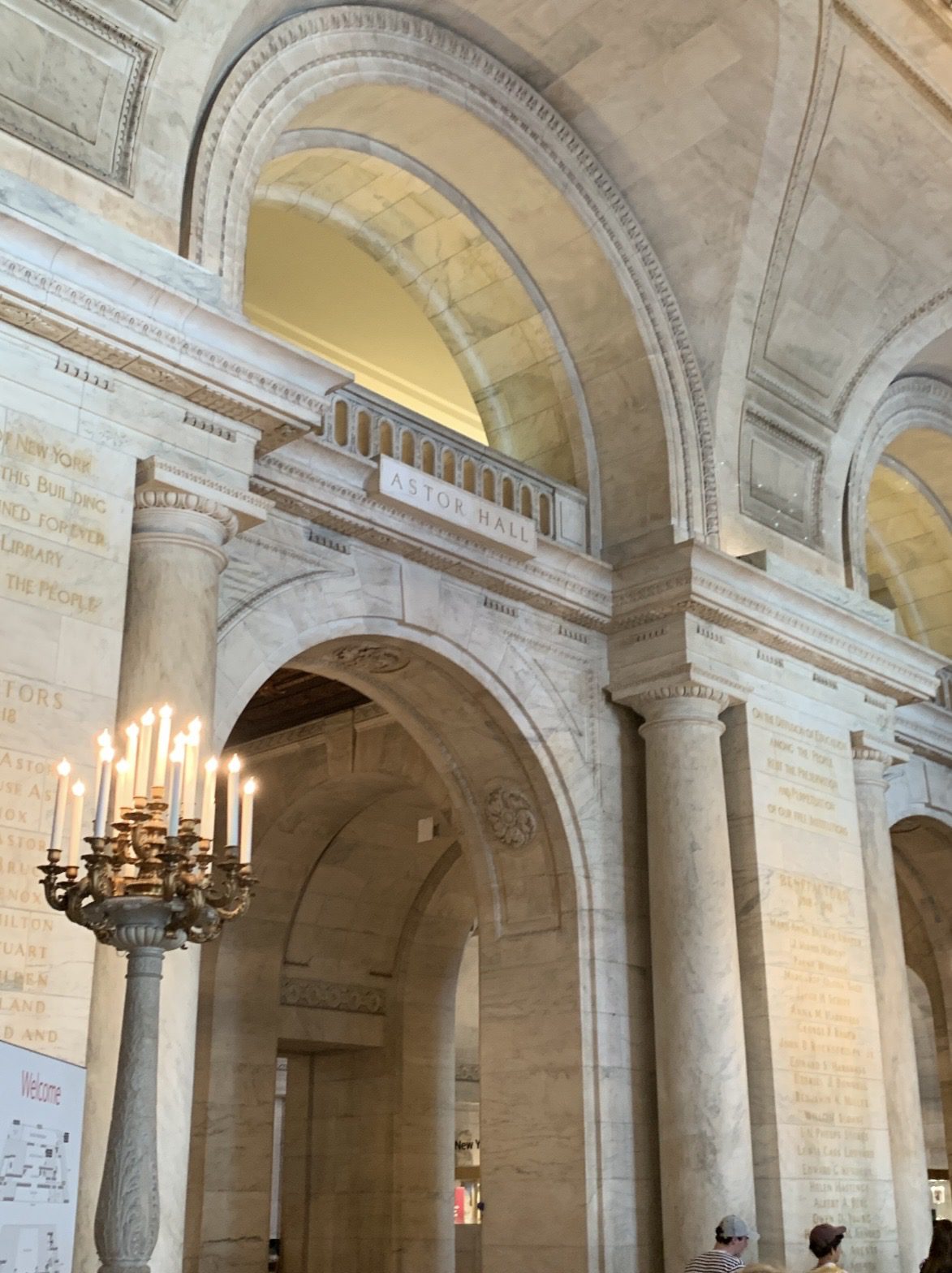
I photographed the New York Public Library. Inside, I noticed a hall. Astor Hall. High ceilings. Marble floors. I took a picture and kept walking.
I stood in front of the Empire State Building and looked up. 102 floors. I pressed the shutter.
Five separate moments, scattered across years. Each one unconnected from the others.
Writing this blog, I finally understood. They were all the same person.
The Butcher’s Son
Walldorf, Germany. 1763. The son of a butcher.
He arrived in New York at twenty-one with almost nothing. He started by selling furs — trading directly with Native tribes, pushing routes farther and farther across the continent. Then he took the money and bought land.
Manhattan. The unfashionable lots nobody wanted, the parcels far north of the developed city. He bought them and kept buying. He never sold. He simply held on. New York grew around him. The values rose. He did nothing, and the money multiplied.
That was his strategy. It required no particular genius. Only patience, and the refusal to let go.
When he died in 1848, his estate was valued at twenty million dollars — roughly one percent of the entire U.S. GDP at the time. Rockefeller, Vanderbilt, Carnegie: not yet born, or still children. He was America’s first true millionaire, and he got there before any of them.
Someone asked him, near the end of his life, what he would do if he could start over.
“I would buy every foot of land on the island of Manhattan.”
There was regret in that. He could have bought more.
In his will, he left $400,000 to establish a public library. That bequest became the foundation of what is now the New York Public Library. The hall inside still carries his name.
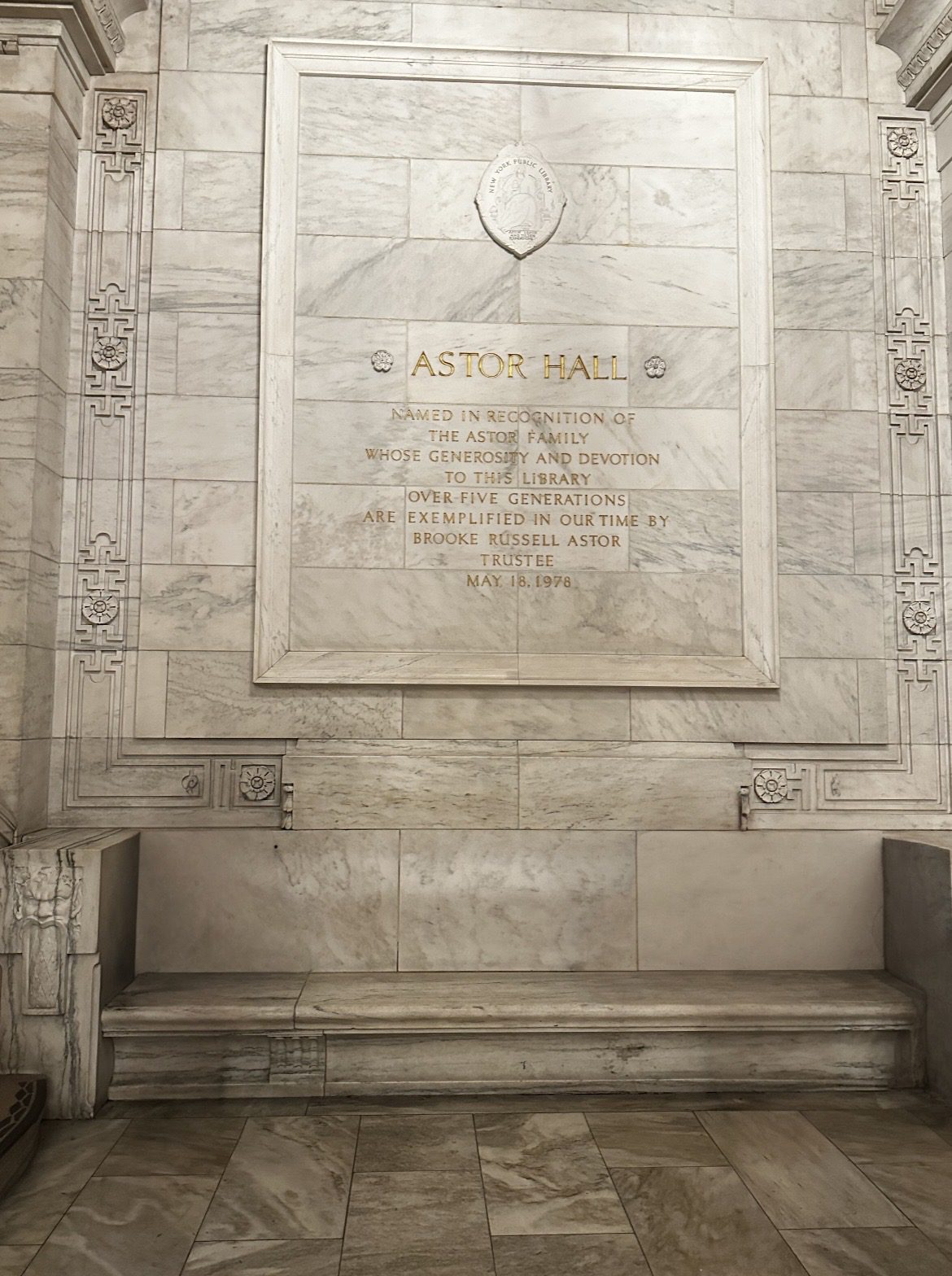
Astor Hall, New York Public Library, 42nd Street. Photo: Serendipity Gaze.The dedication plaque inside Astor Hall. Five generations. The last name on the wall is Brooke Russell Astor, 1978. Photo: Serendipity Gaze.
On the wall, there is a marble plaque. It reads:
Named in recognition of the Astor family, whose generosity and devotion to this library over five generations are exemplified in our time by Brooke Russell Astor — Trustee — May 18, 1978.
Five generations. The last name on that plaque is Brooke Russell Astor — the wife of the man whose father died on the Titanic. She gave away nearly two hundred million dollars to New York City before her death in 2007 at the age of 105. Her son was later convicted of stealing from her estate.
I walked past that plaque without reading it. I had no idea whose name I was standing under.
Build a Hotel Next Door
The fortune passed down through generations. By the third, it had reached two cousins.
They grew up in side-by-side mansions at the corner of Fifth Avenue and 34th Street. They did not get along.
One moved first. He demolished his own mansion and built a thirteen-story hotel directly next to his cousin’s home. The Waldorf Hotel. 1893.
He knew exactly what he was doing. A hotel meant strangers at all hours, luggage at the entrance, noise, staff, the relentless movement of a commercial building pressed against a private home. He built it anyway. It was not a business decision. It was a message.
His cousin held out for a while. Then he made his own decision. He would tear down his house too. He would build taller. Seventeen floors. He hired the same architect.
Eventually the two buildings were joined by a 300-foot marble corridor. Not a reconciliation — a business arrangement. The corridor was called Peacock Alley, after the fashionable men and women who paraded through it to be seen. The combined hotel became known simply as “The Hyphen.” Waldorf-Astoria.
Two buildings born from a family feud became the most famous hotel in the world. Royalty stayed there. Presidents stayed there. A single dinner cost $250 — an almost unimaginable sum at the time.
One cousin eventually left for England. The press had worn him down. He emigrated, took British citizenship, and was eventually made a Viscount. The other stayed in America.
That choice — to leave or to stay — would define everything that followed. But neither of them could have known that yet.
Did You Know
The two cousins were sixteen years apart in age. One left for England and became a British peer. The other remained in America and died on the Titanic. In April 1912, the one in England received the news from across the Atlantic. Their relationship had never been warm. What he thought when he heard, no record survives to tell us.
Jupiter, 2000 A.D.
The cousin who stayed was not a simple real estate heir.
He patented a bicycle brake. He invented a pneumatic road-improvement device. He fought in the Spanish-American War — not as a figurehead, but at his own expense, financing an artillery unit and serving as a lieutenant colonel in Cuba. He came home with the rank of colonel. People called him Colonel Astor for the rest of his life.
And he wrote a novel.
1894. Science fiction. The title was A Journey in Other Worlds. Set in the year 2000, it follows a voyage to Jupiter and Saturn.
The Wright Brothers had not yet flown. The automobile had barely arrived. Among the men of his class — men who summered in Newport, who sailed private yachts, who built hotels to spite their relatives — not one of them imagined Jupiter. He did.
The land could be bought, the hotels built taller, the wars fought and won. And still. Not backward into the past, like Morgan retreating into his Renaissance library. Not inward into legacy, like Carnegie building monuments to his own guilt. Something else — forward, into a century that hadn’t arrived yet.
Whether that was ambition, or loneliness, or simply the restlessness of a mind that money couldn’t occupy — there’s no way to know.
In the spring of 1912, he boarded a ship with his young wife. She was pregnant. They had been traveling through Europe and Egypt, waiting for the gossip about their marriage to quiet down — he was forty-seven; she was eighteen. They wanted the child born on American soil. American soil. The land his family had spent a century accumulating, block by block.
The ship was the Titanic.
He was the wealthiest passenger aboard. His net worth was approximately $87 million — nearly three billion dollars in today’s terms. The man who had imagined the year 2000 was standing on the most advanced vessel human engineering had yet produced. He had said as much himself, to another passenger: “She’s unsinkable, a modern shipbuilding miracle.”
On the night of April 14th, the ship struck an iceberg.
He lifted his pregnant wife through a porthole window and placed her into Lifeboat 4. Then he stepped back onto the deck. Witnesses said he was calm. He watched the boat descend, leaned against the railing, and lit a cigarette.
At 2:20 in the morning, the ship disappeared beneath the surface.
His body was recovered a week later by a cable ship in the North Atlantic. He was identified by the initials sewn into the lining of his jacket. In his pocket was a gold watch. His son kept it for the rest of his life.
The Land Remained
After he died, the Waldorf-Astoria continued without him. By 1929, the hotel had grown dated — fashionable New York had moved north, well past 34th Street — and it was sold. The building was demolished. In its place rose the Empire State Building.
The building I photographed without knowing what had stood there before.
The hotel name moved uptown to a new Art Deco tower on Park Avenue, which opened in 1931. That building passed to Hilton, then in 2014 was purchased by a Chinese insurance company for $1.95 billion — at the time, the most expensive hotel sale in history. After eight years of renovation, it reopened in 2025. It is now for sale again.
Where the Hotel Astor once stood in Times Square, there is now an office building. One Astor Plaza. On the third floor, there is a theater. I saw The Lion King there. Several times. I walked out every time into the light of Times Square without reading the name above me.
The fortune he left behind passed to his son. The son was troubled by what the family had been — landlords who extracted rents from tenants who had nowhere else to go. He sold assets. He started a foundation. When he died in 1958, he left everything to his wife, Brooke. She gave nearly $200 million back to the city — to hospitals, libraries, community programs. She died in 2007 at 105. Her son was convicted of stealing from her estate. That was the end of the American Astors.
The name the butcher’s son carried out of Germany in 1783 now belongs to a building owned by a Chinese state-backed insurance company on Park Avenue.
Did You Know
The cousin who left for England never lost his footing. His descendants held onto their title and stayed close to British power. The 4th Viscount Astor is a member of the House of Lords and the stepfather of Samantha Cameron — wife of former British Prime Minister David Cameron. Same family, same starting point. One line ended on the Titanic. The other is still in the room where decisions are made.
The tile mosaics at Astor Place subway station — 1904, one of the original twenty-eight stops on the New York City line — are decorated with beavers. A tribute to the fur trade that started everything. Every day, thousands of people walk past them on the platform without stopping.
I got off at that station for years.
I never looked down.
Gaze’s Pick — Where to Stay
The St. Regis New York2 East 55th Street at Fifth Avenue · Midtown · $$$$Built by Colonel Astor himself in 1904 — the same man who died on the Titanic eight years later. He designed it as his finest hotel, and it remains one of the most distinguished addresses in New York. The building has been here longer than the Empire State Building. It outlasted him, and the fortune that built it.Explore →
Taste — Where to Eat
The Knickerbocker6 Times Square at 42nd Street · Midtown · $$$Colonel Astor built this hotel in 1906, directly across Times Square from his cousin’s Hotel Astor — another chapter in the same rivalry that produced the Waldorf-Astoria. The Knickerbocker still stands. One Astor Plaza, where the Hotel Astor once was, does not. Come for a drink at the bar and look out at the corner where two cousins once competed for the same block of sky.Explore →
American History · No. 15Newport, Rhode IslandThe Breakers
Vanderbilt: They Called It a Summer CottageI arrived expecting Gatsby. I found something closer to a ruin — intact, imposing, and waiting for a season that hadn’t come.
The Newport I had pictured was green.
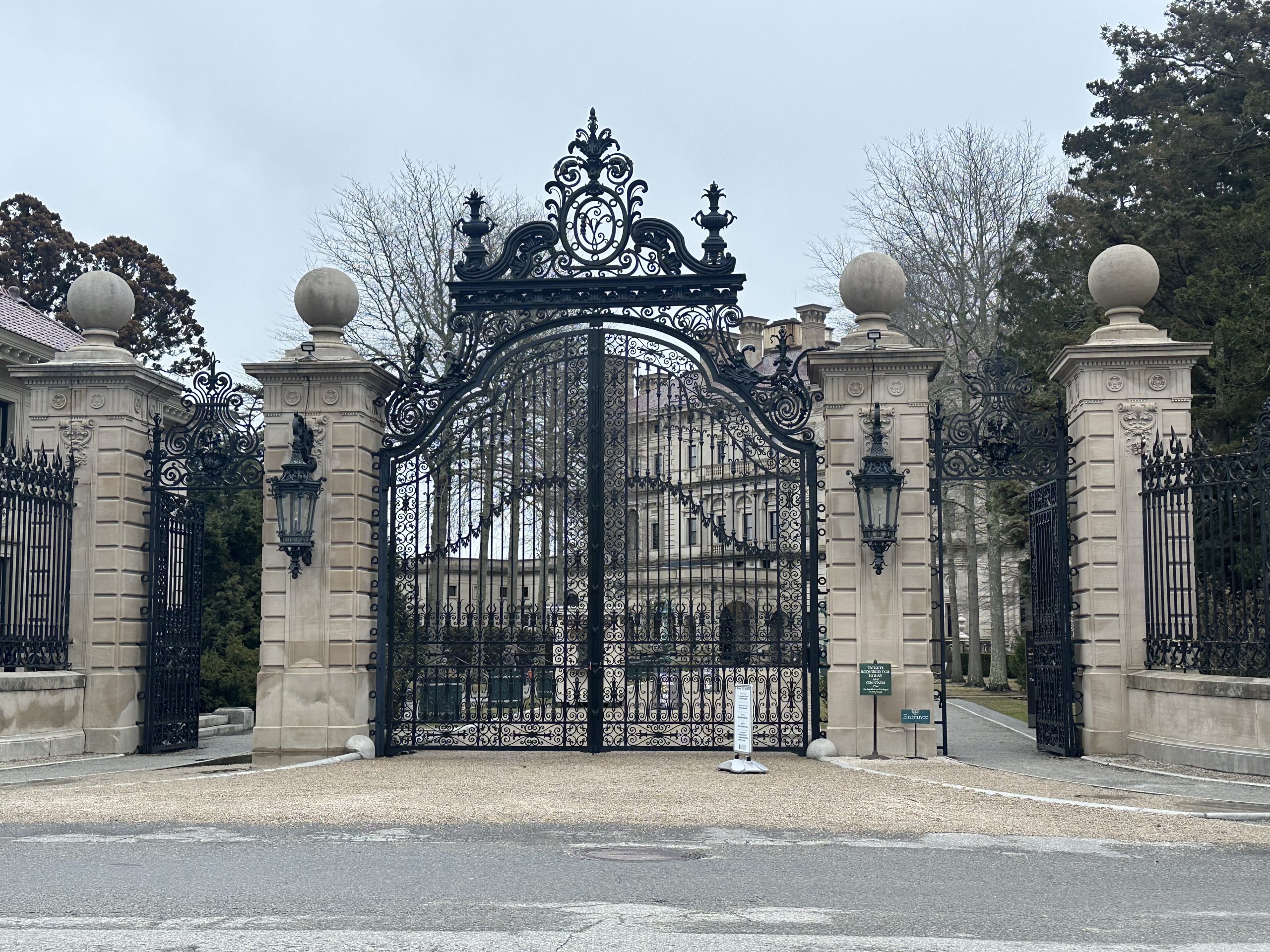
Manicured lawns, ocean light, white facades glimpsed through iron gates. Something out of Gatsby. I arrived at the end of March expecting spring.
When I stepped onto the Cliff Walk, the trees had no leaves.
Bare branches. Gray sky. The Atlantic came straight at me off the water. The estates began appearing to my left, and several were under construction — scaffolding, tarps, work signs. Nothing like what I’d imagined.
Then The Breakers came into view.
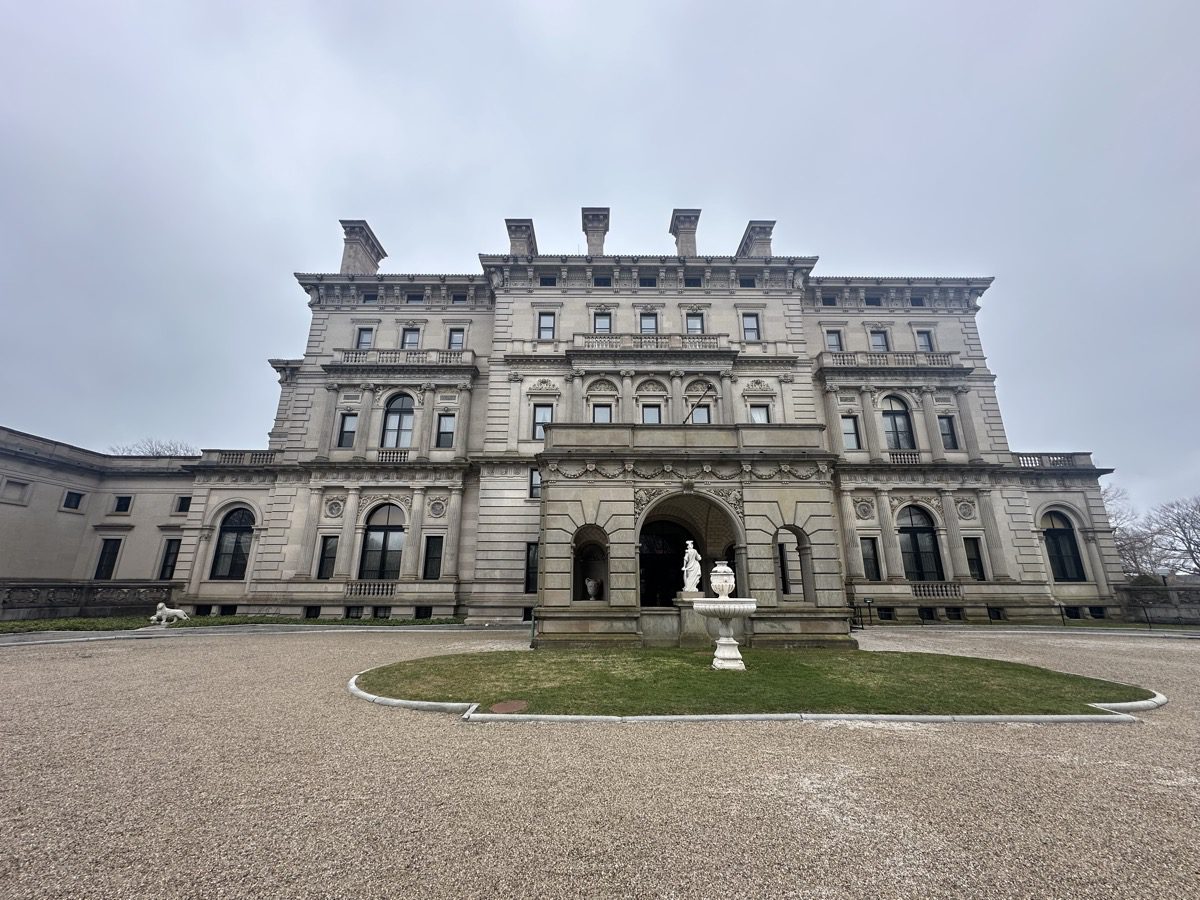
It wasn’t a ruin. But it felt like one. The building was intact, imposing, exactly as advertised. It stood alone on the cliff under a gray sky, waiting for a season that hadn’t come.
The entrance gate. March. The trees still bare. Photo: Serendipity Gaze.The Breakers, 44 Ochre Point Avenue. Completed 1895. Photo: Serendipity Gaze.
The Cottage
Cornelius Vanderbilt II built this house.
He was the grandson of the Commodore — the man who started with a borrowed boat and ended up controlling every railroad entering Manhattan, who built the original Grand Central Depot in 1871. Cornelius II purchased this site in 1885 for $450,000. Seven years later, the house that stood here burned down. He summoned architect Richard Morris Hunt and gave him one instruction: build something that cannot burn.
Limestone and steel. Not a piece of structural wood anywhere. The boilers were buried underground, away from the house entirely. Construction began in 1893 and finished in 1895.
Seventy rooms. Five floors. Fourteen acres on the cliffs above the Atlantic.
They called it a summer cottage.
Inside
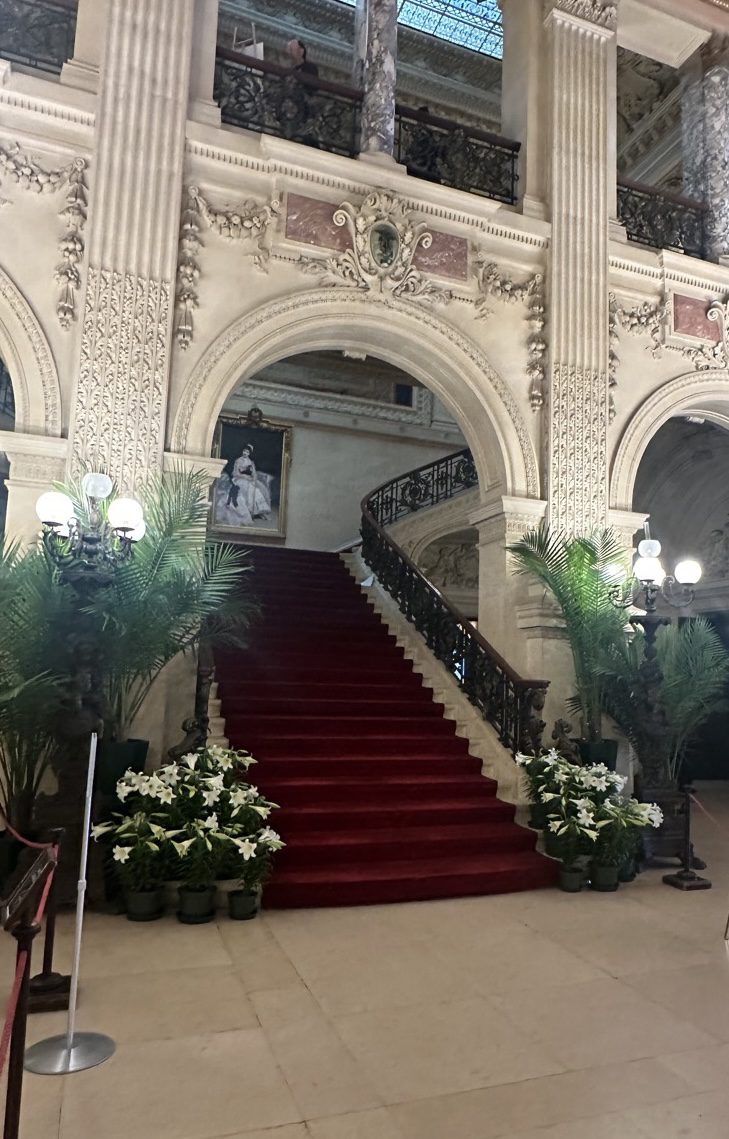
The Great Hall stopped me first.
Fifty feet in every direction. A red-carpeted staircase curving upward through arches stacked on arches, the whole room designed to make an entrance worth making. Everyone around me looked up. So did I, at first.
The Great Hall. The staircase steps were built two inches shorter than standard — so debutantes wouldn’t trip on their gowns. Photo: Serendipity Gaze.
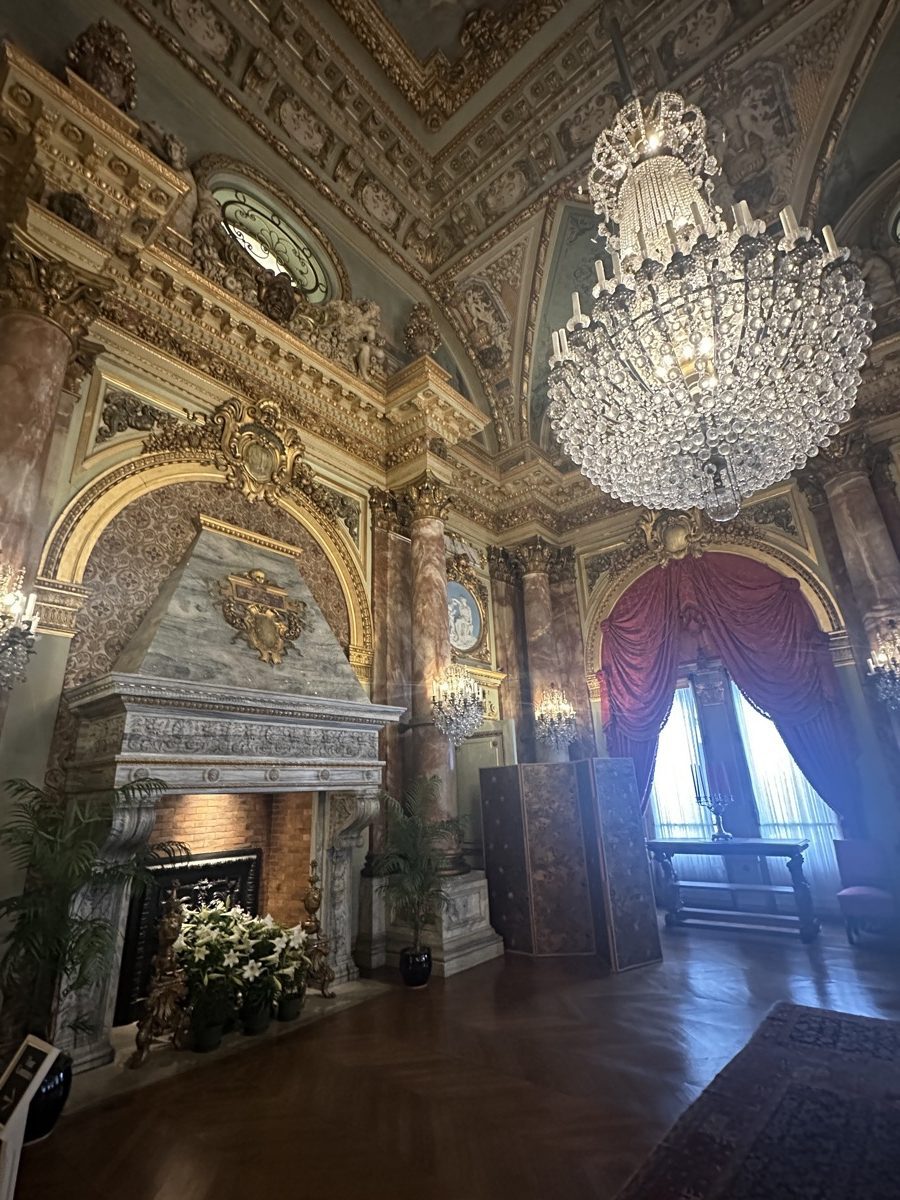
The rooms kept coming. Crystal chandeliers, gilded ceilings, crimson drapes, marble fireplaces. It went on and on.
The chandeliers are Baccarat crystal. The ceiling panels are gilded. Every room a different marble. Photo: Serendipity Gaze.
The materials were the finest available. The craftsmanship was beyond question. And yet something was missing. I couldn’t name it.
The Hidden Rooms
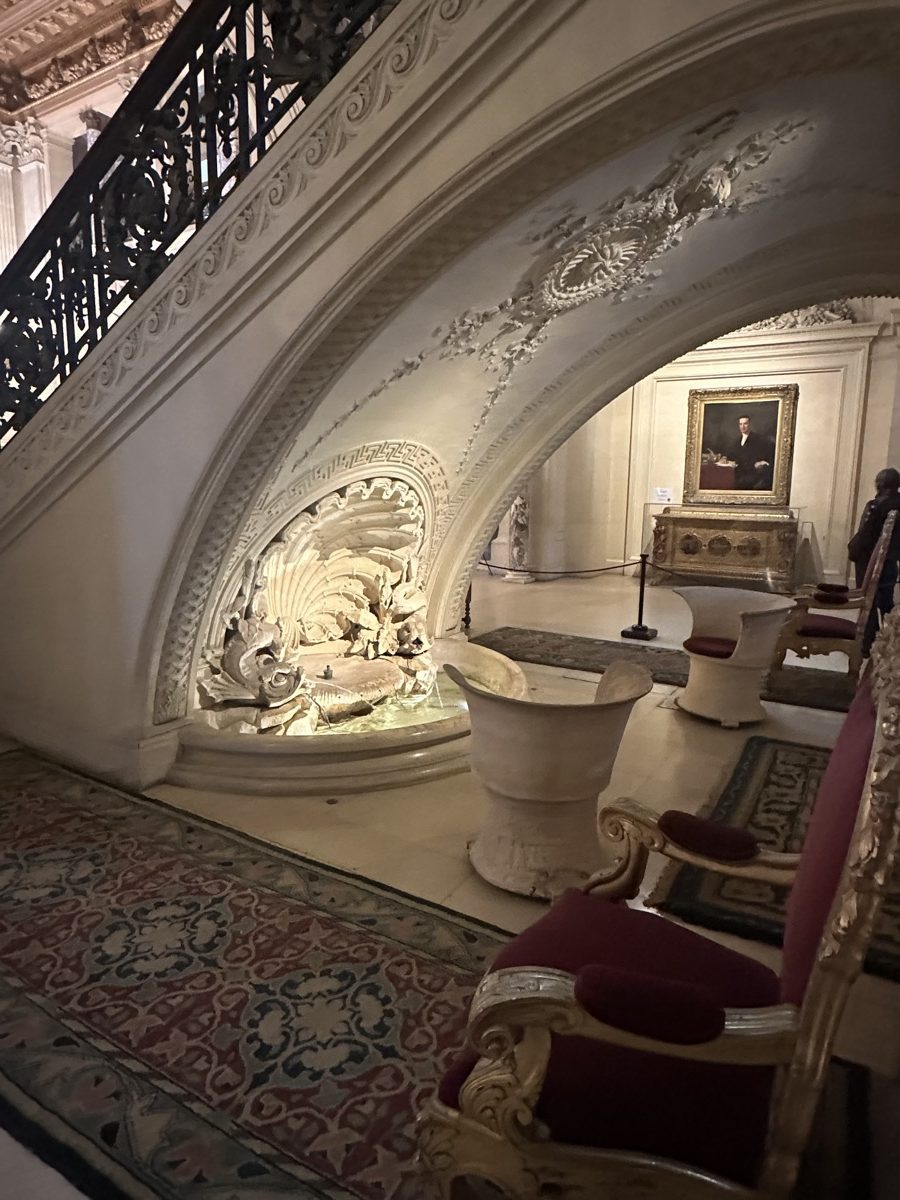
Then I stopped under the staircase.
Set into an arch beneath the grand stairs was a grotto — a carved marble tableau of seashells and dolphins, lit from within, with water trickling somewhere inside. No one else stopped. The other visitors walked past without slowing. There was no sign pointing to it, no audio guide entry.
Nobody was going to notice it. That was, apparently, beside the point.
Under the grand staircase. A grotto no one is directed to. The water still trickling. Photo: Serendipity Gaze.
The kitchen was in a separate wing.
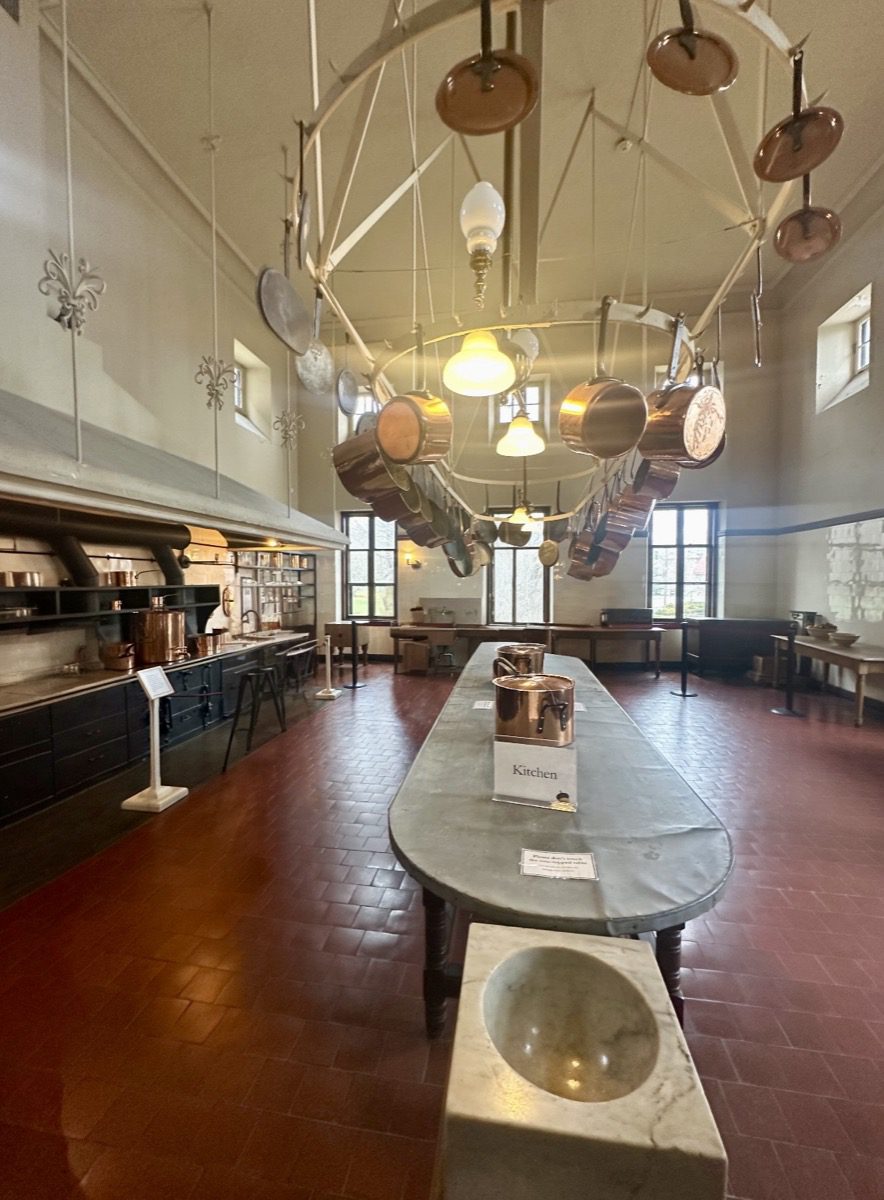
It had been built away from the main house as a fireproofing measure — nothing was going to burn this place down a second time. When I walked through the door, I had the distinct feeling of stepping somewhere I wasn’t supposed to be. Copper pots hung in rings from the ceiling. A cast-iron range the length of a wall. A zinc-topped work table. Terra cotta tile floors.
How many people worked in this room, I wondered. And did the family ever come in here — even once?
The guests certainly never did. The owners, probably not either.
The kitchen. A separate wing. Guests never came here. Photo: Serendipity Gaze.
The Acorn Again
On a column base nearby, I found an acorn.
The same emblem I had first noticed in Grand Central Terminal — carved into the clock, cast into the chandeliers, worked into the stone around the water fountains. The railroad terminal in the middle of Manhattan and the palace on the Newport cliffs, connected by the same symbol. Great oaks from little acorns grow.
I walked out to the ocean terrace. The wind was strong. Gray water, gray sky. No green anywhere. No Gatsby. But standing there, facing the Atlantic, I understood something about why this spot was chosen — why the house faces exactly this way. The wind and the water and the sheer fact of being here, above all of it. Everything else inside was decoration for this moment.
I was, I’ll admit, a little envious.
What Came After
Cornelius II lived in this house for four years after it was completed.
He died of a stroke in 1899. He was fifty-six. His wife Alice maintained the house alone for thirty-five years after that, until her death in 1934 at eighty-nine. By then the property taxes had risen to $83,000 a year. Their daughter Gladys inherited the house, but her husband — a Hungarian count — had his assets seized during World War II.
In 1948, Gladys opened the first floor to the public through the Preservation Society of Newport County, using the ticket revenue to cover maintenance costs. The Society purchased the house outright in 1972. In 2018, the last Vanderbilt descendant moved out of the third floor.
The house stayed. The family left.
When the Commodore died in 1877, his fortune was roughly $100 million. His son William doubled it — the only descendant who ever increased the family wealth. After that, the generations built. Then spent. By 1947, every Vanderbilt mansion on Fifth Avenue had been demolished. In 1970, the New York Central Railroad — the engine of the entire fortune — went bankrupt. In 1973, 120 Vanderbilt descendants gathered for a family reunion. Not one of them was a millionaire.
Great oaks from little acorns grow.
It had taken far less time to go the other way.
I walked back out onto the Cliff Walk. The Breakers was still there behind me, exactly as it had been. Wind off the water. Tourists with their cameras. The trees still bare.
Somewhere inside, beneath the grand staircase, a light was on in the grotto. The water was still trickling. Nobody was looking at it.
Gaze’s Pick — Where to Stay
The Vanderbilt, Auberge Resorts Collection41 Mary Street · Downtown Newport · $$$$The Breakers was built by Cornelius Vanderbilt II and his wife Alice. This downtown mansion was built by their son, Alfred Gwynne Vanderbilt, in 1909 — a few blocks from his parents’ cliff-side palace. Alfred died aboard the Lusitania in 1915. The building eventually became a YMCA, then a hotel. Now it’s the number one hotel in the Northeast according to Condé Nast Traveler. Same family name, different generation, different ending.Explore →
Taste — Where to Eat
White Horse Tavern26 Marlborough Street · Downtown Newport · $$$Opened in 1673. America’s oldest tavern. The Breakers was completed in 1895 — more than two hundred years after this building first served a meal. When the Vanderbilts were building their summer palaces on the cliffs, this place was already old. Walking distance from The Breakers. The kind of continuity Newport does quietly, without making a point of it.Explore →
Plan Your Visit
44 Ochre Point Avenue · Newport, Rhode Island
Open daily. Hours vary by season — verify at newportmansions.org before your visit.
Audio tour app available for download. Cliff Walk entrance is a short walk from the house.
Spring and summer are peak season. Late March visits offer smaller crowds — and a different kind of atmosphere.
American History · No. 14New YorkGrand Central Terminal
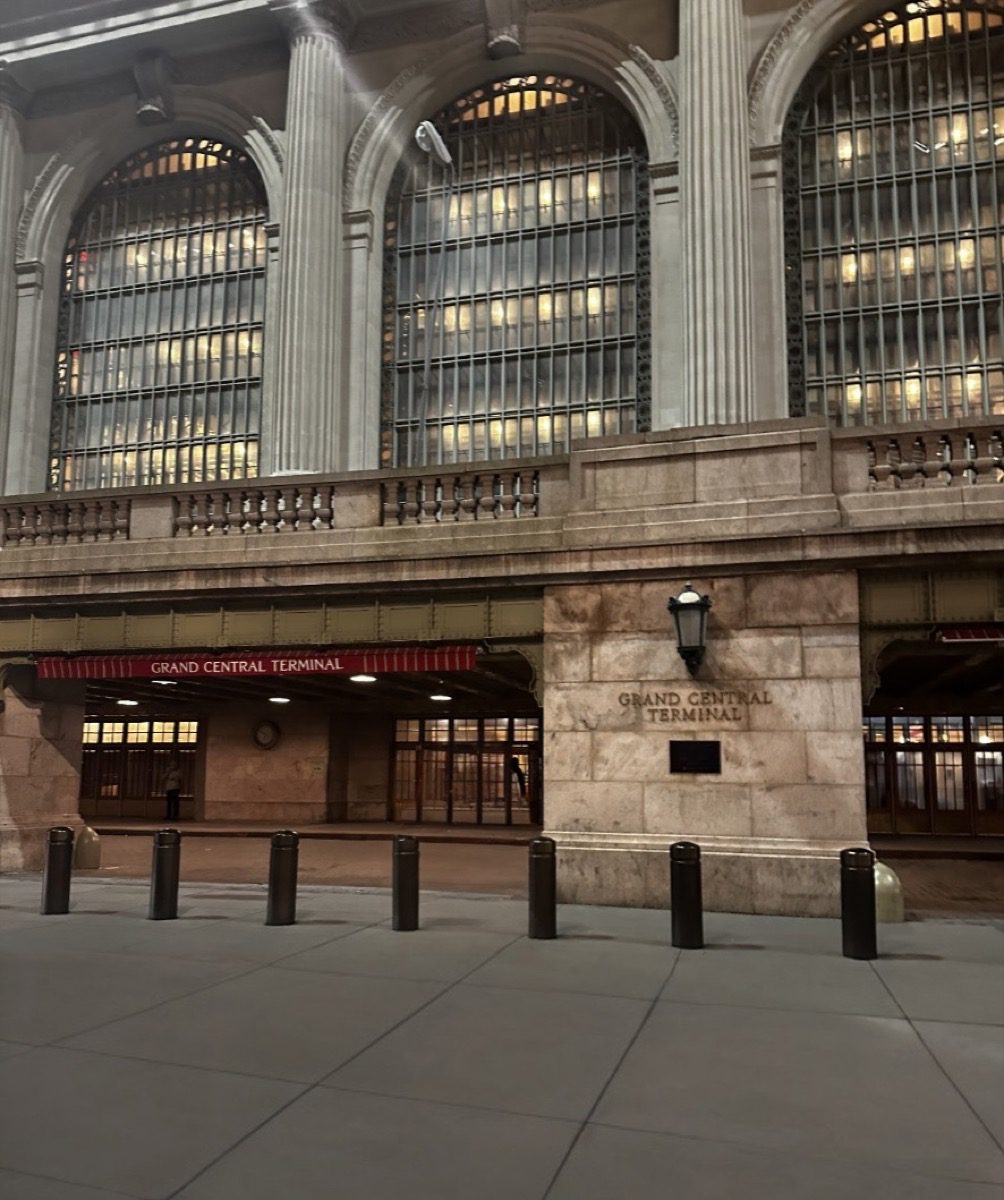
Vanderbilt: The Name Was EverywhereI walked into Grand Central Terminal twice. The first time, I was taking notes. The second time, I finally looked up.
The first time I walked into Grand Central Terminal, I was taking notes.
It was an architecture class. The professor led us into the main concourse and pointed up at the ceiling. Beaux-Arts. Limestone. The proportions of the arches. I wrote it all down. And I saw nothing. At twenty, your eyes are too busy moving forward to actually look at anything.
That was twenty years ago.
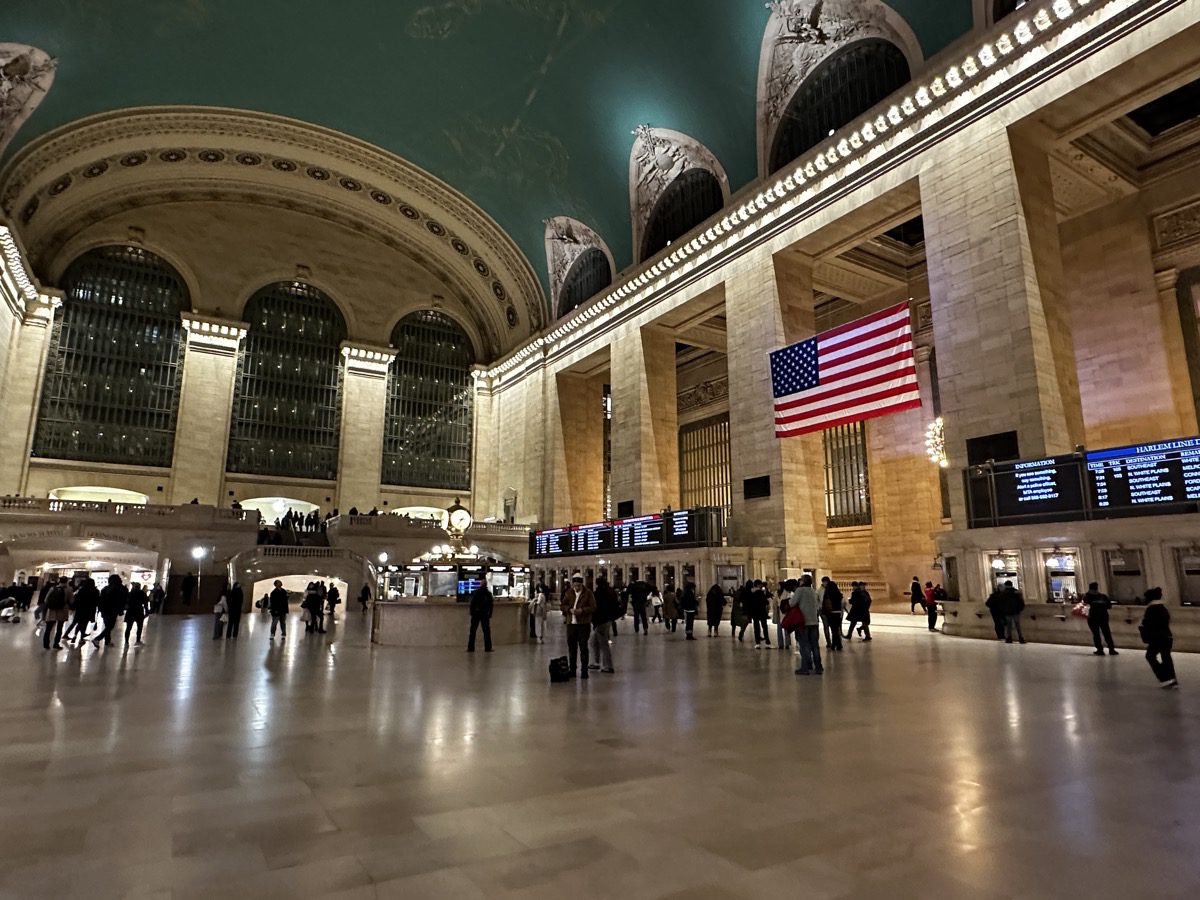
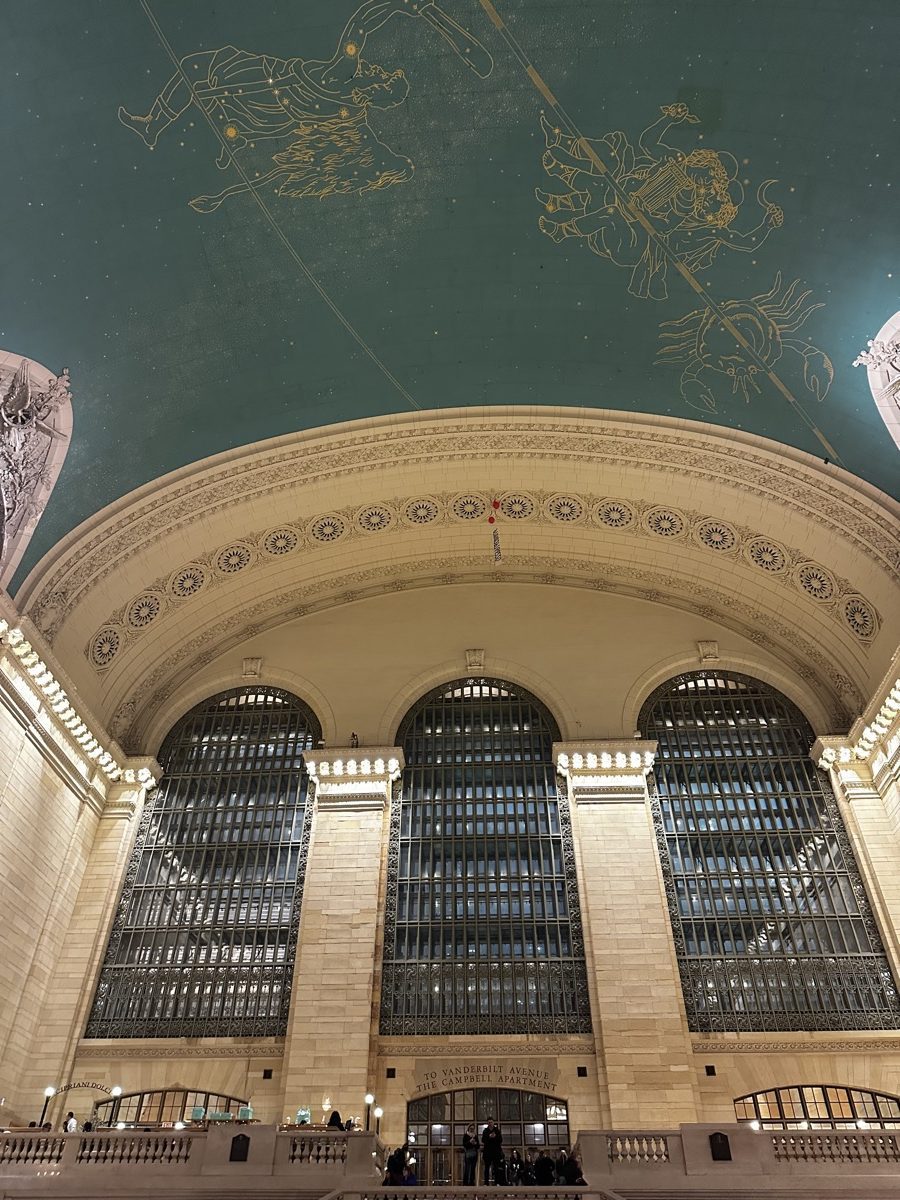
When I came back, I stopped in the middle of the concourse and looked up. The ceiling was higher than I had ever let myself notice. A turquoise vault scattered with gold constellations. Chandeliers pouring light down onto the floor. Everyone around me was moving. I wasn’t. So this is what he was pointing at. I had been standing right here, pen in hand, and missed it entirely.
There aren’t many buildings like this left in New York.
Grand Central Terminal, 42nd Street. 1913. Photo: Serendipity Gaze.
The Name
The name started showing up everywhere.
One Vanderbilt — the tower that went up directly beside Grand Central, with the observation deck that everyone in New York has been talking about. Summit. I rode the elevator up one afternoon, half-listening to the building introduction playing overhead. Vanderbilt. Through the glass, the city spread out below me. Directly underneath was the roof of Grand Central Terminal — I could see the whole shape of it from up there. I noted this with mild interest and moved on.
I didn’t ask whose name was on the building.
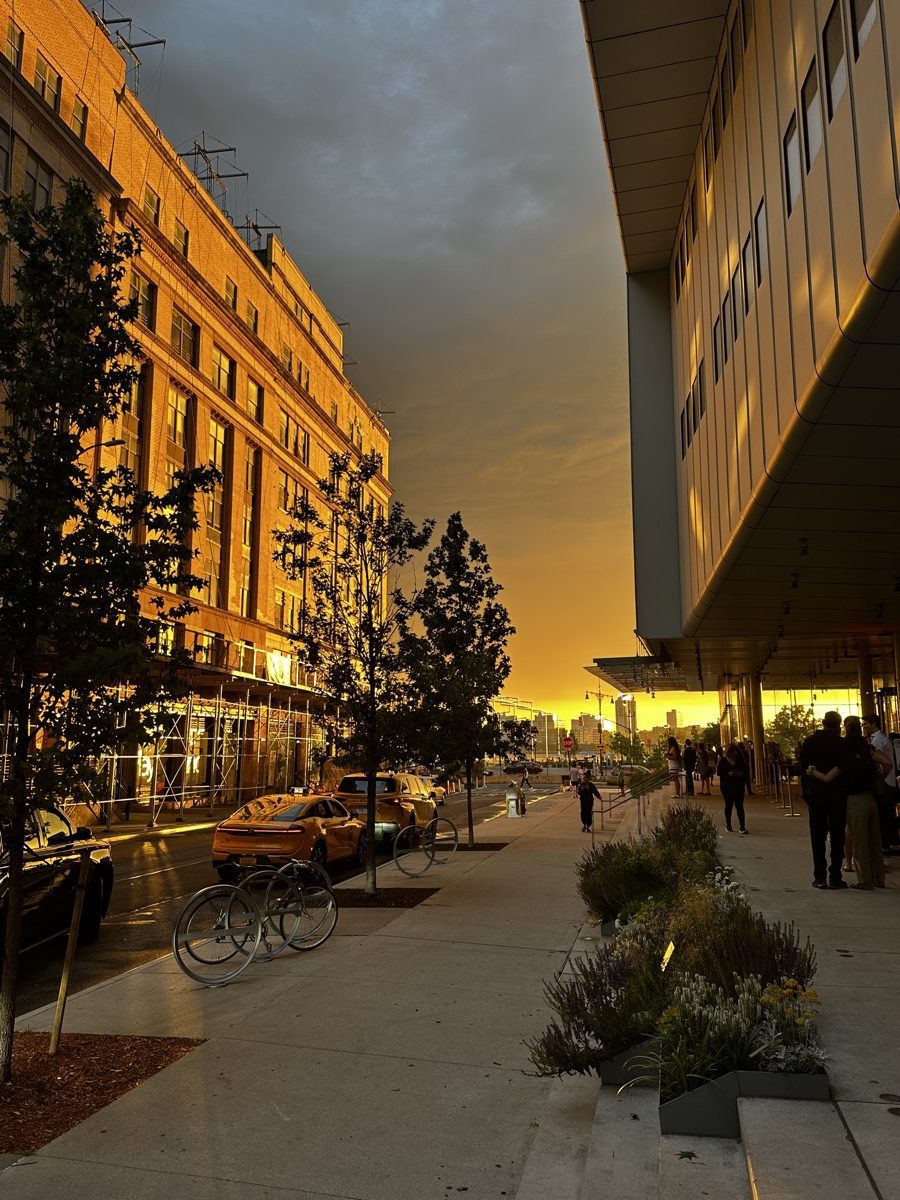
The main concourse. The four-faced clock, the flag, the daily movement of the city. Photo: Serendipity Gaze.Whitney Museum of American Art, Meatpacking District. Photo: Serendipity Gaze.
Then there was a face at the Whitney Museum.
I was moving through a gallery when I stopped at a sculpture near the lobby. A marble head on a dark pedestal. The label read: Gertrude Vanderbilt Whitney. Head for Titanic Memorial, 1922. The museum is called the Whitney. Her other name was Vanderbilt. I read further. Gertrude Vanderbilt Whitney had tried to donate her collection to the Metropolitan Museum of Art. They said no. So she built her own institution, and put her name on it.
The label also said this: the work held personal significance because she had lost a brother in the sinking of the Lusitania during World War I.
Gertrude Vanderbilt Whitney, Head for Titanic Memorial, 1922. Seravezza marble. Whitney Museum of American Art. Photo: Serendipity Gaze.
Vanderbilt. Vanderbilt. Vanderbilt.
The name kept finding me. I heard there was a prominent university in Tennessee that carried it too. The dots were accumulating, scattered and unconnected.
Who exactly was Vanderbilt?
The Commodore
I found out while writing this blog.
I was researching Grand Central Terminal — following one document into another — when I stopped at a single line. Built by Cornelius Vanderbilt, 1871.
The building I first walked into as a student, pen in hand. The roof I had stared down at from the Summit without a second thought. The concourse I had walked through so many times it had become invisible to me, the way familiar things do.
It had all been Vanderbilt. From the beginning, before I knew to look.
Cornelius Vanderbilt was born in 1794 on Staten Island. His father ran a small boat, ferrying cargo across the harbor. Cornelius left school at eleven. At sixteen, he borrowed money from his mother and bought a single sailboat — a small vessel that crossed between Staten Island and Manhattan. Carrying passengers. That was how it started.
He moved from sail to steam. When competitors found him too difficult to beat, they paid him — substantial sums — simply to leave their routes alone. He took the money and opened new ones. By his fifties, he had turned his attention to railroads, acquiring the Hudson River Railroad and the New York Central by 1867 and consolidating effective control over every rail line entering Manhattan. His peers called him the Commodore — a naval honorific that had followed him since his days on the water. A title for a man who had started with one borrowed boat.
In 1871, he opened Grand Central Depot at 42nd Street, at what was then the northern fringe of developed Manhattan. His own advisors thought he was building too far out. He built it anyway. When he died in 1877, his fortune was estimated at roughly $100 million — equivalent, by some calculations, to one-eighty-seventh of the entire U.S. money supply.
The Building
The building we stand in today is not the one Cornelius built.
He died in 1877. The current terminal was designed starting in 1903 and opened in 1913, financed by the generation that followed him. One of the two firms brought in to design it — Warren & Wetmore — was co-founded by Whitney Warren, a cousin of the Vanderbilt family. The family had a hand in choosing who would build their monument, and then made sure that monument knew whose it was.
Vanderbilt Hall. Vanderbilt Avenue. The name is worked into the building at every turn.
The constellation ceiling. Turquoise and gold, 1913. Below: the passage to Vanderbilt Avenue. Photo: Serendipity Gaze.
And yet the man himself stands apart from all of it. Cornelius Vanderbilt’s bronze statue — eight and a half feet tall — is mounted on the terminal’s south facade, above the Park Avenue Viaduct. Cars pass beneath him at speed. Almost no one looks up. He stands there watching over a building that carries his family’s name in a dozen places, from a spot the city has largely forgotten to notice.
The Acorn
I stood in the main concourse and looked up one more time.
The constellation mural covers the full vault — turquoise ground, gold stars, the sweep of the zodiac. But the stars are backwards. East and west are transposed; the whole map is a mirror image of the actual sky. Shortly after the terminal opened in 1913, a commuter wrote in to point this out. The Vanderbilt family’s response was brief: the ceiling had been painted from God’s vantage point, looking down at the constellations from beyond them. The real explanation is simpler. The painter had laid his sketch flat on the floor while he worked, and the image came out reversed. The family knew this. They kept the other story anyway.
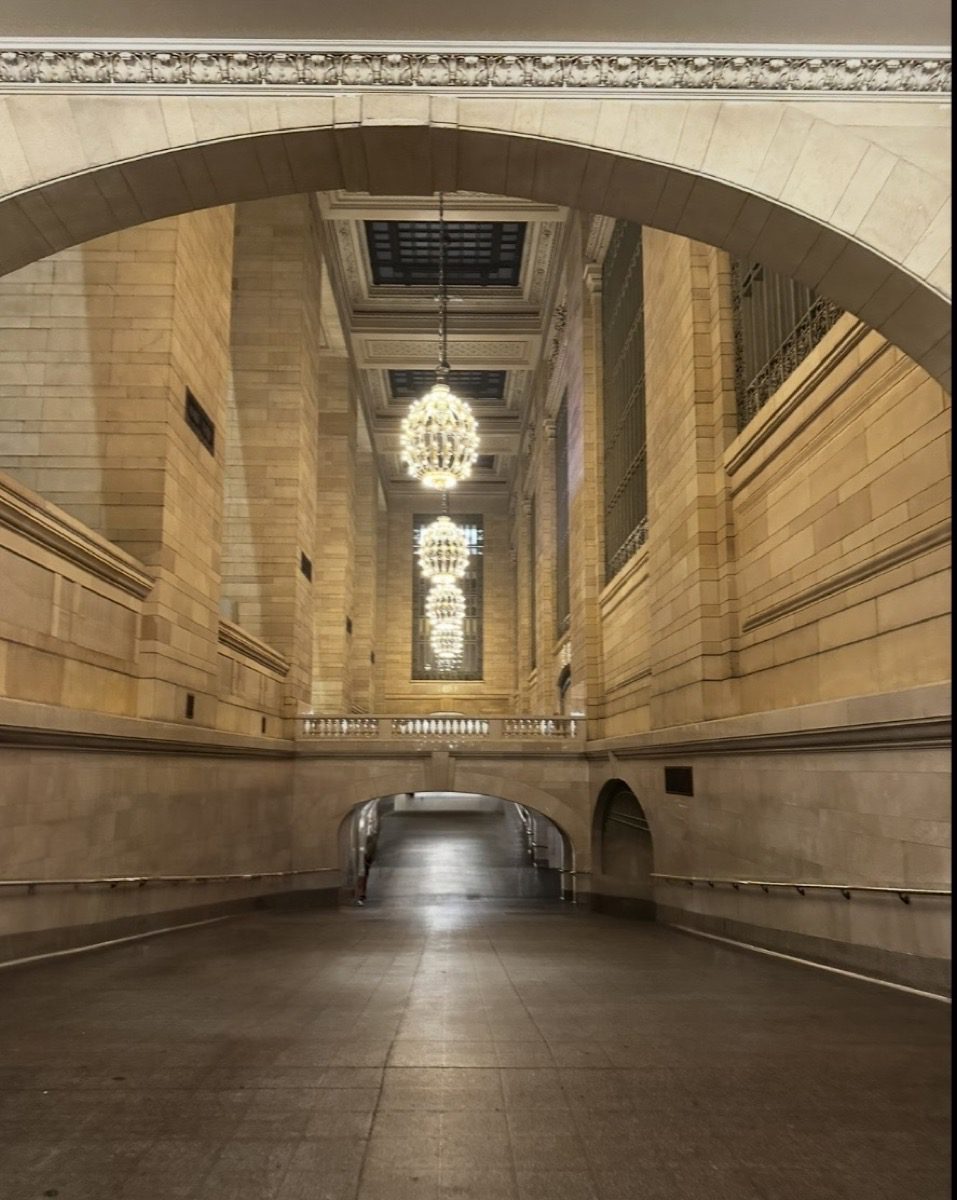
The passage through. Chandeliers, limestone, the quiet between crowds. Photo: Serendipity Gaze.
It was only after all of this that I noticed the acorns.
They are everywhere in Grand Central, hiding in plain sight: carved into the column bases, cast into the chandeliers, set atop the four-faced clock at the center of the concourse, worked into the stone around the water fountains. The Vanderbilt family emblem. A dynasty that had built itself from nothing — no inherited title, no ancestral crest — chose its own symbol, along with the motto that came with it.
Great oaks from little acorns grow.
When Cornelius Vanderbilt adopted that motto, he was narrating his own life. A borrowed sum. A single boat. A fortune that would make him, by some measures, the second-wealthiest individual in American history. He wasn’t wrong.
The acorn became the oak. What came after is a different story — and it’s in Newport.
Gaze’s Pick — Where to Stay
The Sherry-Netherland781 Fifth Avenue at 59th Street · Upper East Side · $$$$When this building went up in 1927, the Vanderbilt mansion was being demolished directly across Fifth Avenue. The carved limestone panels from that mansion were salvaged and installed in the Sherry’s lobby, where they remain. The elevator panels came from the same house. At the corner of Fifth and 59th, across from the entrance to Central Park — a hotel that carries the Vanderbilt story in its walls.Explore →
Taste — Where to Eat
Grand Central Oyster BarGrand Central Terminal, Lower Level · Midtown · $$Opened in 1913, three weeks after the terminal itself. The Guastavino-tiled vaulted ceilings are unchanged. The oysters come in thirty varieties daily. It is, simply, the oldest restaurant inside the building Vanderbilt built — and one of the few places in New York where nothing about the room has been touched. Monday through Friday, lunch and dinner. Closed weekends.Explore →
Andrew Carnegie: The Man Who Dies Rich Dies DisgracedI walked in without knowing what it was. Museum Mile does that to you. There’s always an open door. I found out later whose house it had been.
Carnegie Hall. Carnegie Mellon University. The Carnegie Corporation.
I’d heard the name my entire life. It was everywhere — on buildings, on diplomas, on the sides of concert halls. But I couldn’t have told you who he was. The name had become so large it had stopped belonging to a person.
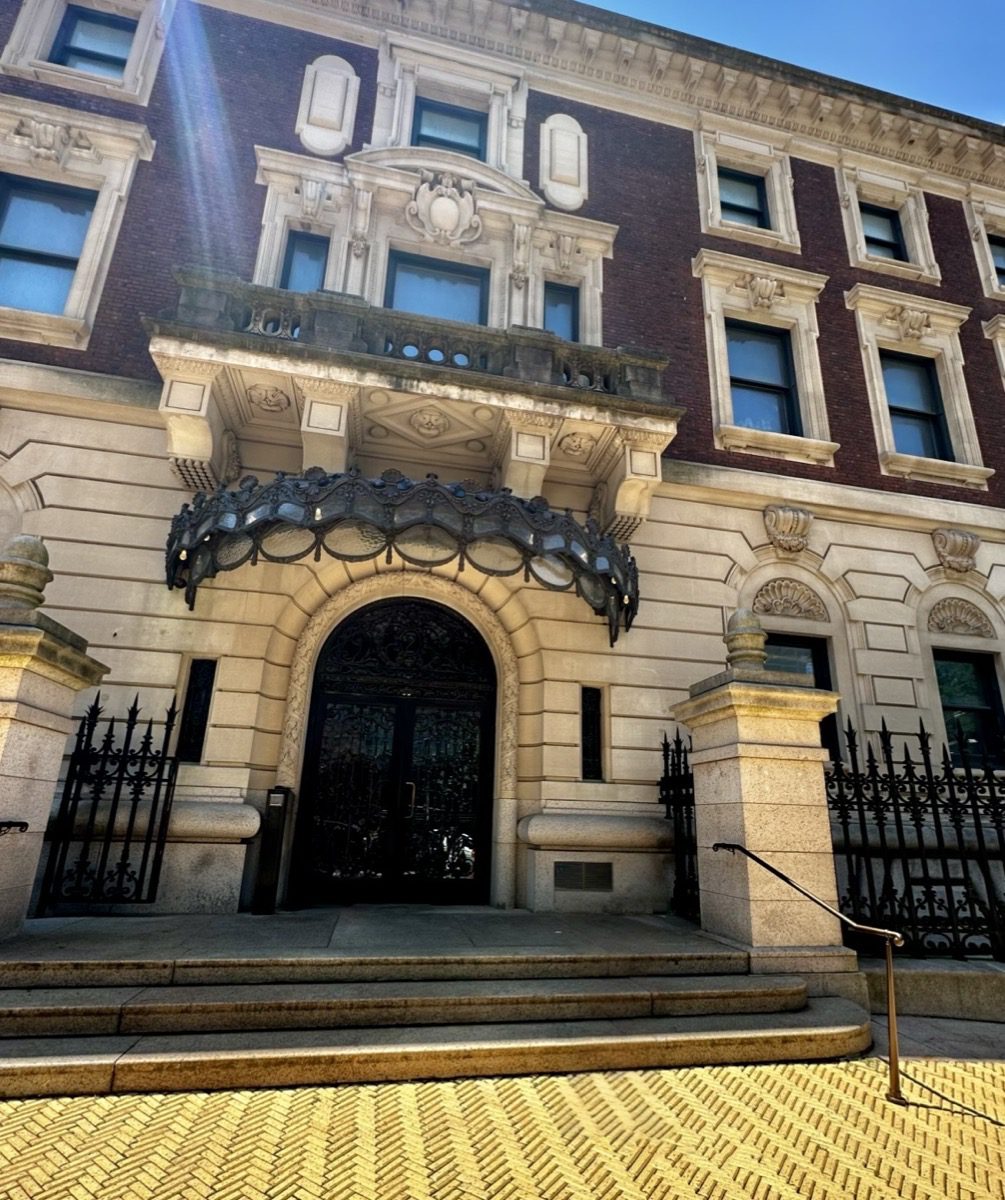
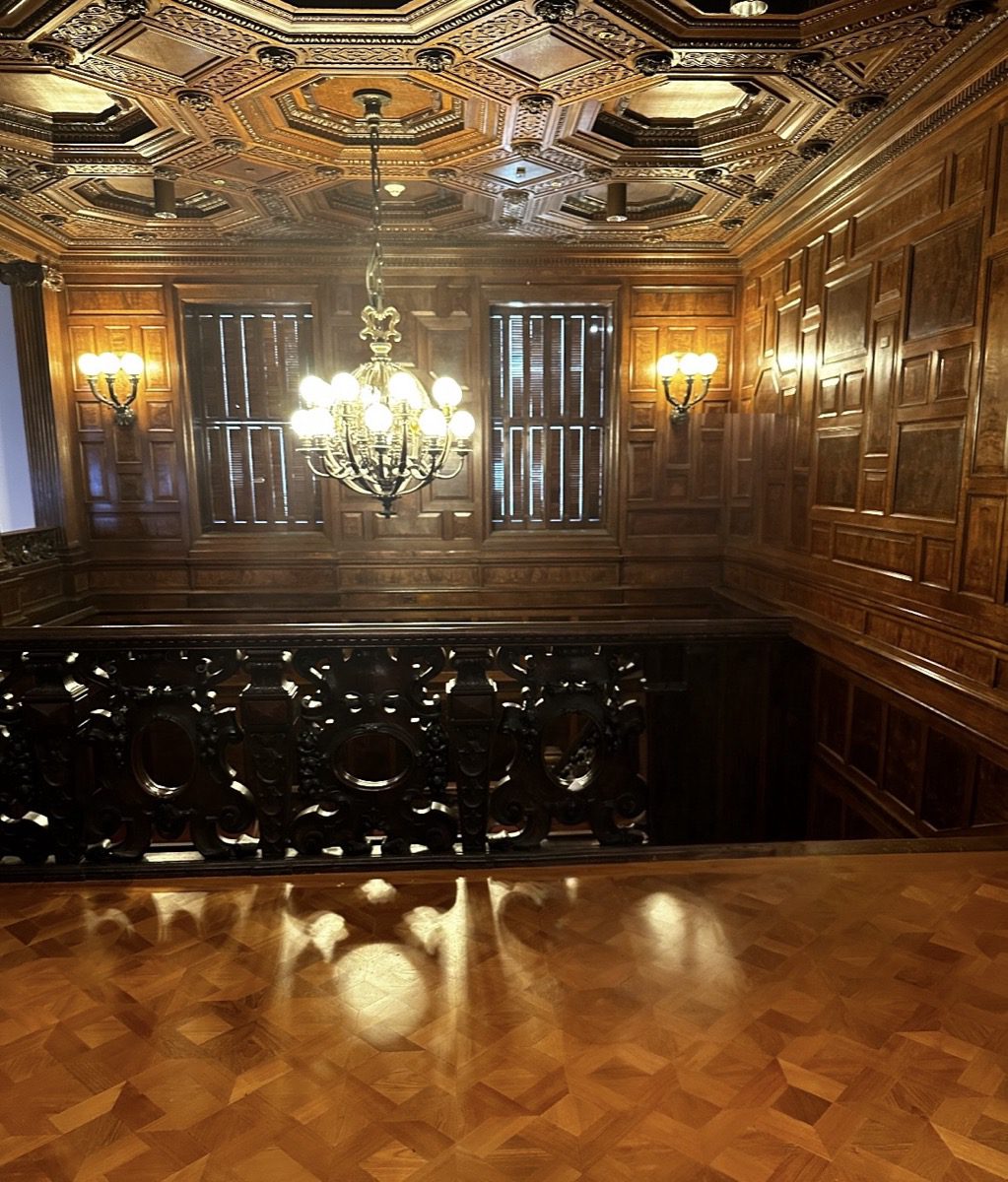
I walked in without knowing what it was. Museum Mile does that to you. There’s always an open door. Inside, the light dropped immediately. Dark wood paneling ran floor to ceiling — panels, moldings, a heavy carved banister, all the same shade of brown, all the same weight. It felt less like a museum and more like somewhere someone had actually lived.
It was. Andrew Carnegie died here.
So I went looking. Who was this man whose name was on everything?
2 East 91st Street. Completed in 1902. Carnegie lived here until his death in 1919. Photo: Serendipity Gaze.
The Beginning
Dunfermline, Scotland, 1835. His father was a weaver. The Industrial Revolution arrived, and the loom became obsolete, and the family had nothing. In 1848, when Andrew was thirteen, they borrowed money and sailed for America.
Pittsburgh. A cotton mill. Twelve hours a day, six days a week, $1.20.
That’s where it started.
He became a telegraph messenger, running dispatches across Pittsburgh until he had the city’s geography memorized — every street, every name, every face that mattered. He wasn’t just delivering messages. He was studying. He moved to telegraph operator, then to the Pennsylvania Railroad, then to managing Union rail and communications during the Civil War.
After the war, he noticed something. Wooden bridges. They burned, they rotted, they washed out in floods, and every few years someone built them again. Across the entire country, the same cycle. He saw what wasn’t there yet: iron. Steel. Something that didn’t rot.
Carnegie Steel became the largest steel producer in America — cheaper, faster, more ruthless than anyone else. Bridges, railroads, skyscrapers — the country was building itself at full speed and Carnegie was at the exact center of it. In 1901, J.P. Morgan came to him with an offer: $480 million. Carnegie sold. U.S. Steel was formed — the first billion-dollar corporation in history.
He was sixty-five. He retired.
The main hall. Dark walnut paneling, coffered ceiling. 1902. Photo: Serendipity Gaze.
Homestead
But there is 1892.
Homestead, Pennsylvania. Carnegie Steel. The workers went on strike — wages had been cut, and they refused. The company hired armed Pinkerton agents. Ten men died: seven workers, three Pinkerton agents. The Pennsylvania governor sent in the state militia. The union was broken. The workers came back at lower pay.
Carnegie was in Scotland. He said he hadn’t given the order. But it was his company, his managers, his decision to put Frick in charge.
The following year, he donated a library to Pittsburgh. For the workers, he said.
He later wrote that Homestead was the saddest episode of his life.
Colonel Anderson
There was something Carnegie carried from those Pittsburgh years that never left him.
A man named Colonel Anderson had opened his personal library to working boys every Saturday. Free. No application, no fee. Carnegie walked in and read. That was it. That was the whole story.
He later wrote that Colonel Anderson had made him.
So he built libraries. More than 2,500 of them, across the world. Carnegie Hall. Carnegie Mellon. Foundations, endowments, pension funds for teachers. Over eighteen years, he gave away roughly $350 million — close to five billion dollars today.
The man who dies rich dies disgraced.
This from a man who started at $1.20 a week.
The Conservatory
Further inside the mansion, I found the conservatory.
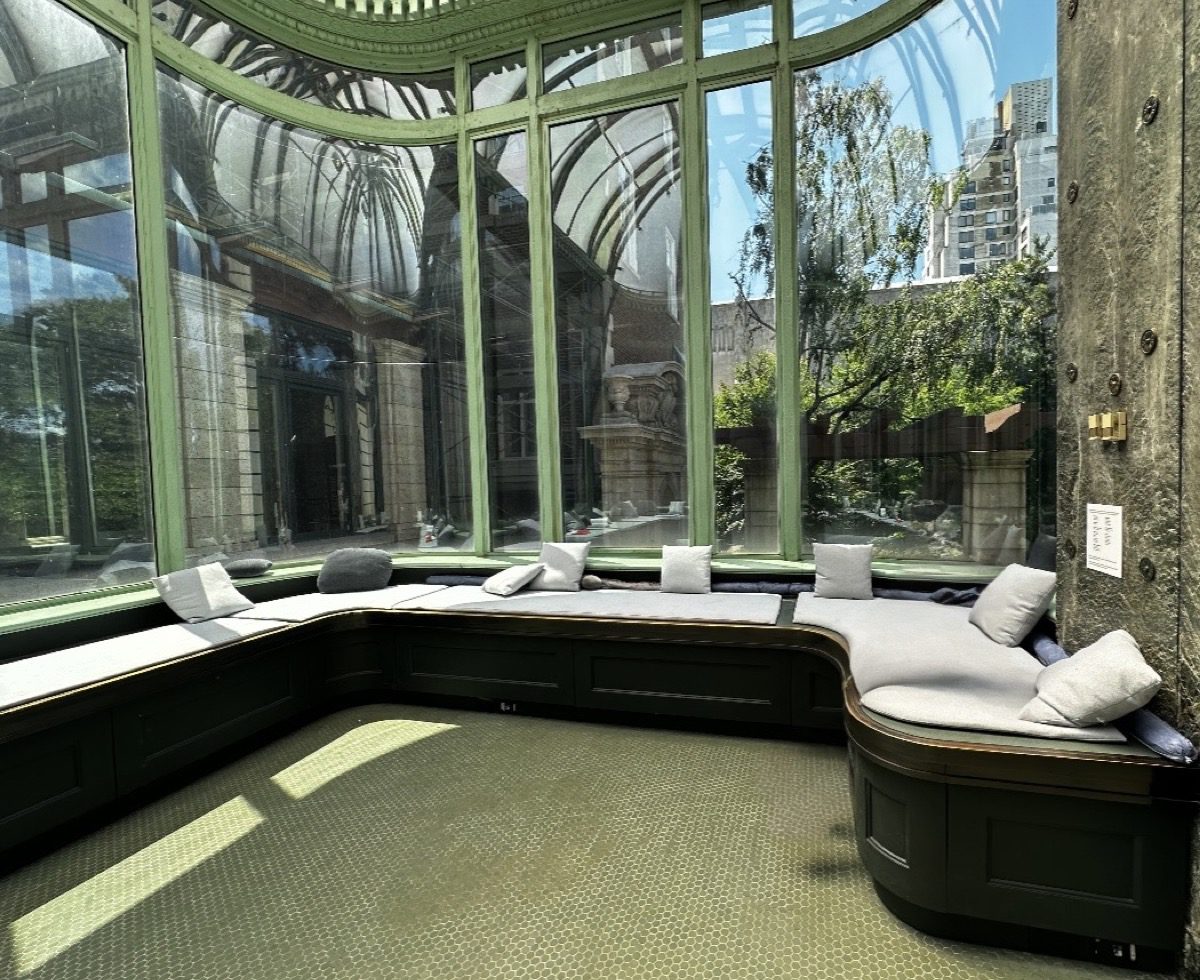
Glass dome. Green iron framework. Windows from floor to ceiling, the garden visible on all sides. Carnegie had it designed into the house when it was built in 1902. Now there are cushions along the window ledges. People sit and lean and look out at 91st Street.
The conservatory. Carnegie designed it into the house in 1902. The cushions are new. Photo: Serendipity Gaze.
Carnegie spent his last years in these rooms. He died in 1919, in Massachusetts, but this was his home — the place he built after selling the company, after the libraries were built, after the war he tried to stop and couldn’t.
I still don’t entirely know what to make of him.
He was the son of a man who lost everything to industrial progress, and he became industrial progress. He wrote passionately about the dignity of workers and crushed a union without blinking. He gave away more money than almost anyone in history, and it doesn’t cancel what happened at Homestead, and yet the libraries are still standing.
The same man did all of it.
Did You Know
Carnegie left his wife and daughter a house and a modest trust. Nothing reached his grandchildren. This was intentional. He believed inherited wealth was a waste — that the poor had an advantage over the rich because necessity sharpened them in ways comfort never could. His great-grandson wrote online, years later: “I go to work every day. And I enjoy it.”
Gaze’s Pick — Where to Stay
The Carlyle, A Rosewood Hotel35 East 76th Street · Upper East Side · $$$$Opened in 1930, named after the Scottish essayist Thomas Carlyle. Carnegie was Scottish. The hotel is fifteen minutes from his mansion on foot, on the same stretch of the Upper East Side he chose to build his home. Art Deco, discreet, unchanged in the ways that matter. Bemelmans Bar downstairs has live jazz most evenings.Check availability →
Taste — Where to Eat
Russian Tea Room150 West 57th Street · Midtown · $$$$Founded in 1926, next door to Carnegie Hall. For decades it was where people came after performances — actors, writers, musicians, the people whose careers played out in the building Carnegie built. The connection is not incidental. The room is red and gold and unchanged.Explore →
Plan Your Visit
2 East 91st Street at Fifth Avenue · Subway: 4/5/6 to 86th St