Boston was not new to me.
I had lost count of the visits. But Griffin’s Wharf was different. There is something particular about encountering the unfamiliar inside a city you think you know. That was the whole of that morning.
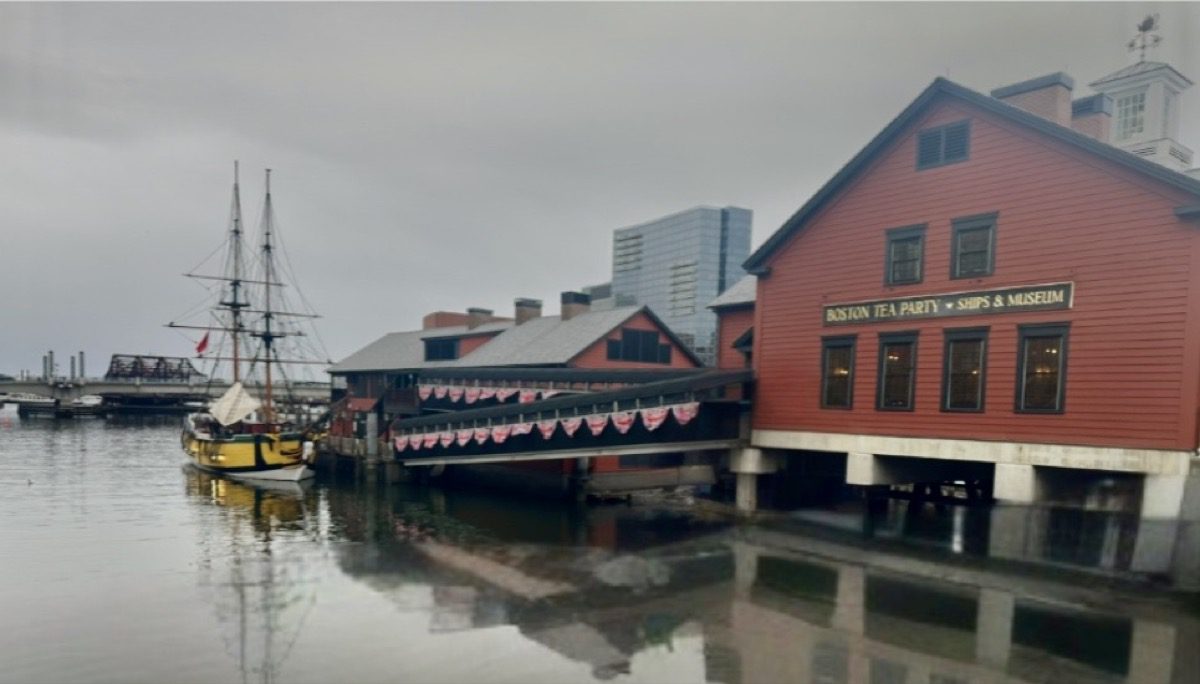
It was raining. I stood at the edge of the harbor and looked out at an eighteenth-century tall ship riding at anchor, its masts cutting the low grey sky. Behind it, forty floors of glass and steel rose without apology. Two centuries sharing the same frame. Neither one flinching.
Benjamin Rice
I walked inside and someone handed me a card.
Benjamin Rice. No explanation. No ceremony. Just pressed into my hand as I came through the door.
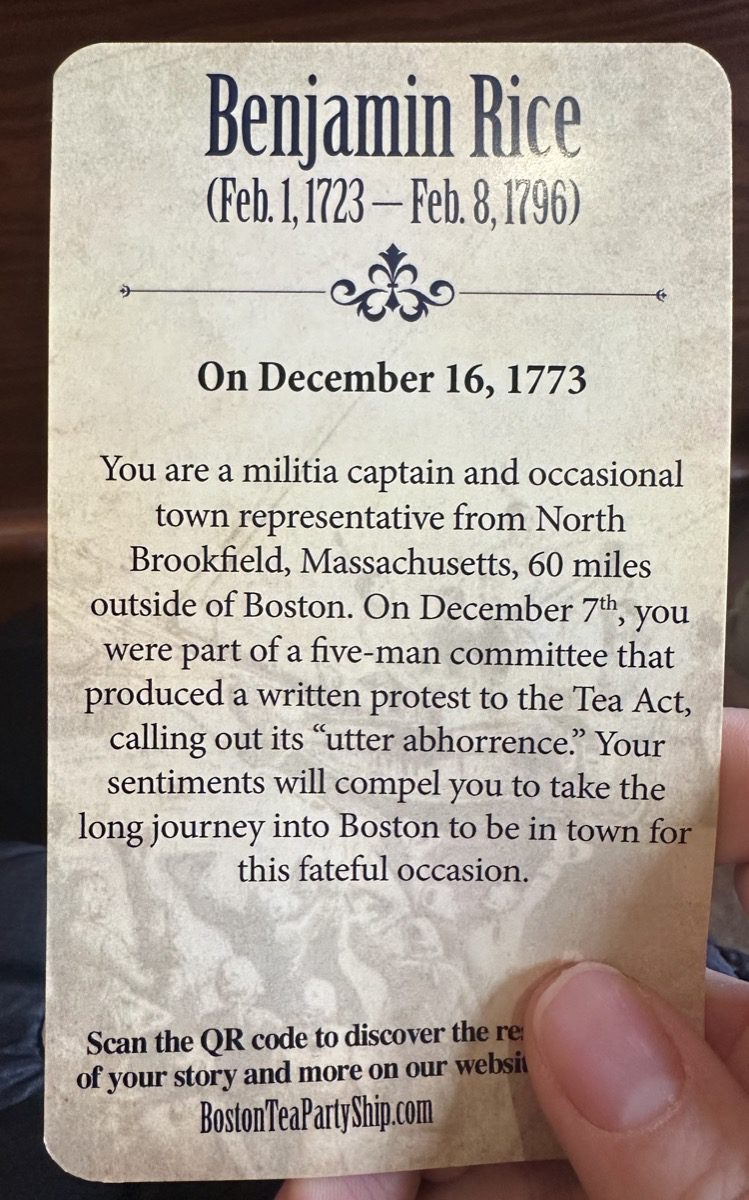
I read it slowly. Born 1723. Militia captain from North Brookfield, Massachusetts — a town sixty miles from where I was standing. In early December 1773, he had served on a five-man committee that drafted a formal protest against the Tea Act, the British Parliament’s decision to tax colonial America on tea without a single colonial representative having any say in the matter. Nine days after signing that document, he walked to Boston. Alone. Sixty miles. In December.
The back of the card offered one line of explanation: Your sentiments will compel you to take the long journey.
Not duty. Not strategy. Sentiments.
I held the card and walked toward the ship.
The Deck
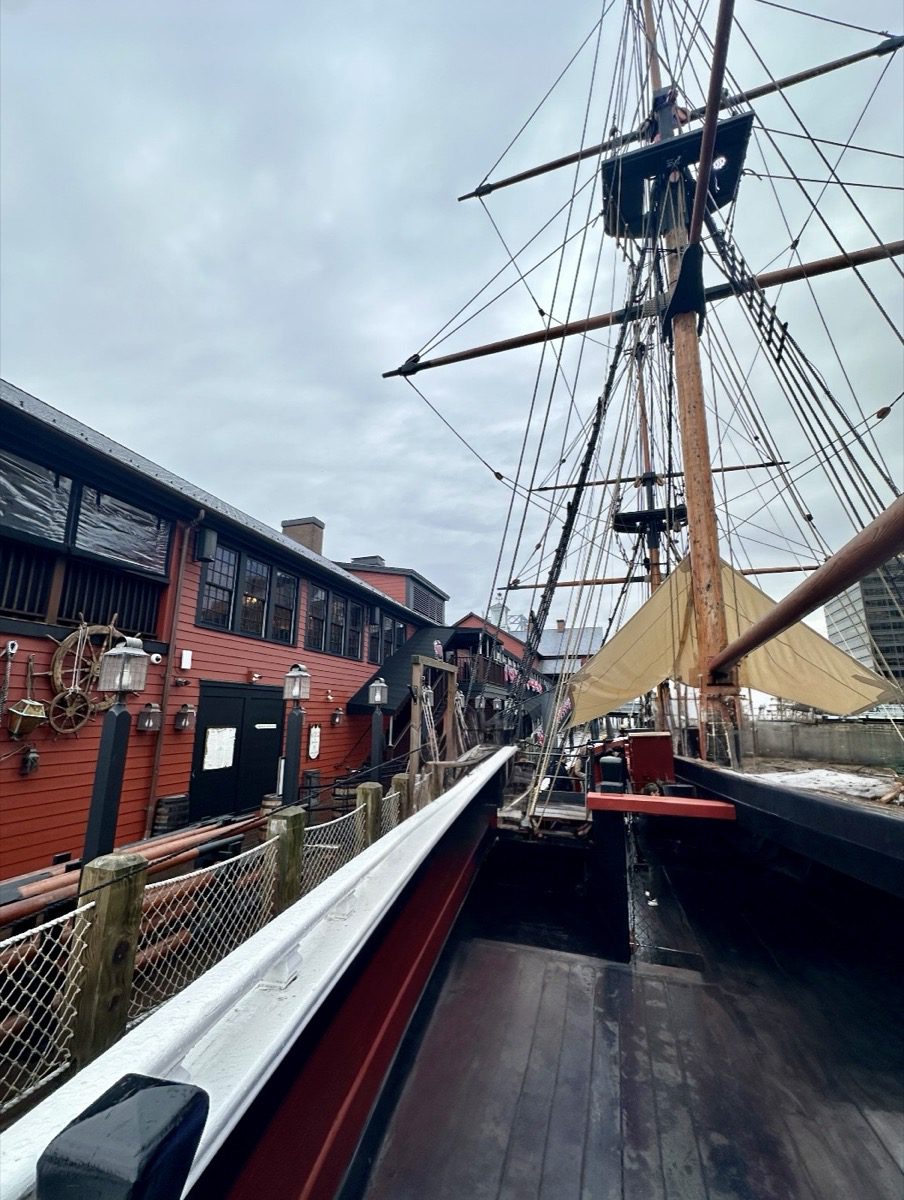
The deck was wet. A woman in a white apron and dark cape stood at the bow, her posture unwavering, her accent carefully period. She spoke about this night as though it were still happening — as though the outcome remained uncertain. Around her, visitors in down jackets held up their phones. The rain came down without drama.
It was, undeniably, a little awkward.
Then the tea chests appeared.
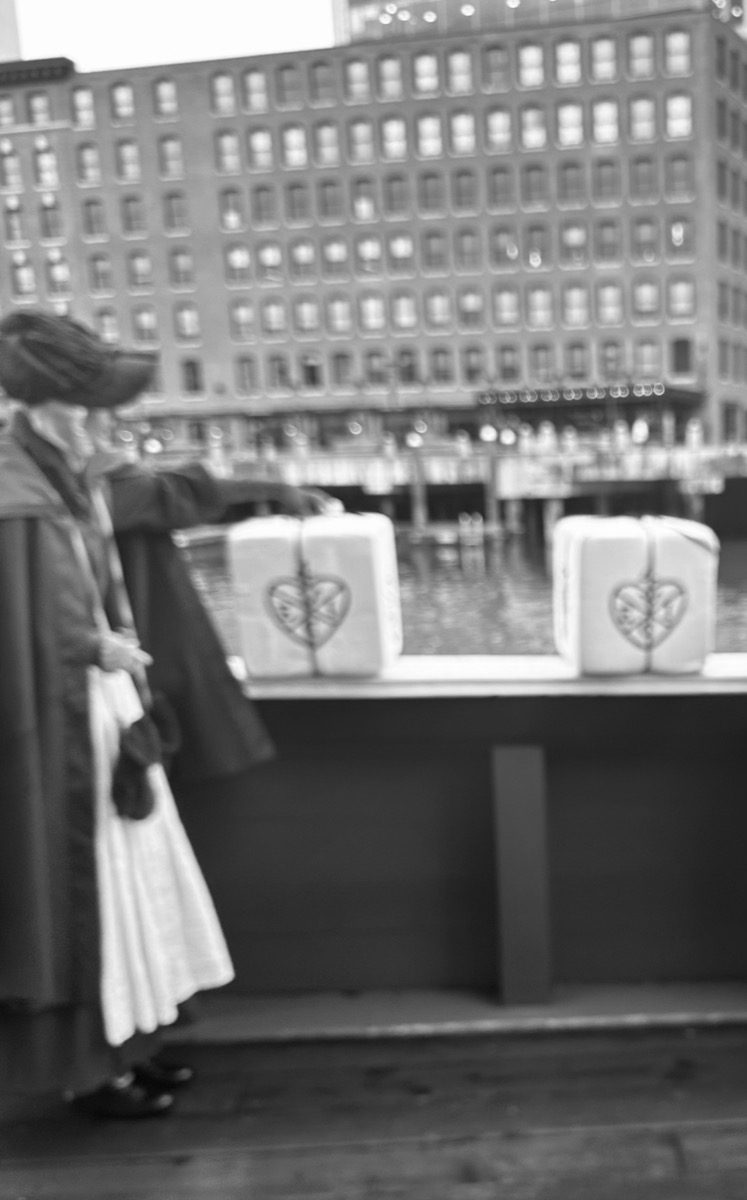
Foam props, East India Company insignia stamped on each side. Go ahead, someone said. Throw them.
A beat of silence. Then one person threw. Then everyone threw — laughing, filming, doing it again.
I didn’t throw.
I stood there watching, and the awkwardness and the gravity refused to cancel each other out. Because on the night of December 16, 1773, somewhere very close to where I was standing, it actually happened. One hundred and sixteen men boarded three ships — the Dartmouth, the Eleanor, the Beaver — and spent three hours emptying 342 chests of tea into Boston Harbor. Ninety thousand pounds of it. When they were done, they swept the decks clean. They took nothing. They left no trace beyond the fact of what they had done.
Revolution, it turns out, is methodical.
On the night of December 16, 1773, approximately 116 men — organized under the Sons of Liberty and disguised as Mohawk Indians — boarded three British ships docked at Griffin’s Wharf. Over three hours, they emptied 342 chests of tea into Boston Harbor. The cargo was valued at roughly £10,000 — close to $1.8 million today. When the work was done, they swept the decks clean. Nothing was stolen. Nothing was damaged except the tea. A protest designed to make one point, and no others.
Samuel Adams
Inside, a man in a tricorn hat stood elevated at a pulpit. He was playing Samuel Adams. Or he was Samuel Adams — in that room, the distinction blurred in ways that felt intentional.
He looked out over the assembled visitors and spoke with the gravity of someone who understood exactly what came next.
This meeting can do nothing more to save the country.
The room was quiet. In 1773, the people who heard those words walked out to the harbor.
The British Parliament’s response was swift and severe. In 1774, it passed the Intolerable Acts — placing Massachusetts under military rule. The backlash united the colonies in ways years of debate had not. Later that year, delegates gathered for the First Continental Congress. The following spring, the first shots were fired at Lexington. And on July 4, 1776 — two years and seven months after the tea hit the water at Griffin’s Wharf — fifty-six men signed their names to it.
Leaving
Leaving, I turned the Benjamin Rice card over one more time.
He is not in the history books. Not the way Adams is, or Revere, or Hancock. He was a militia captain from a small town who wrote a protest letter and then decided, for reasons the card called sentiments, that he needed to be there in person. Sixty miles in winter. No guarantee that any of it would matter.
I looked back at the harbor one last time. The water was still. Whatever was thrown into it that night — the tea, the anger, the argument that would not be settled any other way — had long since dissolved.
But here, two hundred and fifty years later, was the country it made.
Whether that was enough reason to walk sixty miles, I honestly couldn’t say.
Boston Tea Party Ships & Museum — Congress Street Bridge, Boston, MA 02210.
Timed entry; booking in advance is recommended, especially in summer. The experience runs approximately 60–90 minutes and includes both ships, museum galleries, and the living history program.
Hours: Daily 10 AM – 5 PM (extended hours in peak season). Admission: Adults $34.95 / Children $25.95.
Boston Harbor Hotel
Rowes Wharf — ten minutes on foot from Griffin’s Wharf, directly on the harbor. The same harbor. Floor-to-ceiling windows, Forbes five-star service, and a waterfront address that earns its rate. Condé Nast Traveler Readers’ Choice #1 in Boston, 2025.
Check availability →Omni Parker House
The oldest continuously operating hotel in the United States, open since 1855, sitting squarely on the Freedom Trail. Longfellow drafted Paul Revere’s Ride here. Every American president since Ulysses S. Grant has passed through. It is not a hotel that trades on history as decoration — it is history, still operational.
Check availability →Chart House Boston
Long Wharf. The building itself was once the John Hancock Counting House — named for the man whose signature on the Declaration of Independence was large enough, he said, for King George to read without his spectacles. New England seafood, harbor views, and a room that has been watching this waterfront longer than most. Order the lobster.
Leave a Reply