We all carry him in our wallets. Nobody ever asked who he was. Neither did I.
I lived six blocks from his grave for four years. Walked past it every morning. Never once went in.
That’s the thing about being young in a city — you’re so busy surviving it that you miss what it’s actually telling you. New York in 2004 was just a map I hadn’t learned yet. The subway lines were foreign. The skyline had a wound where two towers used to be. I was twenty-something, running late, carrying too many textbooks.
The city didn’t care. It never does.
Twenty years later, I came back. And it finally started talking.
Alexander Hamilton. America’s first Secretary of the Treasury, appointed by George Washington in 1789. Born in the Caribbean island of Nevis — no money, no family name, no connections. Arrived in New York as a teenager, alone. By thirty, he had designed the entire financial architecture of a new nation: central bank, national credit, the U.S. dollar. He died in 1804, shot in a duel by the sitting Vice President Aaron Burr. The only non-president on U.S. currency still in circulation. If you’ve seen the musical — this is where the story actually happened.
Trinity Church — The Door I Never Opened
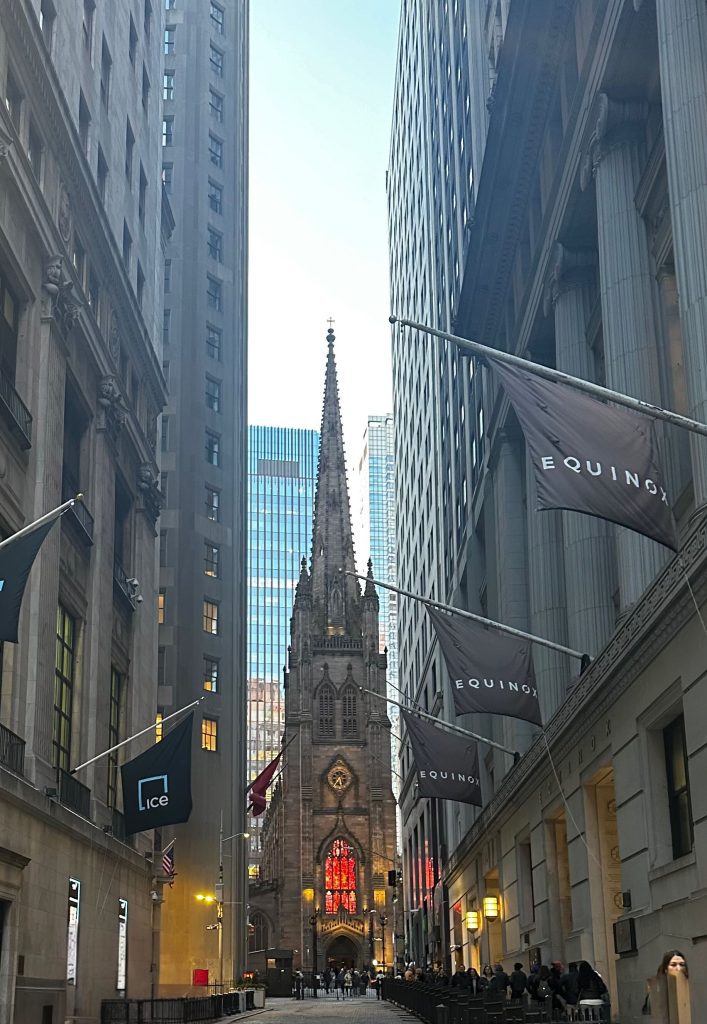
89 Broadway. A Gothic spire wedged between glass towers. As a student I cut through the front steps when I was running late. That was my entire relationship with one of the oldest churches in America — a shortcut.
Twenty years later I finally opened the door.
Stained glass throwing color across stone floor. The noise of the city — gone. Just like that. Outside, someone was closing a deal. In here, time moved differently.
I walked through to the south churchyard. Old trees, white marble monuments, the smell of winter stone. And at the end of a gravel path — a white pyramid.
Alexander Hamilton. 1755–1804.
At the base of the monument, $10 bills. Several of them, left by strangers. The man who designed America’s currency, still being paid in it. Two hundred years later.
Four years. Every single morning. I never knew he was here.
Hamilton came to New York the same way I did — knowing nobody, understanding nothing. He was seventeen. I was twenty-two. Two hundred years apart, same island, same starting point: complete overwhelm, and nowhere to go but forward.
The difference is what he built while he was here.
Bank of New York, 1784 — still operating today as BNY Mellon. Law practice on Wall Street. Cases that shaped American property rights. The financial district you’re walking through isn’t an accident. It’s what Hamilton deliberately built here, block by block, after the Revolution.
South churchyard — left as you face Trinity from Broadway. Look for the white marble pyramid. The $10 bills are almost always there. Go on a weekday morning before the tourists arrive. trinitywallstreet.org · 89 Broadway, NY 10006
84 William Street — The Building That Remembers
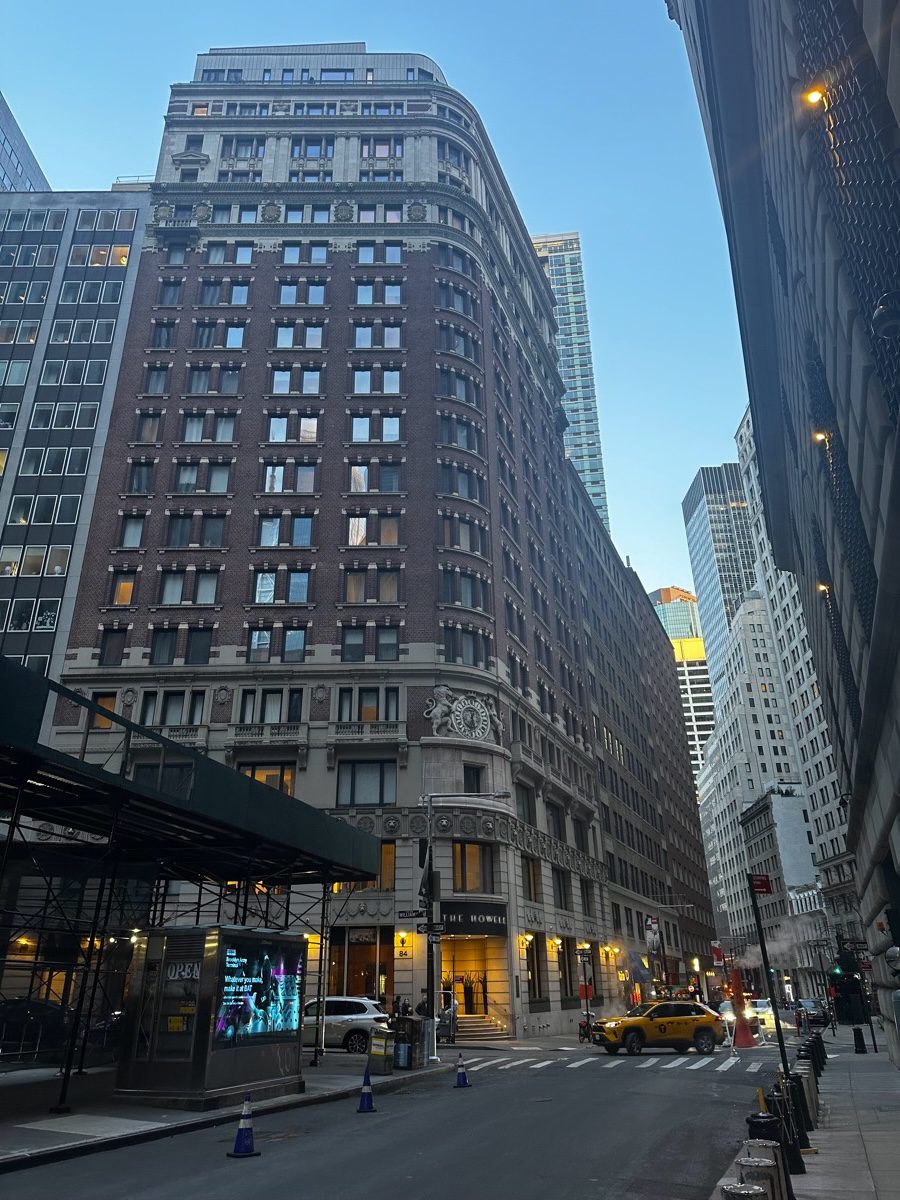
Two blocks from Trinity Church. I stopped without meaning to.
The building went up in 1907 — Neoclassical, lion carvings on the facade. Back then it was a dormitory where I ate bagels and drank black coffee and had no idea I was living inside one of the most consequential blocks in American financial history. Now it’s called The Howell. Luxury residences. The lions are still there.
Hamilton’s law office was on this street. His bank was two blocks away. The system he was building — the invisible architecture of credit and currency that would eventually become the most powerful economy in the world — he was working on it right here. And I was eating bagels on the same sidewalk, thinking about nothing except whether I’d finish my readings before class.
The city was always showing me. I just wasn’t ready to look.
Wall Street takes its name from an actual wall — a wooden palisade built by Dutch colonists in 1653. The New York Stock Exchange, founded in 1792 partly through Hamilton’s push to stabilize national finances, still stands two blocks from here.
Now The Howell — luxury residences, open lobby worth a look. thehowell.com · 84 William St, NY 10038
The Map He Left Behind
I spent that afternoon in the Trinity churchyard, reading about Hamilton on my phone. I missed every meeting I had scheduled.
I didn’t care.
Hamilton didn’t just build institutions. He built a logic — a way of thinking about money, credit, and national identity that was completely new. Before Hamilton, America was thirteen states with thirteen currencies and no shared future. After Hamilton, it was one economy.
He did all of it before he was forty. In a city he arrived in as a stranger. On streets I walked every day without knowing any of this.
The map doesn’t end here. It leads south to Philadelphia — where he built the First Bank of the United States, the physical home of everything he’d been designing in his head on these blocks.
Twenty years later, I’m still following his trail.
I just finally know I’m on it.
Leave a Reply