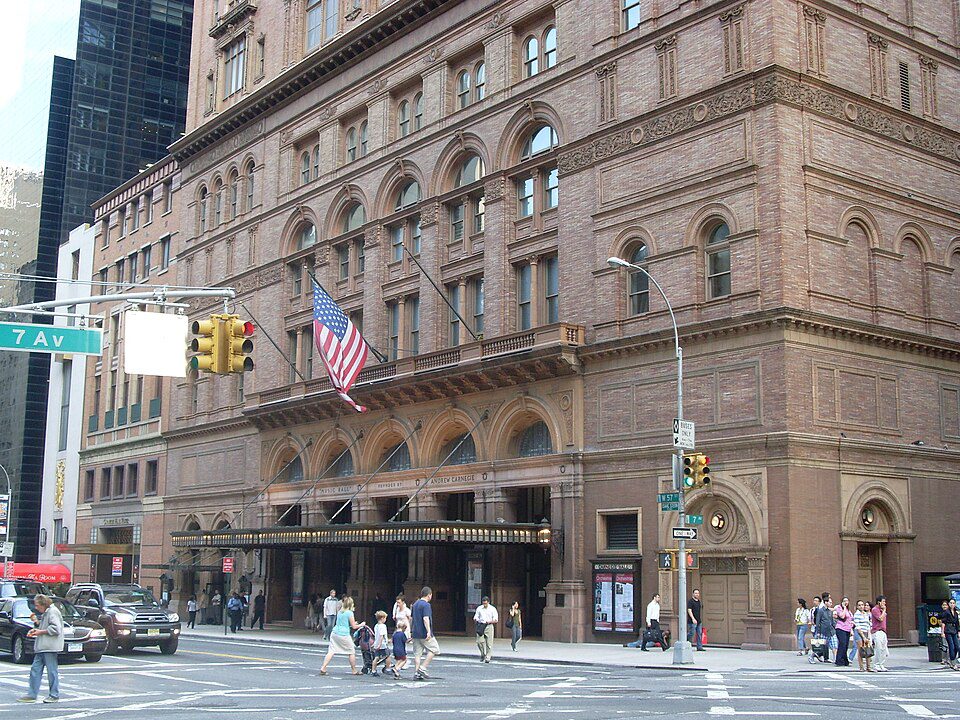
The name above the entrance reads Andrew Carnegie, cut into the stone above the arched doorway on 57th Street.
I must have walked past it a dozen times without reading it. The city moves fast enough that you stop seeing what’s written on things.
I started reading it when I sat down to write about him.
Carnegie Hall is not a museum. It is not a landmark in the way that landmarks are usually managed — roped off, reduced to what they once were. It is a working concert hall. On any given night, someone is on that stage. The lights go down, the room goes quiet, and whatever happened there before recedes into the dark behind the music.
That is what he built. Not a monument. A room that keeps being used.
A Boat, a Conductor, a Check
In the summer of 1887, Andrew Carnegie was crossing the Atlantic with his new wife Louise, on their way to Scotland for their honeymoon. Somewhere on that crossing, he got talking with a conductor named Walter Damrosch.
Damrosch ran the New York Symphony Society. He had one complaint he made to anyone who would listen: New York had no concert hall worthy of the name. The greatest city in the country, and nowhere fit to put a world-class orchestra.
Carnegie listened.
Construction began in 1890. By the following spring the building was done. On May 5th, 1891, it opened — and the man on the podium was Pyotr Ilyich Tchaikovsky, conducting his own music in his American debut, in a hall that hadn’t existed two years before.
Carnegie was in the audience. Whether he fully appreciated what was happening on that stage is not recorded.
The building was called Music Hall. The name Carnegie Hall came three years later, in 1894.
He hadn’t asked for it.
Tchaikovsky arrived in New York for the opening of Carnegie Hall in the spring of 1891 anxious and largely disoriented. He kept a small notebook of questions: what tobacco do New York men smoke, what do their hats look like, can laundry be sent out. He wrote in his diary that the audience’s reception on opening night moved him more than he had expected. He conducted his own music, took his bows, and sailed back to Russia. He was dead two years later. Carnegie Hall was the only American stage he ever stood on.
1960
Carnegie died in 1919. The hall remained.
For four decades it held on — through two world wars, through the Depression, through everything. Then in the late 1950s, Lincoln Center happened. The Philharmonic was moving uptown to a new home, and Carnegie Hall suddenly had no anchor tenant. The building’s owner began talking to developers. The math was straightforward: the site was worth more as an office tower.
A demolition date was set.
In December 1959, a violinist named Isaac Stern decided he wasn’t going to let it happen.
He organized. He lobbied. He sat in rooms with people who controlled things and made the case, over and over, that this was not a real estate question. In June 1960, the city bought Carnegie Hall for five million dollars.
The hall Carnegie built outlasted him. It also outlasted the decision to tear it down.
Today the main auditorium’s official name is Isaac Stern Auditorium. Not the man who built it. The man who saved it.
Isaac Stern was a violinist, not a civic activist. What he was, more than anything, was someone who understood that certain things don’t come back once they’re gone. In 1960 he organized the campaign that saved Carnegie Hall from demolition. He performed there for the next forty years. The auditorium now bears his name. He died in 2001. The building he refused to let disappear is still on the corner of 57th and Seventh, exactly where it has always been.
Lenox, 1919
Carnegie died on August 11th, 1919, at Shadow Brook — his estate in Lenox, Massachusetts. Pneumonia. He was eighty-three. A simple funeral in the music room, no ceremony, no speeches, as he had asked. His body was taken by train to Westchester.
In the eighteen years between selling Carnegie Steel and his death, he had given away roughly ninety percent of everything he had ever made. Libraries — more than 2,500 of them. Carnegie Hall. Carnegie Mellon. A pension fund for university teachers. A foundation for international peace. When the final count came in, the total was somewhere around 350 million dollars.
There was still thirty million left when he died.
That went to the foundations too.
The man who dies rich dies disgraced.
He had written that himself, in an essay called “The Gospel of Wealth.” He meant it. Whether he settled the account — whether Homestead could ever be balanced against two thousand libraries — is a question that has no clean answer.
He knew that too.
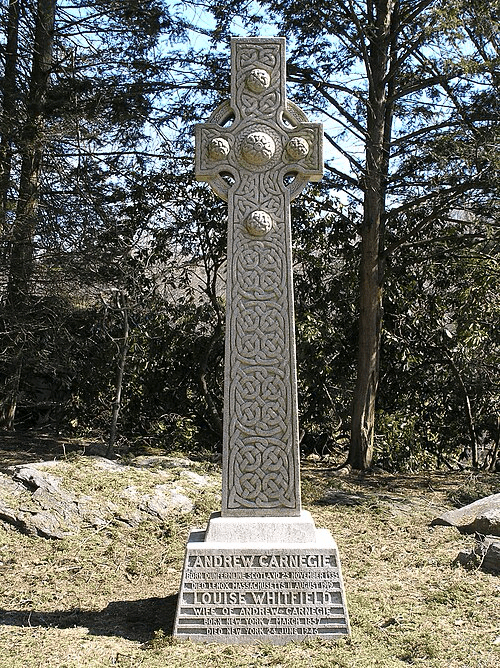
Carnegie is buried at Sleepy Hollow Cemetery in Westchester — named for Washington Irving, who is also buried there, and who arranged in advance for the cemetery to take the name of his most famous story. Carnegie’s headstone is a Celtic cross, cut from granite quarried at his Scottish estate and carved in Glasgow before the Atlantic crossing. A few hundred feet away, Samuel Gompers is buried: the labor organizer who spent his life fighting men like Carnegie. In death, they became neighbors. Visitors still leave coins on Carnegie’s grave. Whether as tribute, or as something harder to name, is difficult to say.
Carnegie Hall — 881 Seventh Avenue at 57th Street, Manhattan.
Tours run most days when the hall is dark. The Rose Museum, inside the building, traces the hall’s history from the 1891 opening to the present. Free with a tour ticket.
Performance schedule and tickets: carnegiehall.org
Leave a Reply