I saw The Lion King more times than I can count.
Times Square. One Astor Plaza. Third floor, Minskoff Theatre. The first time, the second time, and a few times after that. Every performance ended the same way — you walked out into the noise and light of Times Square and the night swallowed you whole. I never read the name of the building. One Astor Plaza. It was just the theater.
In college, I got off the subway at Astor Place. East Village. There were Japanese izakayas nearby — cheap, open late. We walked those blocks many nights. The station name was just a stop on the line. Whose name it carried never crossed my mind.
Later, when I started paying attention to architecture, the name Waldorf-Astoria kept appearing. Some resource I was reading — I no longer remember which one. An extraordinary hotel, it said. The architecture was unusual. I filed it away and moved on without asking why it was called that.
I photographed the New York Public Library. Inside, I noticed a hall. Astor Hall. High ceilings. Marble floors. I took a picture and kept walking.
I stood in front of the Empire State Building and looked up. 102 floors. I pressed the shutter.
Five separate moments, scattered across years. Each one unconnected from the others.
Writing this blog, I finally understood. They were all the same person.
The Butcher’s Son
Walldorf, Germany. 1763. The son of a butcher.
He arrived in New York at twenty-one with almost nothing. He started by selling furs — trading directly with Native tribes, pushing routes farther and farther across the continent. Then he took the money and bought land.
Manhattan. The unfashionable lots nobody wanted, the parcels far north of the developed city. He bought them and kept buying. He never sold. He simply held on. New York grew around him. The values rose. He did nothing, and the money multiplied.
That was his strategy. It required no particular genius. Only patience, and the refusal to let go.
When he died in 1848, his estate was valued at twenty million dollars — roughly one percent of the entire U.S. GDP at the time. Rockefeller, Vanderbilt, Carnegie: not yet born, or still children. He was America’s first true millionaire, and he got there before any of them.
Someone asked him, near the end of his life, what he would do if he could start over.
“I would buy every foot of land on the island of Manhattan.”
There was regret in that. He could have bought more.
In his will, he left $400,000 to establish a public library. That bequest became the foundation of what is now the New York Public Library. The hall inside still carries his name.
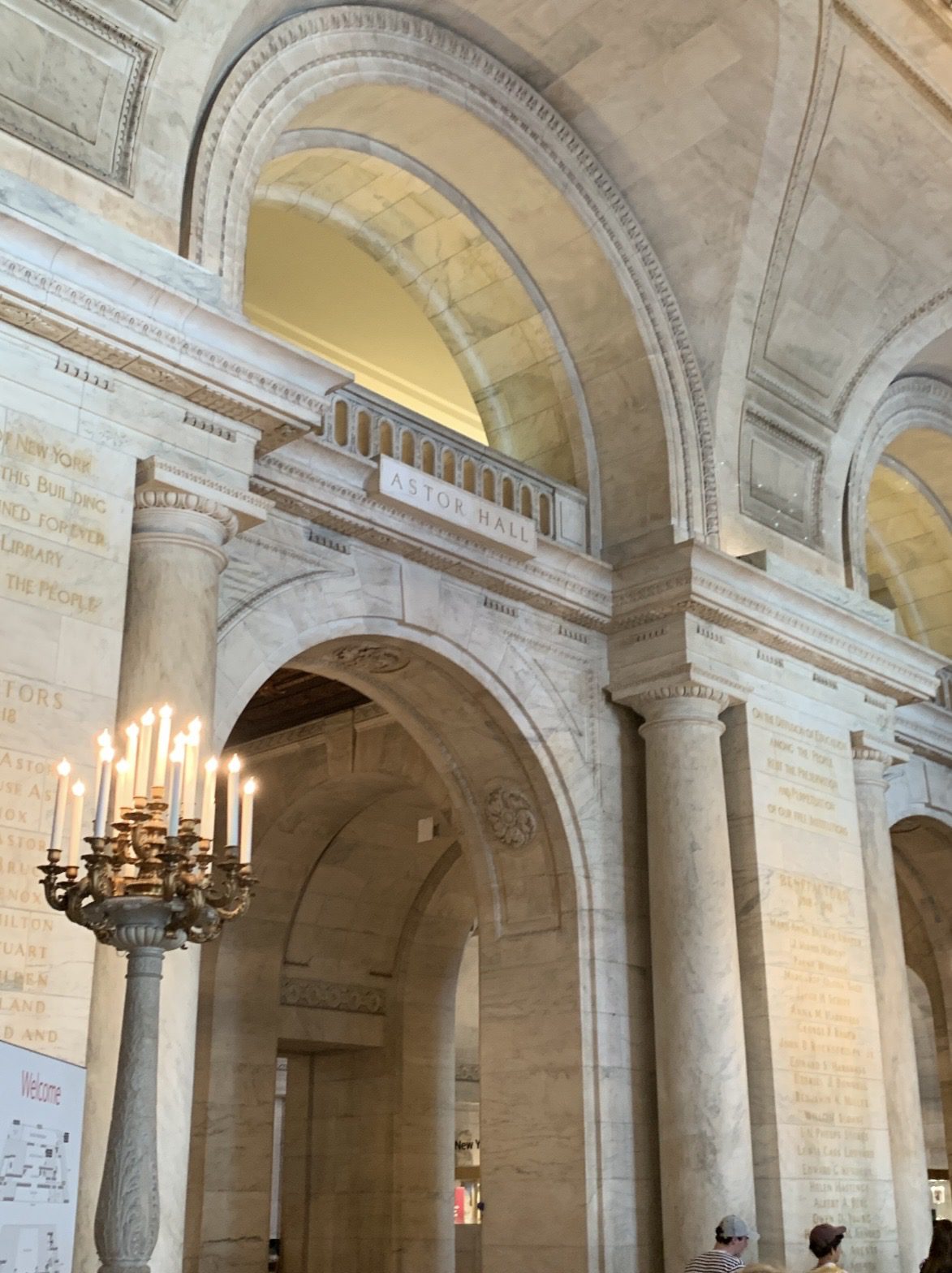
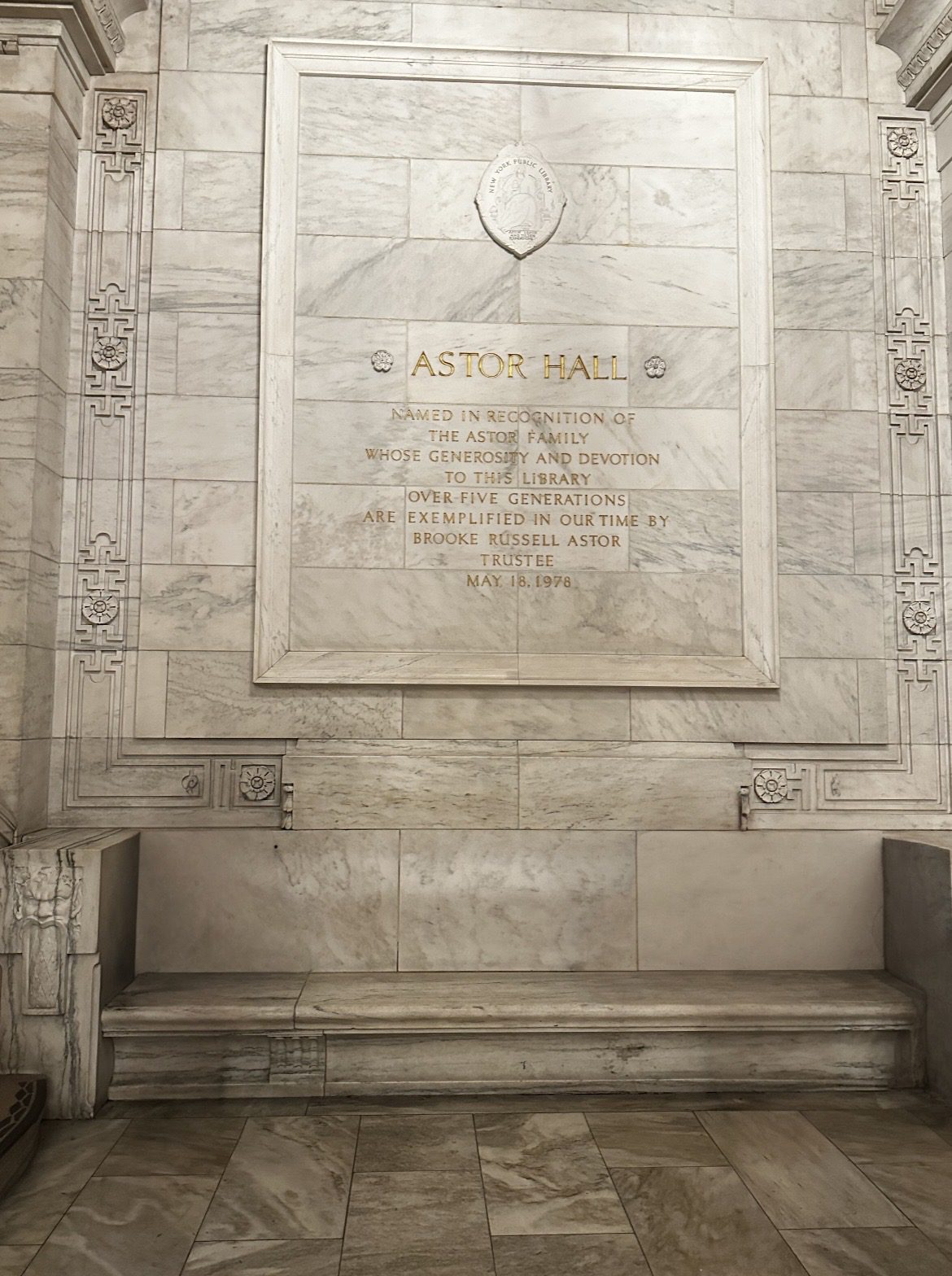
On the wall, there is a marble plaque. It reads:
Named in recognition of the Astor family, whose generosity and devotion to this library over five generations are exemplified in our time by Brooke Russell Astor — Trustee — May 18, 1978.
Five generations. The last name on that plaque is Brooke Russell Astor — the wife of the man whose father died on the Titanic. She gave away nearly two hundred million dollars to New York City before her death in 2007 at the age of 105. Her son was later convicted of stealing from her estate.
I walked past that plaque without reading it. I had no idea whose name I was standing under.
Build a Hotel Next Door
The fortune passed down through generations. By the third, it had reached two cousins.
They grew up in side-by-side mansions at the corner of Fifth Avenue and 34th Street. They did not get along.
One moved first. He demolished his own mansion and built a thirteen-story hotel directly next to his cousin’s home. The Waldorf Hotel. 1893.
He knew exactly what he was doing. A hotel meant strangers at all hours, luggage at the entrance, noise, staff, the relentless movement of a commercial building pressed against a private home. He built it anyway. It was not a business decision. It was a message.
His cousin held out for a while. Then he made his own decision. He would tear down his house too. He would build taller. Seventeen floors. He hired the same architect.
Eventually the two buildings were joined by a 300-foot marble corridor. Not a reconciliation — a business arrangement. The corridor was called Peacock Alley, after the fashionable men and women who paraded through it to be seen. The combined hotel became known simply as “The Hyphen.” Waldorf-Astoria.
Two buildings born from a family feud became the most famous hotel in the world. Royalty stayed there. Presidents stayed there. A single dinner cost $250 — an almost unimaginable sum at the time.
One cousin eventually left for England. The press had worn him down. He emigrated, took British citizenship, and was eventually made a Viscount. The other stayed in America.
That choice — to leave or to stay — would define everything that followed. But neither of them could have known that yet.
The two cousins were sixteen years apart in age. One left for England and became a British peer. The other remained in America and died on the Titanic. In April 1912, the one in England received the news from across the Atlantic. Their relationship had never been warm. What he thought when he heard, no record survives to tell us.
Jupiter, 2000 A.D.
The cousin who stayed was not a simple real estate heir.
He patented a bicycle brake. He invented a pneumatic road-improvement device. He fought in the Spanish-American War — not as a figurehead, but at his own expense, financing an artillery unit and serving as a lieutenant colonel in Cuba. He came home with the rank of colonel. People called him Colonel Astor for the rest of his life.
And he wrote a novel.
1894. Science fiction. The title was A Journey in Other Worlds. Set in the year 2000, it follows a voyage to Jupiter and Saturn.
The Wright Brothers had not yet flown. The automobile had barely arrived. Among the men of his class — men who summered in Newport, who sailed private yachts, who built hotels to spite their relatives — not one of them imagined Jupiter. He did.
The land could be bought, the hotels built taller, the wars fought and won. And still. Not backward into the past, like Morgan retreating into his Renaissance library. Not inward into legacy, like Carnegie building monuments to his own guilt. Something else — forward, into a century that hadn’t arrived yet.
Whether that was ambition, or loneliness, or simply the restlessness of a mind that money couldn’t occupy — there’s no way to know.
In the spring of 1912, he boarded a ship with his young wife. She was pregnant. They had been traveling through Europe and Egypt, waiting for the gossip about their marriage to quiet down — he was forty-seven; she was eighteen. They wanted the child born on American soil. American soil. The land his family had spent a century accumulating, block by block.
The ship was the Titanic.
He was the wealthiest passenger aboard. His net worth was approximately $87 million — nearly three billion dollars in today’s terms. The man who had imagined the year 2000 was standing on the most advanced vessel human engineering had yet produced. He had said as much himself, to another passenger: “She’s unsinkable, a modern shipbuilding miracle.”
On the night of April 14th, the ship struck an iceberg.
He lifted his pregnant wife through a porthole window and placed her into Lifeboat 4. Then he stepped back onto the deck. Witnesses said he was calm. He watched the boat descend, leaned against the railing, and lit a cigarette.
At 2:20 in the morning, the ship disappeared beneath the surface.
His body was recovered a week later by a cable ship in the North Atlantic. He was identified by the initials sewn into the lining of his jacket. In his pocket was a gold watch. His son kept it for the rest of his life.
The Land Remained
After he died, the Waldorf-Astoria continued without him. By 1929, the hotel had grown dated — fashionable New York had moved north, well past 34th Street — and it was sold. The building was demolished. In its place rose the Empire State Building.
The building I photographed without knowing what had stood there before.
The hotel name moved uptown to a new Art Deco tower on Park Avenue, which opened in 1931. That building passed to Hilton, then in 2014 was purchased by a Chinese insurance company for $1.95 billion — at the time, the most expensive hotel sale in history. After eight years of renovation, it reopened in 2025. It is now for sale again.
Where the Hotel Astor once stood in Times Square, there is now an office building. One Astor Plaza. On the third floor, there is a theater. I saw The Lion King there. Several times. I walked out every time into the light of Times Square without reading the name above me.
The fortune he left behind passed to his son. The son was troubled by what the family had been — landlords who extracted rents from tenants who had nowhere else to go. He sold assets. He started a foundation. When he died in 1958, he left everything to his wife, Brooke. She gave nearly $200 million back to the city — to hospitals, libraries, community programs. She died in 2007 at 105. Her son was convicted of stealing from her estate. That was the end of the American Astors.
The name the butcher’s son carried out of Germany in 1783 now belongs to a building owned by a Chinese state-backed insurance company on Park Avenue.
The cousin who left for England never lost his footing. His descendants held onto their title and stayed close to British power. The 4th Viscount Astor is a member of the House of Lords and the stepfather of Samantha Cameron — wife of former British Prime Minister David Cameron. Same family, same starting point. One line ended on the Titanic. The other is still in the room where decisions are made.
The tile mosaics at Astor Place subway station — 1904, one of the original twenty-eight stops on the New York City line — are decorated with beavers. A tribute to the fur trade that started everything. Every day, thousands of people walk past them on the platform without stopping.
I got off at that station for years.
I never looked down.
Leave a Reply