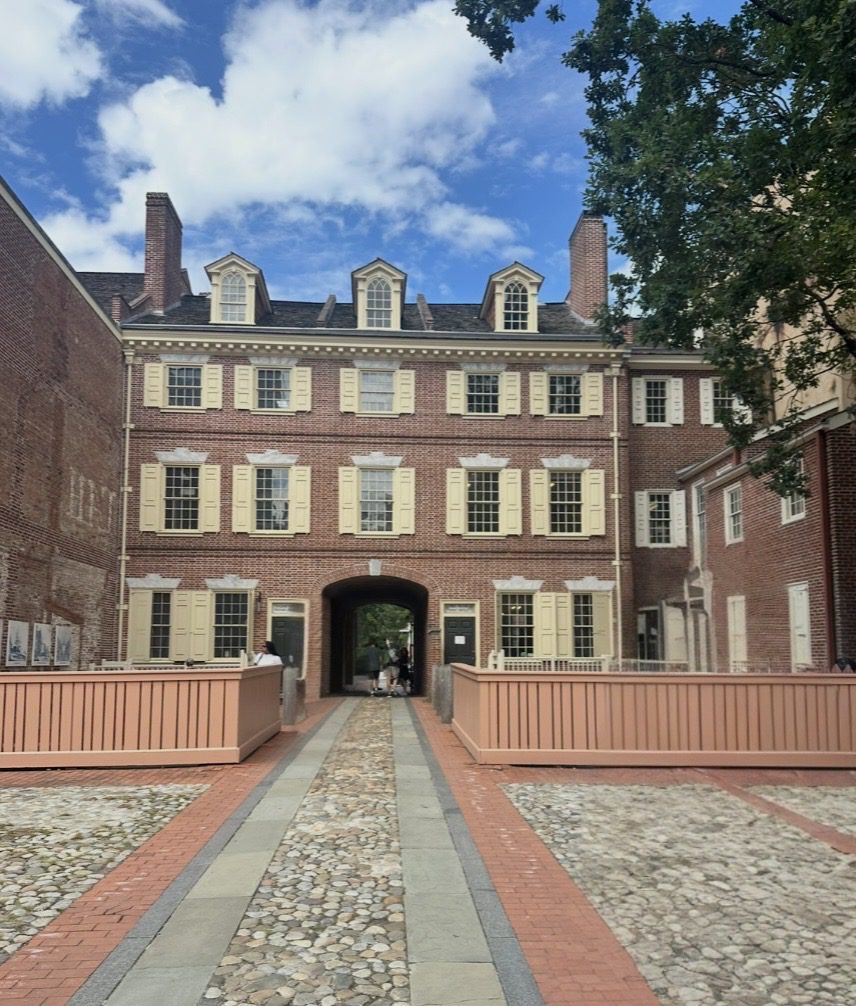
I didn’t know what I was looking at when I walked into Franklin Court.
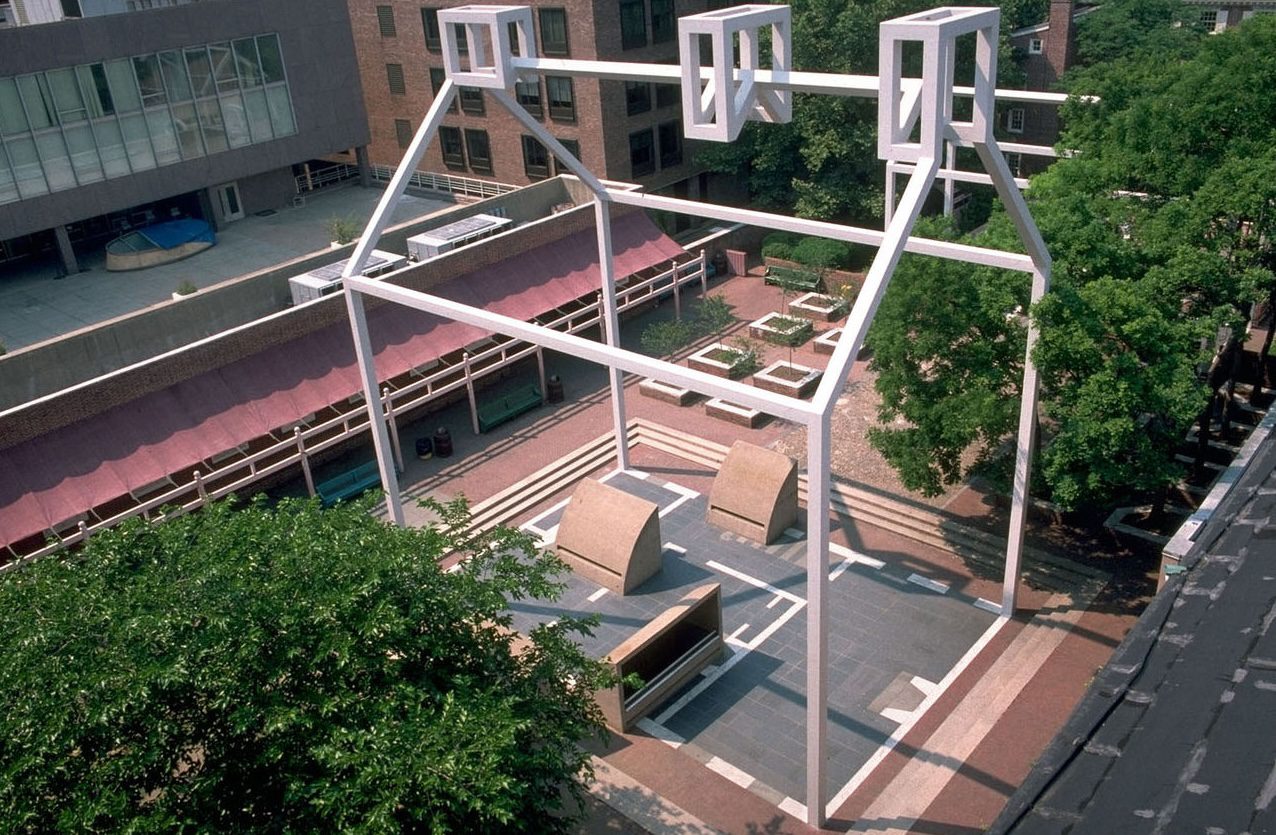
Narrow arch off Market Street, easy to miss. I went through it on a slow afternoon with no particular plan, and on the other side I found a courtyard with two enormous white steel frames standing in it — the shape of buildings, roughly, except with no walls and no roof and nothing inside them. Just the outline. I stood there trying to understand what I was looking at and eventually read the marker.
Benjamin Franklin’s house had been here. Torn down in 1812. The steel frames had gone up in 1976 to mark where it stood, because by then nobody knew enough about the original to rebuild it. This was the best anyone could do: the shape of something gone.
I took a photo and left. On the way home I thought about the face on the hundred-dollar bill, and why I had never wondered about it before.
The Bill
Pull a hundred out of your wallet and look at it.
That’s not a president. Washington is on the one. Lincoln is on the five. Hamilton — who has had some help lately, from a cast album and a sold-out run — is on the ten. Every other face on American currency held the office. Franklin never did. He’s been on the hundred since 1914, through three major redesigns, through security threads and holograms and color-shifting ink, and the question of replacing him has simply never come up.
Turn it over. On the back: Independence Hall. The building where Franklin arrived by sedan chair on the mornings his gout was bad enough that walking wasn’t an option.
Two questions. Why him? And why, given everything, not the presidency?
Franklin is the only person on circulating U.S. currency who never held elected federal office. He is also the only Founding Father to have signed all three of the documents that established the United States: the Declaration of Independence, the Treaty of Paris, and the Constitution.
Twelve
He started in his brother’s print shop at twelve. Setting type, inking the press — the unglamorous physical labor of eighteenth-century publishing. By seventeen he’d fought badly enough with his brother James to make staying impossible, slipped out of Boston without permission, taken a boat to New York, found nothing, walked across New Jersey, and caught a small vessel going down the Delaware. He came ashore at the Market Street wharf — a few blocks from the arch I had just walked through — on the morning of Sunday, October 6, 1723. He had almost nothing in his pockets.
He was nobody yet.
What came next defies summary. Print shop. Newspaper. Poor Richard’s Almanack, ten thousand copies a year, written under a fake name. Lightning rod. Bifocals. Franklin stove. Public library. Fire company. Hospital. The academy that became the University of Pennsylvania. He finished most of this before sixty.
Then he entered politics. He was just getting started.
Paris
October 26, 1776. Congress sent him to France.
Seventy. Gout. Five weeks on the Atlantic. America was losing — the Continental Army was short on everything — and France was the only country with both the means and the reason to change that. They sent the most famous American alive and hoped.
Franklin didn’t negotiate. He performed. Dinner parties. Chess with aristocrats. Deliberately bad clothes — fur cap, plain brown coat — at Versailles, among powdered wigs and silk. The French had decided what they wanted him to be: the philosopher from the wilderness, the genius of the New World. Franklin understood this clearly enough to give it to them with complete precision.
In February 1778, after news of Saratoga reached Paris, France signed the Treaty of Alliance. The Revolution had its turning point.
Nine years he stayed. When he finally came home in 1785, the war was won, he was nearly eighty, and he wanted — badly, by his own account — to rest.
Pennsylvania asked him to serve as governor. He was seventy-nine. He said yes.
The President
He held the governorship for three years. Then the Constitutional Convention: oldest delegate at eighty-one, four months in a sealed room through a Philadelphia August, saying very little and signing at the end because he thought the country needed it more than he needed to be right.
By 1789, when the first presidential election was held, he was eighty-three and couldn’t leave the house.
Washington was fifty-seven.
That’s one answer. The other is that Franklin may have understood, better than anyone in that room, that the office itself wasn’t the point. He had secured the alliance that won the war. He had negotiated the treaty that ended it. He had signed the Declaration and the Constitution — the only Founder to sign all three of the documents that made the country. He had spent fifty years building things that outlasted him, and he had done it without needing his name anywhere in particular.
It ended up on the money instead. The largest bill. The one nobody spends carelessly.
I went back to Franklin Court once more, in the late afternoon when the tourists had thinned out. The steel frames were still there against the sky — the shape of the house, not the house. I thought about what it means to mark something you can’t reconstruct. Whether the outline is enough. Whether it ever is.
I didn’t come to a conclusion. I don’t think Franklin would have minded.
Franklin Court — Between Market and Chestnut Streets, Old City. Enter through the brick passageway on Market Street or the gate from Chestnut. Free to enter. The Benjamin Franklin Museum below the courtyard charges a small admission fee. Hours vary by season. nps.gov/inde
Penn’s View Hotel — 14 North Front Street, Philadelphia, PA 19106.
Forsythia — 233 Chestnut Street, Old City. Dinner nightly; happy hour Monday through Friday from 4:30 p.m.
Leave a Reply