The man who watched John Brown hang went on, six years later, to walk into a theatre on 10th Street.
I had been carrying that thread since Harpers Ferry — the small brick building, the Fort, the question it leaves you with. Ford’s Theatre was always on the list. What I didn’t know, until I got there, was the building directly across the street.
But first, the theatre.
Brick facade. Five arches. From the outside, an ordinary building on an ordinary block. Until you walk in.
Booth came from one of the most famous acting families in America. His father and brother were celebrated stage actors. He was well-known himself — charming, successful, recognizable. A passionate supporter of the Confederacy. In 1859, he stood in the crowd at John Brown’s execution, serving in the Virginia militia.
His original plan wasn’t assassination. He wanted to kidnap Lincoln and exchange him for Confederate prisoners of war. When the South surrendered in April 1865, the plan changed. On the night of April 14, he walked into Ford’s Theatre — a place he knew well, having performed there many times — and found the presidential box unguarded.
The Dark Red
The color hits you first.
Not bright red. Dark red. Curtains, carpet, walls — the whole theatre is saturated in it. Not garish. Heavy. As if that color has been holding the night of April 14, 1865 ever since.
What you see inside is a restoration from 1968, rebuilt to match the 1865 appearance. Not the original carpet, not the original curtains. But the stillness it creates is real. There are things a restored space can make you feel that a perfect replica never could.
I stood in the aisle and looked up at the Presidential Box. 1,700 people sat in these seats that night. The play was a comedy. People were laughing.
The Timeline & The Gun
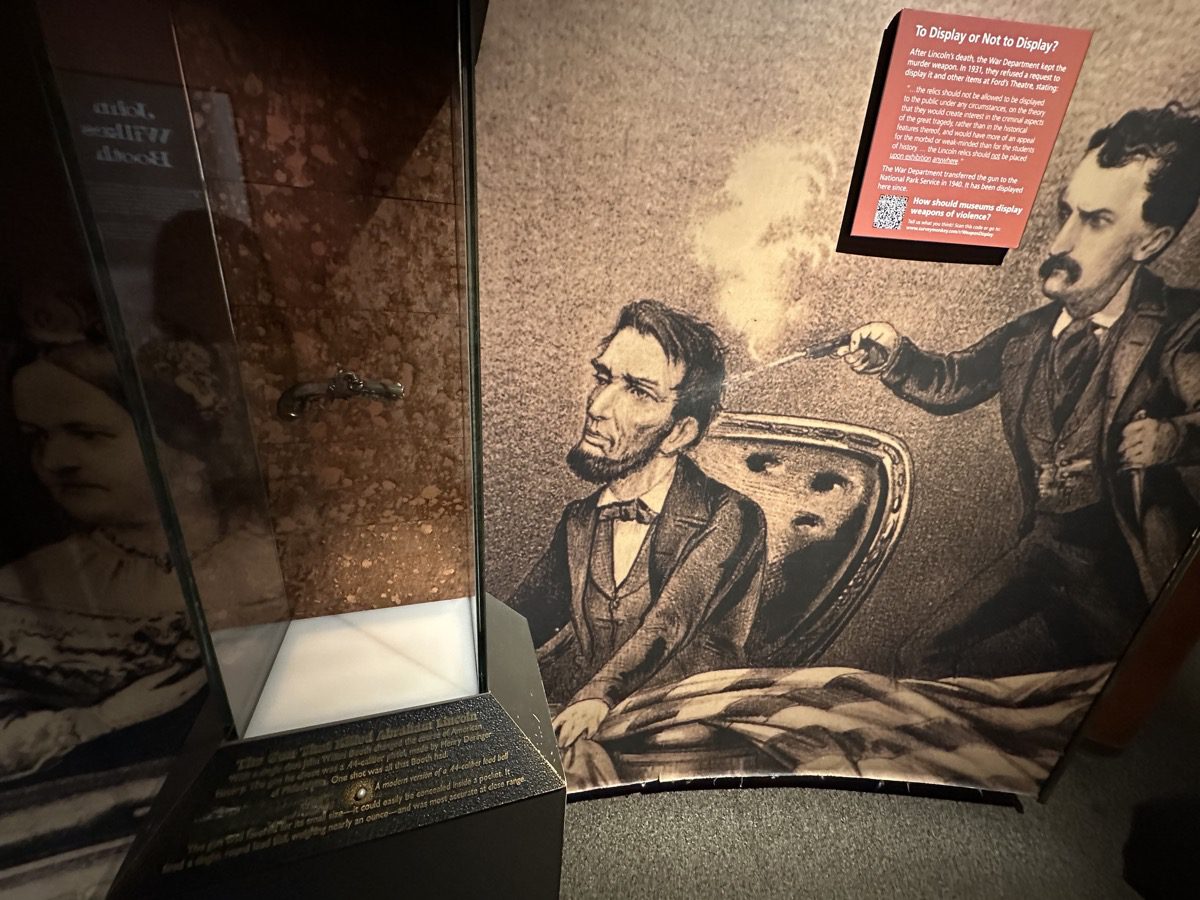
Inside the museum, there’s a timeline of that night.
Lincoln’s movements. Booth’s movements. Two separate lines, mapped in minutes, moving toward the same point. What time Lincoln’s carriage arrived. What time Booth entered. What time the shot was fired.
Watching two people’s paths converge like that — minute by minute, without either of them knowing — is unsettling in a way that’s hard to explain.
And then the gun.
A .44 derringer. Booth carried it in his pocket. It fits in a palm. The exhibit room was dark — the whole space felt deliberately dim, heavy. Standing in front of that glass case, something felt wrong about being there. That felt like the right response.
April 14, 1865 was five days after General Robert E. Lee surrendered at Appomattox — effectively ending the Civil War. Lincoln had led the country through four years of the bloodiest war in American history. He didn’t want to go to the theatre that night. Records suggest he was exhausted and would have preferred to stay home. But the presidential party’s attendance had already been announced publicly, and he didn’t want to disappoint.
The play was a comedy called Our American Cousin. The last thing Lincoln heard before the shot was the audience laughing.
The Presidential Box
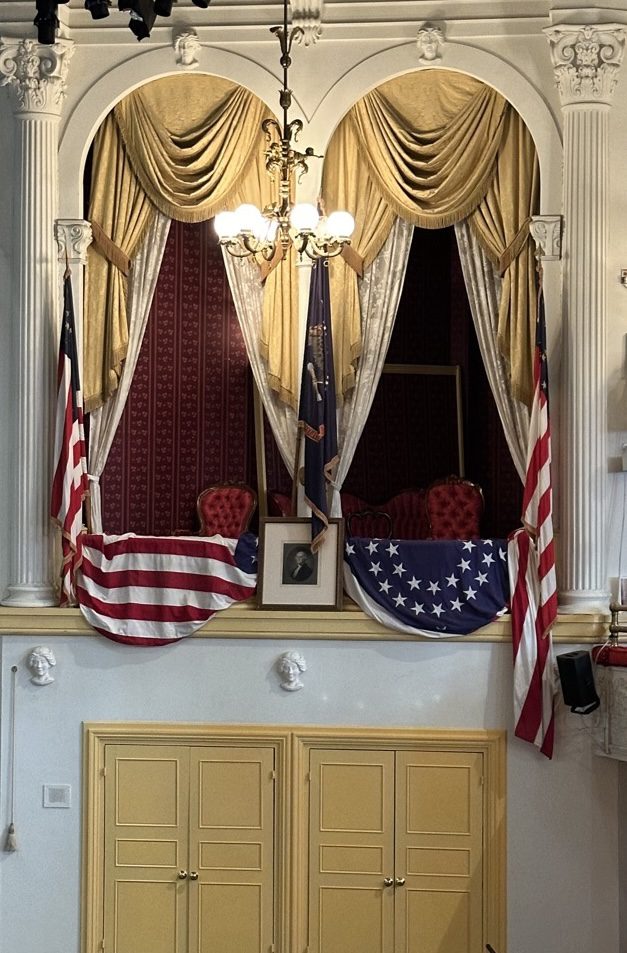
Upper right. Draped in flags, a portrait of George Washington hanging between them. It looks the same today as it did that night — the theatre dressed it specially for the president’s visit.
The guard assigned to the box had left his post. Booth came through the door. The shot went off at 10:15 p.m. Booth leaped from the box to the stage — a drop of about twelve feet — and broke his left leg on landing. He shouted something, ran, and was gone.
I stood on the theatre floor and looked up at that box for a long time. Nothing came out. Some spaces just don’t give you words.
Petersen House — The Smaller Space
I hadn’t known about Petersen House before that day.
Ford’s Theatre I knew. The assassination, the box, the gun — all of it. But when I came out of the theatre and saw the building directly across the street, with a small sign and a line of people waiting, I stopped.
After the shot, Lincoln was carried out of the theatre. The doctors said he wouldn’t survive a carriage ride to the White House — too far, too rough. Someone pointed to the house across the street. They carried him in through the front door, down a narrow hallway, to a small back bedroom. Lincoln was too tall for the bed. He lay diagonally. Nine hours passed.
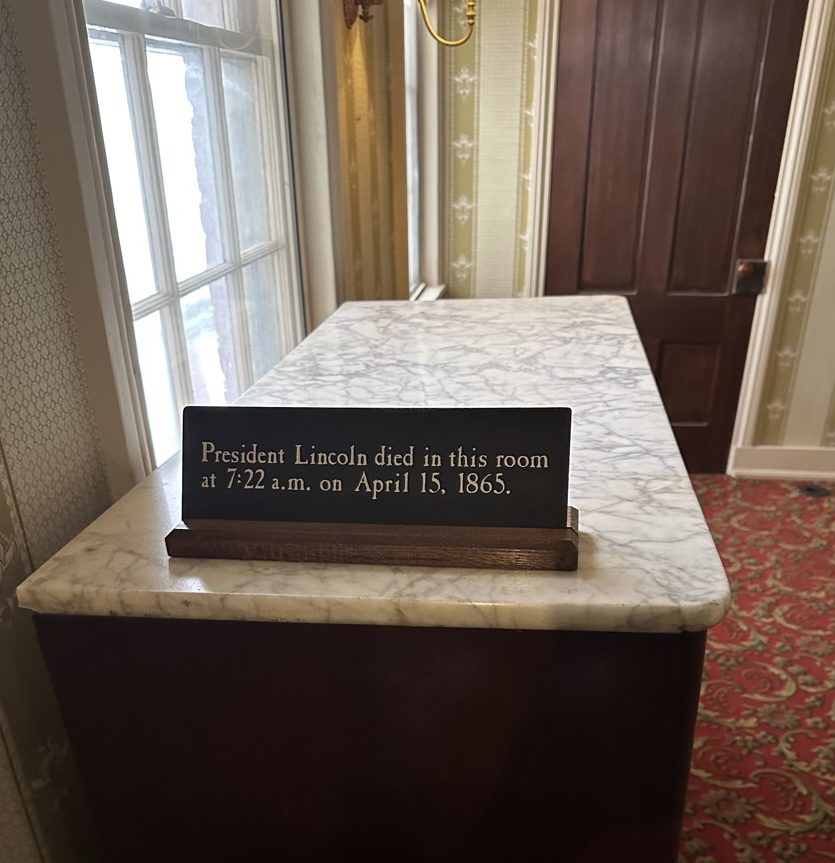
At 7:22 a.m. on April 15, 1865, he died in that room.
Standing in the doorway, I could see the sign on the dresser. Close enough to almost touch. The room was small — smaller than you expect for the last place of someone this large in history. A stranger’s back bedroom. A bed he didn’t fit in.
The John Brown Fort came back to me. A small brick building, 35 by 24 feet. History’s biggest moments keep ending in the smallest spaces.
When Lincoln died, Secretary of War Edwin Stanton stood in that room and said: “Now he belongs to the ages.”
Epilogue
John Brown died in Charles Town, Virginia. Lincoln died in a stranger’s back bedroom on 10th Street. Both ended in small spaces, with no way out.
Hamilton designed the system. The Liberty Bell named the ideal. Brown walked into a Fort. Lincoln died trying to hold it all together.
Four posts. One thread.
And the thread continues. What Lincoln fought for — a united country, freedom, democracy on record — is waiting at the next stop. On the banks of the Potomac. In a building with his name on it.
Next: The Lincoln Memorial — and the steps where another chapter of that same story was written.
Leave a Reply