Winter in Washington D.C. turns everything gray. The sky, the stone, the faces of strangers.
I arrived at the National Archives on a December morning and found a line already stretching along Constitution Avenue. People stood in silence, collars turned up against the cold. Some were tourists. Some were students. Some had come alone. No one complained. The wait stretched past thirty minutes.
I found this strange. We had all seen photographs of what waited inside — printed in textbooks, posted online, reproduced ten thousand times over. And yet here we stood, in the cold, waiting.
The Line in Winter
Entrance was like passing through an airport. Bag off, belt off, eyes forward through the security checkpoint. The guards were quiet and thorough. My body understood, before my mind caught up, that this was not an ordinary museum.
The National Archives building was designed by architect John Russell Pope — the same architect behind the Jefferson Memorial — and completed in 1937. Pope envisioned it as a temple to American democracy. The Rotunda lighting is dimmed to the equivalent of two candles at one foot: the minimum needed to see the documents without damaging them. The Declaration of Independence, the Constitution, and the Bill of Rights have been on permanent display here since 1952, sealed in argon-filled, bulletproof encasements monitored by technology developed for NASA.
The Shrine
The Rotunda swallowed the light the moment I stepped inside.
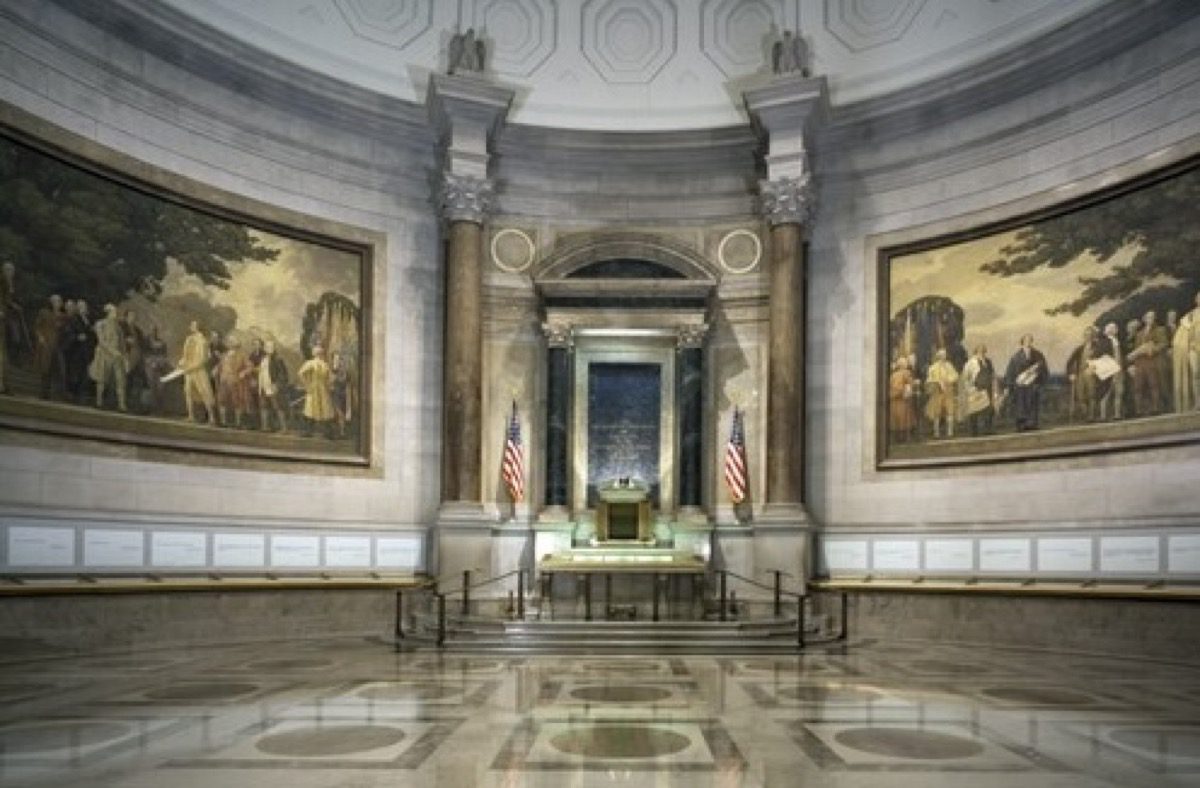
It was not darkness — it was control. The air itself felt deliberate, cooled and filtered. The domed ceiling curved overhead. Along the curved walls, two enormous murals by Barry Faulkner depicted the Founders: Jefferson presenting the Declaration, Madison offering the Constitution. Their figures watched from the shadows.
The word that came to me, unbidden, was shrine. A shrine built by a nation for itself. And at the altar, behind bronze-framed bulletproof glass, the parchment waited.
The Handwriting
I had been to Philadelphia. I had stood in Independence Hall — the room where the Declaration was debated and signed in the summer of 1776. I had seen the Liberty Bell. What I felt there was the weight of place: the floors, the walls, the windows, the specific air of a room where history happened.
What I felt here was different.
Behind the thick glass, the Declaration of Independence lay on its parchment. The ink had faded — more than I expected. Some lines had thinned to near-invisibility. The paper had aged into something closer to skin than document. I pressed my face toward the glass.
This was their handwriting. Jefferson. Franklin. Adams. These names that had lived in textbooks, remote and untouchable — the letters on this page came from their hands. A quill dipped in ink, pressed to parchment, drawn across in the particular way that each man held a pen.
I came specifically for the Declaration. Not for the building, not for the archives, not for the other documents — though I paused at the Constitution, and again at the Bill of Rights. I came because I had stood in the room where it was written, and now I wanted to see the thing itself.
No cameras were permitted. I put nothing away to take home. I only looked, for as long as I could.
Original
Independence Hall is where it was declared. The National Archives is where it exists. One is the place of the act. The other is the place of the object.
A reproduction carries the same words. A high-resolution scan shows more detail than my eyes could find through that glass. And yet something is present in an original that a copy cannot transmit. Not information. Something else — perhaps simply the bare fact of its survival. This document passed through wars, through fires, through decades of careless storage. It is still here. That changes how you read the words.
When I walked back out into the gray winter air, the line had not shortened. People were still waiting, still silent, still patient in the cold.
You do not wait thirty minutes in December to see information. You wait to see the original.
- National Archives and Records Administration — archives.gov
- Charters of Freedom — visit.archives.gov
- History of the National Archives Building — archives.gov
- National Archives Building — Wikipedia
- Rotunda photo: Carol M. Highsmith, Library of Congress. Public Domain. lccn.loc.gov/2011630817
Leave a Reply