Standing in front of the Liberty Bell, I read that word. Abolitionists.
In 1837, abolitionists gave this bell its name — the Liberty Bell. People who genuinely believed the inscription meant what it said: Proclaim Liberty throughout all the land. And during the years that name rang out across the country, the most radical figure in that movement headed toward a small town in the mountains of Virginia.
The bell named the ideal. John Brown acted on it.
I had been to that town. By accident, on the way back from Luray Caverns. Someone had mentioned the view — two rivers meeting, mountains closing in from every side. I pulled off the highway without thinking much about it. It was cold. I found a museum. I went in to warm up.
A man’s face covered the wall. White beard. Intense eyes. Born 1800. Farmer. Devout Christian. The most radical abolitionist in American history. In 1859, he led 21 men into this town, seized the federal armory, and tried to start a slave uprising across the South. Captured in two days. Tried for treason. Hanged.
His closest ally had called the plan suicidal. Brown went anyway.
I read that standing in my coat, still cold from outside. Something shifted.
The Town at the Confluence
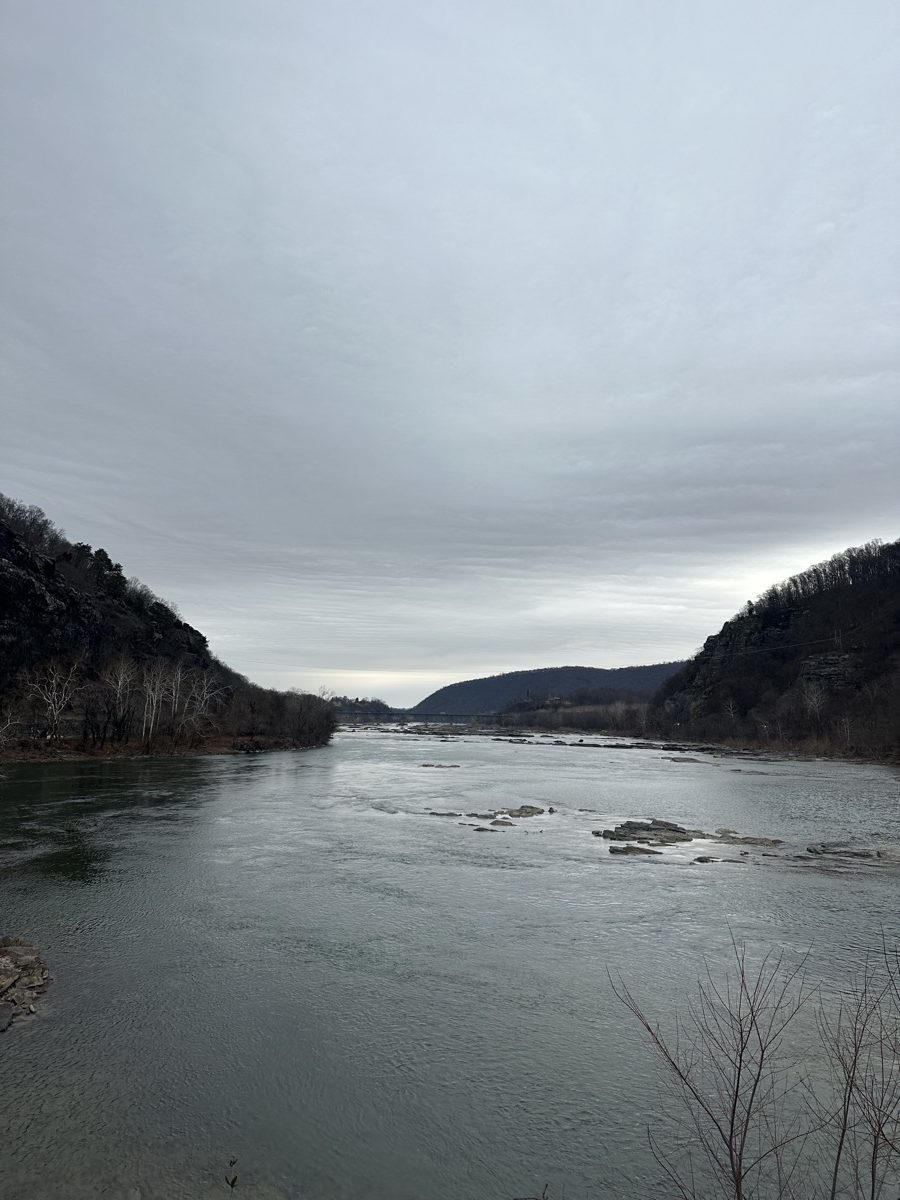
Harpers Ferry sits where the Shenandoah and Potomac Rivers meet, framed by the Blue Ridge Mountains on every side. People call it one of the most beautiful spots on the East Coast. Thomas Jefferson stood here in 1783 and wrote that the view was worth crossing an ocean to see.
I went in winter. The trees were bare. The rivers were grey. The mountains sat cold and still behind everything. It wasn’t the postcard version — but there was something about that coldness that felt right for this place. Some stories aren’t meant to be told in warm light.
The town’s name is itself a clue. Originally called Peter’s Hole — a hole in the mountains — it was renamed after Robert Harper, who bought the land in 1747 and ran a ferry across the Potomac. “Mr. Harper’s Ferry.” The apostrophe disappeared in 1891.
George Washington personally ordered a federal armory built here: the rivers provided waterpower for the machinery, the location was close to Washington D.C. but safe from foreign invasion, and the two rivers made shipping easy. From 1799 to the Civil War, the armory produced over 600,000 rifles and muskets. The Lewis and Clark Expedition was equipped here.
The Broken Bridge
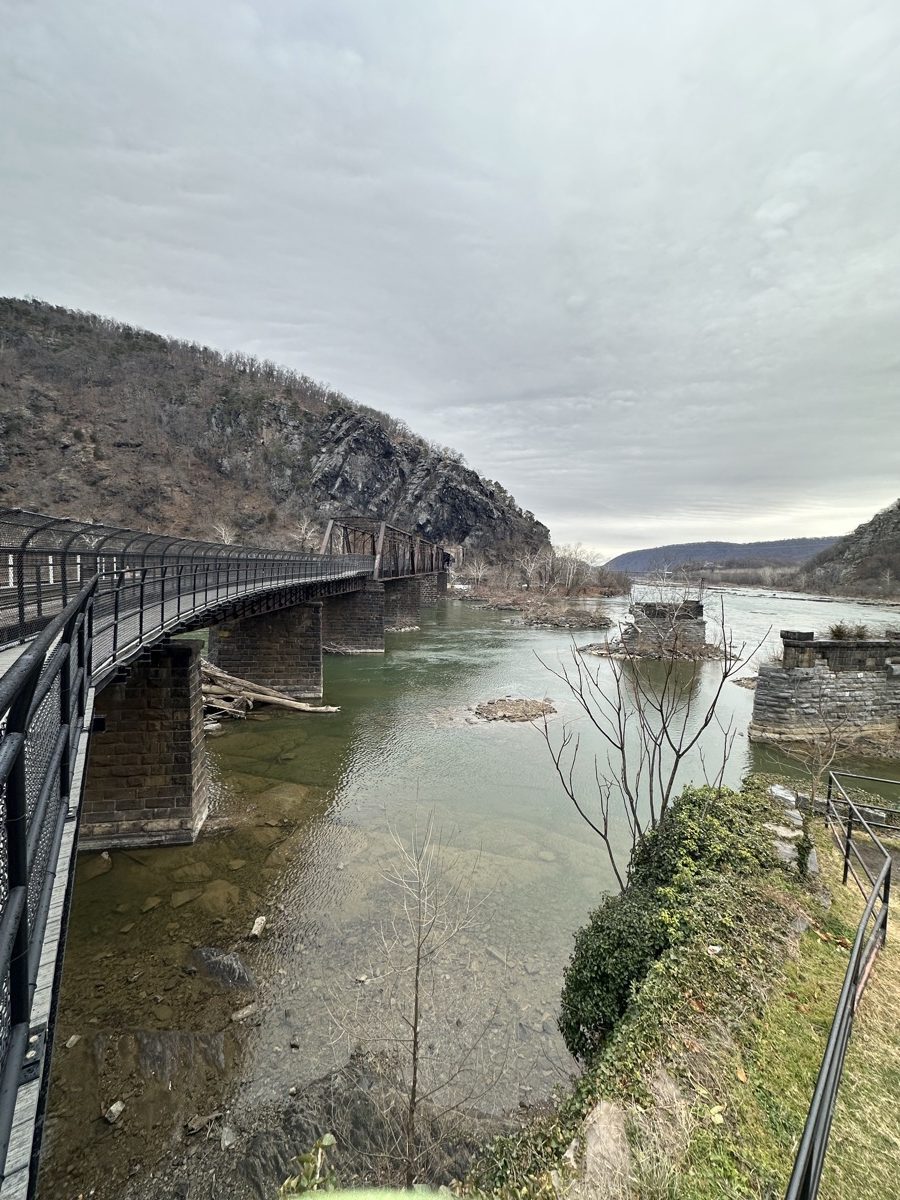
The first thing I noticed outside was the bridge. Or what’s left of it — the stone piers still standing in the current, the rest long gone.
Harpers Ferry sat at the crossroads of the C&O Canal and the B&O Railroad, the arteries connecting the coast to the mountains. Those bridges were everything. Control them and you controlled the movement of people, weapons, and freedom.
B&O stands for Baltimore and Ohio — the first long-distance railroad in America, connecting the East Coast to the interior. The only railroad bridge crossing the Potomac was right here at Harpers Ferry. Control this bridge, and you controlled everything moving across the country.
The Potomac is no ordinary river. Washington D.C. sits on its banks. During the Civil War, it became the boundary between the Union and the Confederacy. And after shooting Lincoln, John Wilkes Booth crossed this river fleeing south. This river runs through everything in this series.
On the night of October 16, 1859, Brown led his 21 men — 16 white, 5 Black — across the Potomac bridge in the dark. They cut the telegraph wires as they moved. By 10 p.m., they held the federal armory. By midnight, the bridges. The plan was to arm the enslaved with the armory’s weapons and let the uprising spread south.
By the following afternoon, the local militia had retaken the bridges. The rivers were too wide. The mountains too close. There was no way out.
Standing at the river’s edge, looking at where the bridge once stood, I tried to imagine October 17, 1859. The cold made it easy to feel. Surrounded.
John Brown’s Fort — Smaller Than You Think
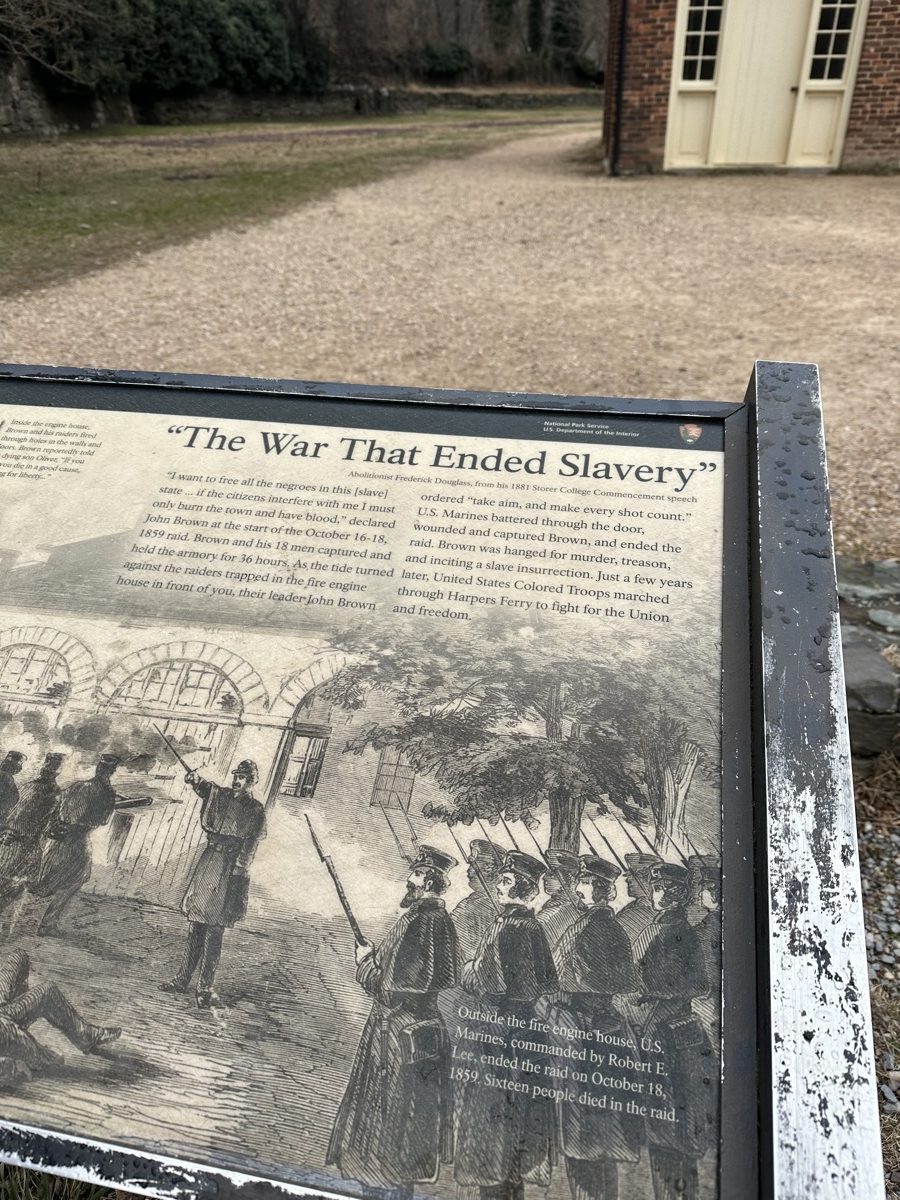
At the center of it all sits a small brick building.
Built in 1848 as a fire engine house and guardhouse, it measures 35 by 24 feet. One story. Brick walls. A few small windows. This is where it ended.
As the militia closed in, Brown retreated here with his remaining men and hostages — among them Lewis Washington, great-grandnephew of the first president. They barricaded the doors. Fired through gaps in the brick. Waited.
On the morning of October 18, ninety U.S. Marines arrived under Lieutenant Colonel Robert E. Lee. His aide, Lieutenant J.E.B. Stuart, walked forward under a white flag with a surrender demand. Brown refused. Lee ordered the door broken down with a ladder used as a battering ram. The whole thing was over in less than three minutes.
I stood in front of it for a long time. It’s smaller than you expect. That’s the first thing. History has a way of making things seem larger — the speeches, the trial, the legacy. But the actual space where everything collapsed is just a small brick room. No escape route. No reinforcements coming. Just four walls, and outside those walls, the world closing in.
He had been offered safe passage under a white flag. He refused. He knew exactly what was coming.
What do you keep fighting for, when you already know you’ve lost?
The Question He Left Behind
Here’s where the story gets strange.
Three men were at Harpers Ferry that day. Robert E. Lee commanded the federal response — and would later command the Confederate Army of Northern Virginia. J.E.B. Stuart delivered the surrender demand — and would become Lee’s most celebrated cavalry general. And six weeks later, at Brown’s execution, a young actor stood in the crowd: John Wilkes Booth, serving in the Virginia militia.
The man who watched Brown hang was the man who would, five years and four months later, shoot Abraham Lincoln at Ford’s Theatre. Harpers Ferry, the Civil War, Lincoln’s assassination — all connected by a single thread.
Brown was tried for treason, murder, and conspiring with slaves to rebel. He conducted his own defense from a cot, still recovering from a saber wound. Guilty on all counts. On the morning of his execution, December 2, 1859, he handed a note to his jailer.
“I, John Brown, am now quite certain that the crimes of this guilty land will never be purged away but with Blood.” — December 2, 1859. Sixteen months later, the first shots of the Civil War were fired at Fort Sumter.
History still can’t decide what to do with him. In the North, he became a martyr almost immediately — soldiers marched to battle singing John Brown’s Body, the melody Julia Ward Howe later turned into The Battle Hymn of the Republic. In the South, he was proof that abolitionists would stop at nothing — fuel, some said, for leaving the Union entirely.
Hero? Terrorist? The question tends to reveal more about who’s asking than about Brown himself.
Standing in front of that small building in the cold, I thought about what actually happened here. Sixteen people died in this raid. Brown’s actions deepened the divide between North and South — and pushed the country closer to the war that followed.
Frederick Douglass — his closest friend in the movement — called the plan suicidal and refused to join. Brown went anyway.
Was that conviction or madness? History hasn’t decided. I haven’t either.
Epilogue
The Liberty Bell is inscribed with “Proclaim Liberty throughout all the land.”
Hamilton designed a system. The Liberty Bell named an ideal. Brown walked into this town with 21 men and a plan nobody else would follow.
The Fort is still here. So is the question.
Three posts. One thread. And that thread doesn’t end here. The man who watched John Brown hang went on, five years later, to walk into a theatre in Washington D.C.
Next: Ford’s Theatre — and the memory of that dark red room.
- Harpers Ferry National Historical Park — nps.gov/hafe
- John Brown’s Fort — nps.gov
- American Battlefield Trust — battlefields.org
- PBS American Experience — pbs.org
- Harpers Ferry Armory — Wikipedia
- Baltimore and Ohio Railroad — Wikipedia
- David S. Reynolds, John Brown, Abolitionist (Knopf, 2005)
Leave a Reply