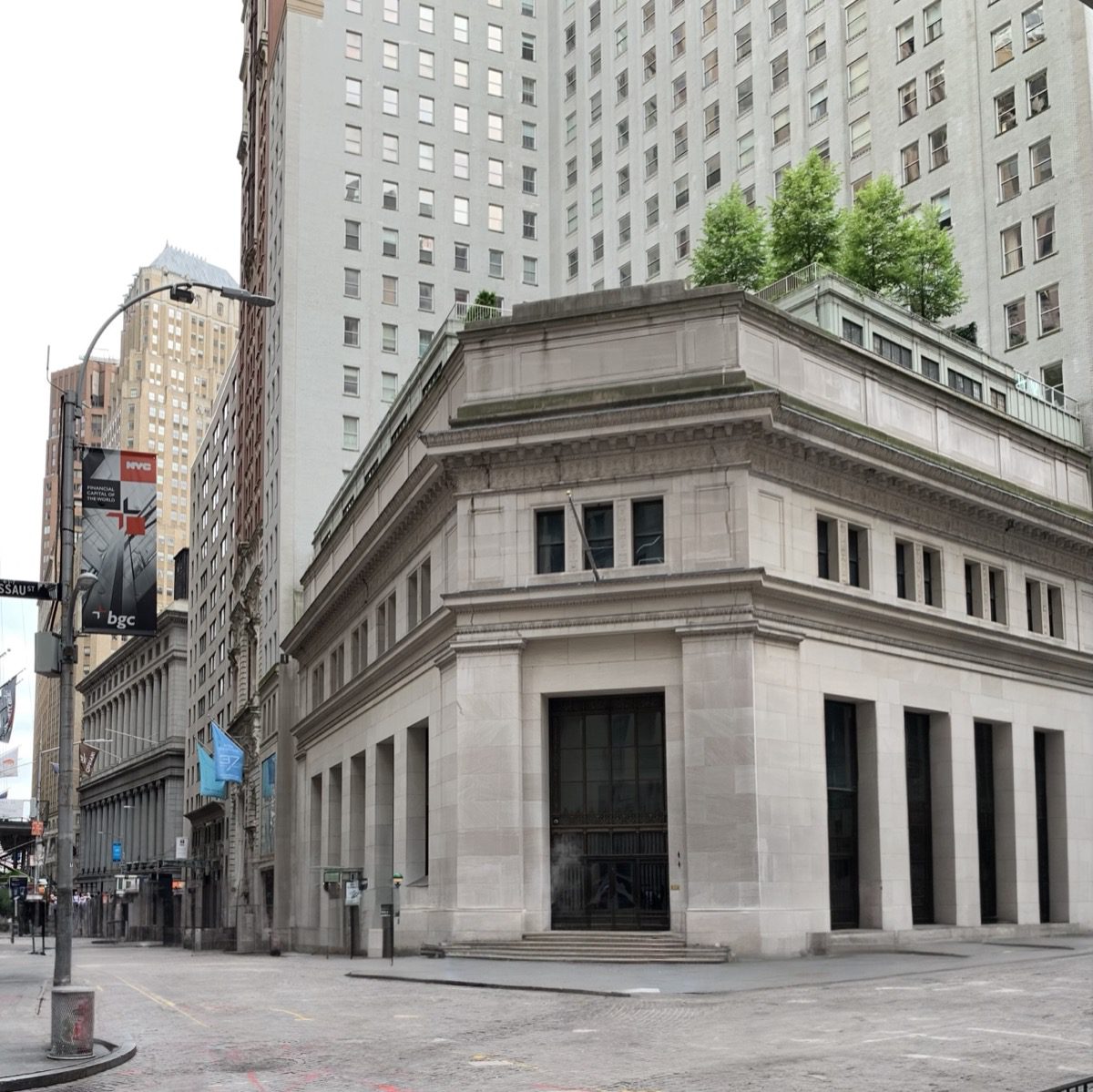
The building at the corner of Wall and Broad has no name on the door. Four stories of pink Tennessee marble, barely visible between the towers. I almost didn’t stop.
Something made me take a photo anyway. I didn’t know why at the time.
The Corner
Every tourist on Wall Street faces the same direction. The New York Stock Exchange — columns, flags, the whole performance. I turned the other way.
No sign. No logo. A low marble building that seemed almost out of place, dwarfed by everything around it. And scattered across the facade, small holes in the stone. Irregular. Deliberate-looking.
I took the photo and kept walking.
The Question
Back home, I looked it up. Two things didn’t make sense.
Why four stories. This was the most expensive piece of land in America. Skyscrapers were going up on every side. Wall Street’s logic has always been vertical. Morgan built four floors. He did engineer the foundations to support forty.
He just didn’t feel the need to go any higher.
And why no name on the door.
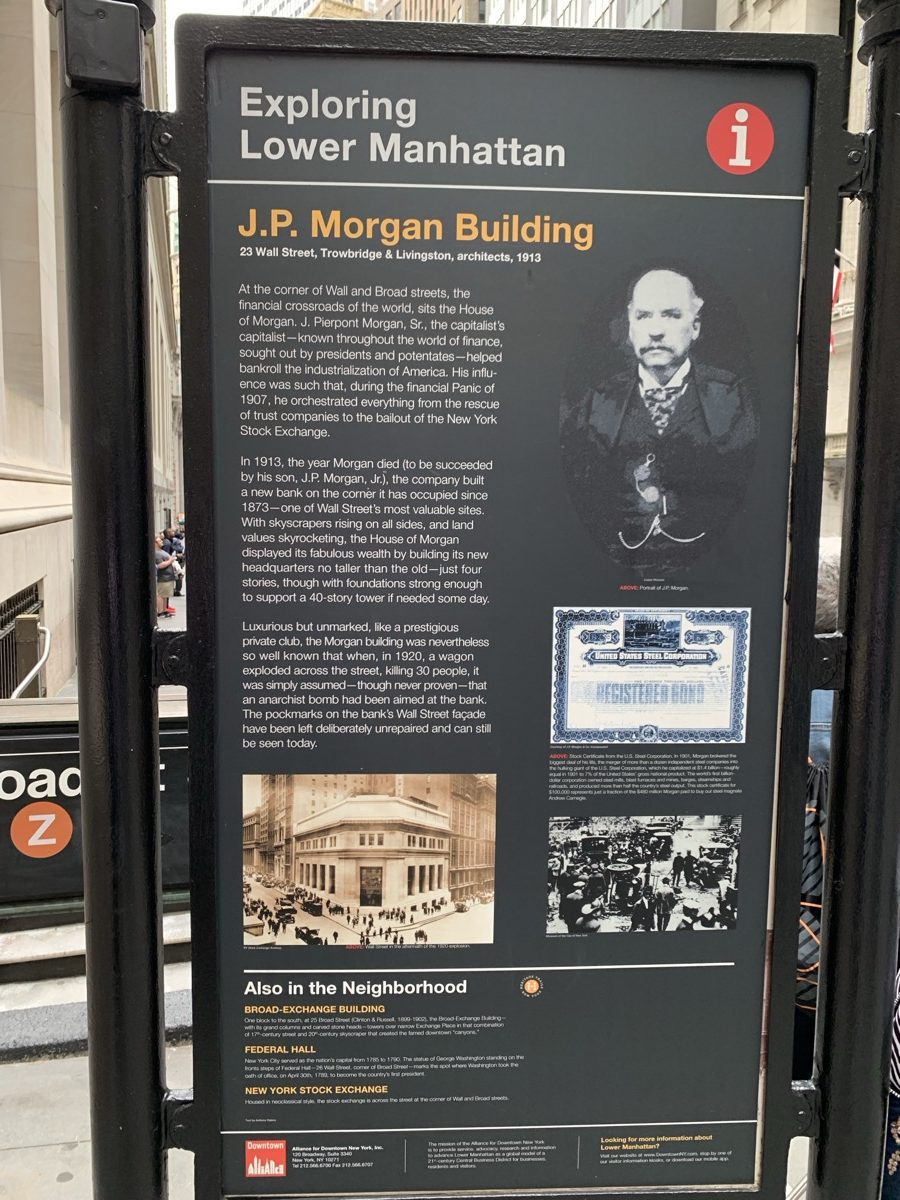
Because everyone already knew. In New York, in London, anywhere serious money moved — this corner required no introduction. There is a kind of power that announces itself by refusing to announce itself. J.P. Morgan understood this better than anyone.
The Panic
In the autumn of 1907, the President of the United States sent a telegram to a private citizen.
Do whatever you think is necessary.
The man was seventy years old. He was playing cards.
The economy had been unraveling for weeks, starting with a single mid-sized bank — Knickerbocker Trust — and a rumor that it had lost everything on a copper bet. No one had time to verify it. The lines outside told their own story. People withdrew what they could before realizing, too late, that the money was already gone.
Knickerbocker failed within three days.
The contagion moved fast. The president of the New York Stock Exchange came personally to find Morgan. He said the Exchange might have to suspend trading by afternoon. There was no money left.
Morgan looked up. “How much?”
“Twenty-five million dollars.”
He had it assembled in ten minutes. The Exchange stayed open.
The panic wasn’t finished. Morgan began calling the city’s senior bankers to his private library — locking the door, working through the nights, deciding who would be saved and who would be allowed to fail. On one side of the room, men in evening clothes stared at ledgers until dawn. Morgan played solitaire. When someone approached to report on the situation, he answered without lifting his eyes from the cards.
Everyone was waiting on that answer. The President. The bankers. The country.
An agreement was reached. The panic subsided.
He had never held office. Never been appointed to anything. Just a seventy-year-old man with a card game and a room full of frightened executives.
The President who sent that telegram was Theodore Roosevelt — the great trust-buster, the man who spent years fighting the power of people like Morgan. When the moment came, there was no one else to call.
Congress drew the obvious conclusion. In 1913, the Federal Reserve was created to do permanently what Morgan had done once, informally, at his own discretion. That same year, Morgan died in a hotel in Rome. Seventy-five. He never saw the building completed.
The day his body passed through Wall Street, the stock market closed for two hours. The kind of honor usually reserved for heads of state.
His library still stands. 36th Street, Midtown.
The Bomb
Seven years after his death, someone tried to leave a mark on the building.
During the First World War, J.P. Morgan & Co. had served as the official purchasing agent for the British and French governments — brokering some three billion dollars in war supplies. To certain people, that made it a symbol worth targeting.
September 16, 1920. Just after noon. A horse-drawn cart pulled up across from 23 Wall Street and stopped. The driver stepped down and walked into the lunch crowd. Minutes later, it exploded. Thirty-eight people died. The perpetrators were never identified. The case is still open.
J.P. Morgan & Co. opened for business the next morning. They decided not to repair the marks in the marble. They would stay exactly as they were.
Those are the holes I photographed without knowing what they were.
Stand in front of that wall and you might feel both things at once — the pride of a man who never felt the need to justify himself to anyone, and the rage of someone who needed, just once, to leave a mark on something that refused to be marked.
The “Chase” in JPMorgan Chase traces back to a company founded in 1799 by Aaron Burr — the man who killed Alexander Hamilton in a duel. Two hundred years later, the two names merged into the world’s largest bank. The history of that duel is still in the name.
Now
The building has been empty for over thirty years. Various plans came and went — condominiums, a retail flagship, a bowling alley. All of them collapsed into legal disputes. The current owner is Sonangol, the Angolan state oil company. The most consequential address in American financial history sits largely vacant.
The building that once needed no name now has no name — in a different sense. Its current owner is Sonangol, Angola’s state oil company. A bowling alley, a fitness chain, a luxury retailer: every prospective tenant has ended in litigation. It remains empty.
The name J.P. Morgan still appears on the world’s largest bank. The Morgan family has had no involvement with it since the mid-1970s.
A name without a dynasty. A building without a name.
Leave a Reply